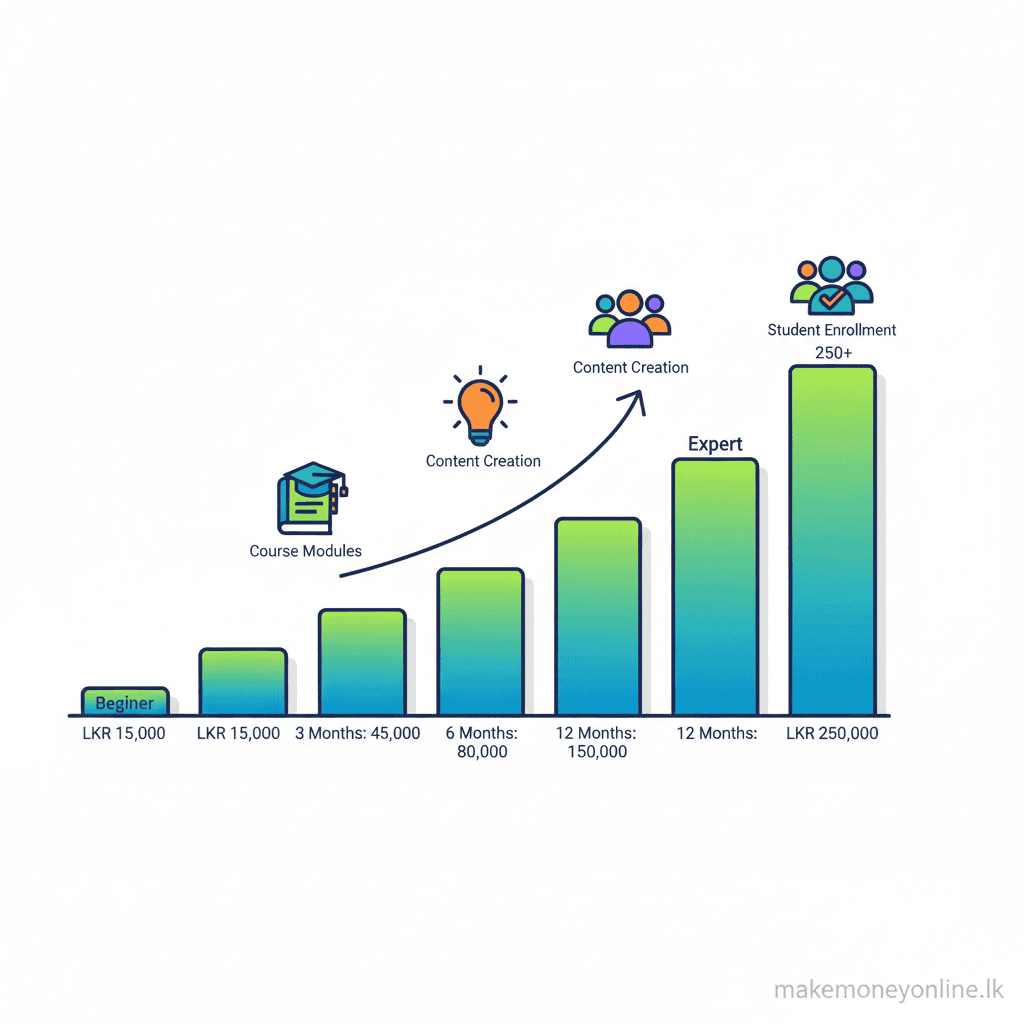
Dilshan spent three years answering the same beginner questions in Facebook groups about digital marketing. A friend suggested he record his answers once and sell them. His first Udemy course launched with no marketing budget. Six months later, it was generating LKR 45,000 per month while he slept. That was two years ago. He now has four courses and earns LKR 180,000 per month from existing recordings.
Online courses are one of the most scalable income methods available to Sri Lankans. You create the course once and sell it indefinitely. There is no limit to the number of students who can enroll, and no additional work per student for a pre-recorded course.
The challenge is that most beginners overestimate what they need to start and underestimate how long it takes to build sales momentum. This guide covers what actually works, what it costs to start in Sri Lanka, and which platforms pay Sri Lankan creators reliably.
What Is Creating and Selling Online Courses?
Creating an online course means recording video lessons that teach a specific skill or topic, packaging them into a structured learning experience, and selling access to that course to students worldwide.
The core structure: a series of short video lessons (5 to 15 minutes each), organized into sections, covering a topic from beginner to competent. Students pay once for lifetime access or subscribe monthly, depending on the platform.
What you can teach is extremely broad. The most successful course topics are skills people pay to learn for career or income reasons: software tools (Excel, Python, Photoshop, WordPress), digital marketing (SEO, social media, ads), language skills, professional certifications prep, programming, finance, and health or fitness.
Sri Lankan creators have a specific advantage in the South Asian market. Courses in Sinhala, Tamil, or English taught by Sri Lankans for Sri Lankan audiences fill gaps that international English-language courses cannot. Both international platforms and local direct-to-student models work.
How Much Can You Earn from Online Courses in Sri Lanka?
Earnings depend heavily on the platform, topic demand, and how much you promote the course. New course creators earn LKR 10,000 to LKR 40,000 per month in their first six months while building reviews and visibility. Creators with established courses on high-demand topics earn LKR 80,000 to LKR 200,000 per month. Top creators in competitive niches like programming or digital marketing earn LKR 300,000 to LKR 800,000+ per month.
Platform Revenue Comparison
| Platform | Creator Share | Sri Lanka Payout | Best For |
|---|---|---|---|
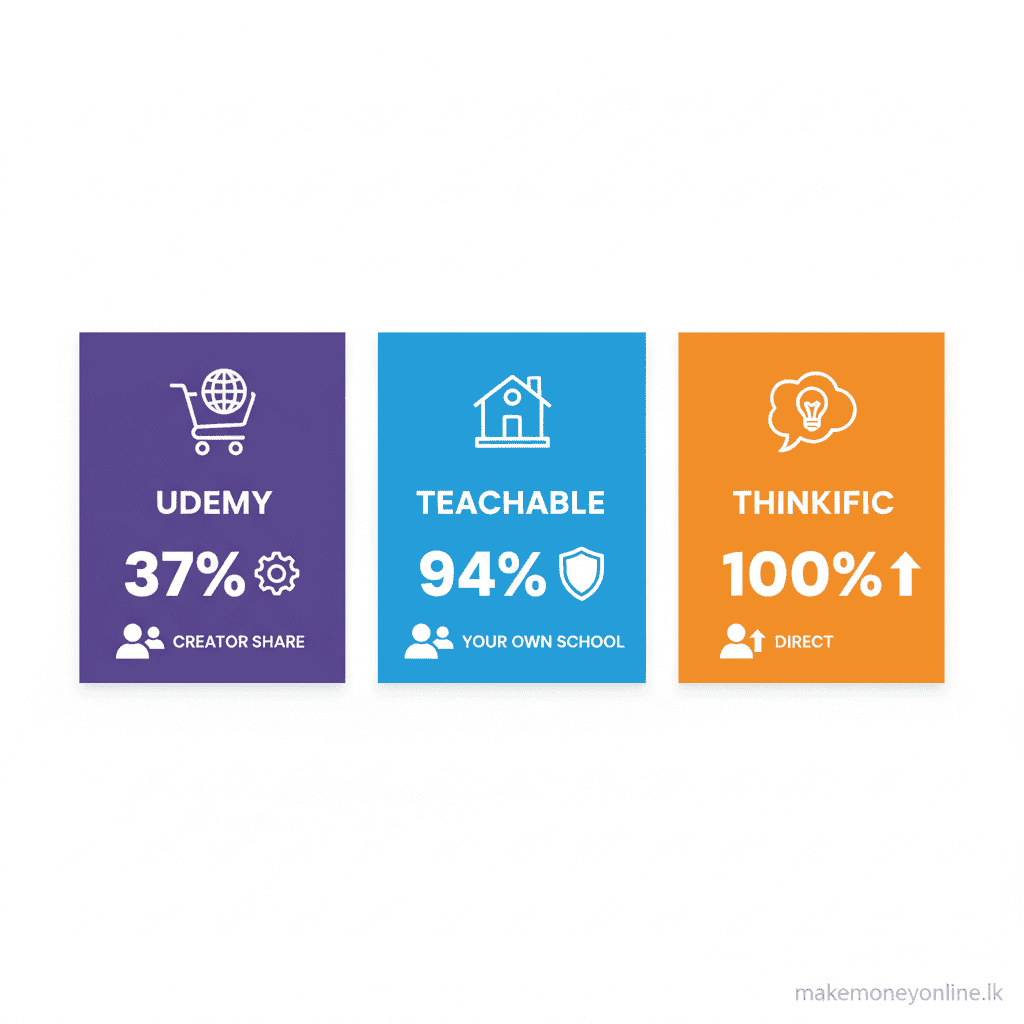
| Udemy (organic) | 37% of sale price | Payoneer | Volume discovery, passive sales |
| Udemy (direct referral) | 97% of sale price | Payoneer | Driving your own traffic |
| Teachable | 94 to 100% (minus payment fees) | Stripe or PayPal | Building your own student base |
| Thinkific | 100% (minus transaction fees on free plan) | Stripe or PayPal | Direct sales without platform cut |
| Gumroad | 91% (9% platform fee) | Payoneer | Simple digital product sales |
Exchange rate: 1 USD = approximately 305 LKR.
A Udemy course priced at $15 that makes 30 organic sales per month earns approximately $170 (LKR 51,850) per month at 37% creator share. The same course driven by your own audience at $30 with direct referral links earns $870 (LKR 265,350) per month.
How Does Selling Online Courses Work?
Step 1: Choose a topic you can teach well. It does not need to be your profession. It needs to be specific and teachable. “Digital marketing” is too broad. “How to set up a Google Ads campaign for a local business” is specific.
Step 2: Outline the course. Break the topic into sections. Break each section into 5 to 15 minute video lessons. A beginner course typically has 15 to 30 lessons across 2 to 4 hours of total content.
Step 3: Record video lessons. You do not need a professional camera. A smartphone on a tripod or a decent webcam works. What matters most is audio quality and screen recording clarity for software-based courses.
Step 4: Edit videos. Remove long pauses, mistakes, and dead air. Add a simple intro and outro. Keep lessons concise. Basic video editing in DaVinci Resolve (free) or iMovie is sufficient.
Step 5: Upload to your chosen platform. Organize lessons into sections. Write section and lesson titles clearly. Write a compelling course description with keywords students search for.
Step 6: Set pricing and publish. On Udemy, set your price and Udemy’s algorithm handles discovery. On Teachable or Thinkific, you control pricing and must drive your own traffic.
Step 7: Receive payment via Payoneer (Udemy) or Stripe/PayPal (Teachable, Thinkific) into your Sri Lankan bank account.
What Skills Do You Need to Create Online Courses?
Subject matter expertise: You need to know your topic well enough to teach it clearly. You do not need a degree. You need to have used the skill yourself, gotten results, and be able to explain how.
Clear communication: Explaining complex topics simply. On-screen delivery without rambling. This improves with practice. Your fifth course will be significantly better delivered than your first.
Basic video recording: Framing a camera or screen recording correctly, speaking clearly, keeping energy consistent across 20 lessons. This is learnable by watching how popular Udemy instructors present.
Basic video editing: Cutting dead air, adding text overlays for key points, assembling sections in order. Entry-level editing, not motion graphics or color grading.
Course structure: Knowing how to sequence information so students build understanding progressively. Start with why it matters, then what it is, then how to do it, then common mistakes.
Patience for the slow start: Udemy courses often take three to six months to build enough reviews to appear in search results. Direct sales courses require an existing audience or significant marketing effort.
How to Get Started Creating Online Courses in Sri Lanka
Step 1: Identify your teachable topic. Answer this question: what have you learned to do that others want to learn? It could be a professional skill (Excel, Photoshop, accounting), a hobby (guitar, cooking, photography), or a career skill (resume writing, interview preparation, freelancing).
Step 2: Validate demand before recording. Search your topic on Udemy. If courses on this topic have 500+ students and 3.5+ star ratings, there is demand. Search YouTube; if people are watching long tutorials on this topic, they will pay for a structured course.
Step 3: Set up basic recording equipment. A smartphone camera or 1080p webcam is sufficient. The critical investment is audio: a USB microphone (LKR 5,000 to LKR 20,000) makes the single biggest difference to perceived quality. Record in a quiet room with soft furnishings to reduce echo.
Step 4: Install OBS Studio (free) for screen recordings. For software-based courses, OBS records your screen and webcam simultaneously. For in-person delivery, a smartphone on a tripod works well.
Step 5: Install DaVinci Resolve (free) for editing. Cut out mistakes, add section title cards, export at 1080p MP4. Udemy requires 1080p, 30fps, high-quality audio (no background noise).
Step 6: Create a Udemy instructor account. Udemy is the fastest path to organic student discovery for new creators. The platform reviews your course before publishing. Submit your course and expect a one to three business day review.
Step 7: Set up Payoneer for Udemy payouts. Udemy pays Sri Lankan instructors via Payoneer. Minimum payout threshold is $35. Transfers to Commercial Bank, Sampath, BOC, HNB, or People’s Bank take one to three business days after Payoneer receives the funds.
Step 8: Build your own audience over time. Start a YouTube channel in your course topic, write blog posts, or build a social media following. Your own audience allows you to use direct referral links (97% revenue share on Udemy) and eventually move to Teachable or Thinkific where you keep nearly all revenue.
How to Learn Course Creation
Free resources:
- Udemy Instructor Center (teach.udemy.com): Free guides, video tutorials, and best practices from Udemy’s team. Covers recording setup, course structure, pricing strategy, and Udemy’s search algorithm.
- YouTube: Search “Udemy course creation tutorial 2025” for updated walkthroughs of the full creation and publishing process.
- Teachable Academy (teachable.com/academy): Free guides specifically on building and marketing courses on Teachable.
Paid learning:
- Udemy courses on course creation (USD 15 to USD 30 or LKR 4,575 to LKR 9,150 during sales): Meta courses that teach you how to create Udemy courses. Search for courses by instructors with 50,000+ students.
- Course Creators Academy (various pricing): Deep community and training for serious course creators, covering advanced topics like launching, email marketing, and building a paid membership.
Pros of Creating Online Courses
Scalable income. Once recorded and published, a course sells with no additional work per student. Unlike freelancing where income is tied to hours, course income scales with enrollment, not your time.
Low startup cost. A USB microphone (LKR 5,000 to LKR 20,000) and free software (DaVinci Resolve, OBS, Audacity) are the main investments. A complete beginner setup costs under LKR 25,000.
Platform-driven discovery on Udemy. Udemy brings students to your course through its search engine and email promotions. You do not need a marketing budget to get your first students if your topic has existing demand.
Teach once, earn long-term. A course created in 2024 can still generate income in 2028 if the topic remains relevant. Minor updates extend the lifespan. Digital marketing fundamentals, Excel skills, and English communication remain in demand year after year.
Growing South Asian market. Sri Lankan and Indian creators teaching in English or regional languages have an underserved market of 1.5 billion people in South Asia who prefer instruction from educators who understand their context.
Cons of Creating Online Courses
Slow initial traction. New Udemy courses typically need 20 to 50 genuine reviews before appearing in competitive search results. Getting those first reviews takes time and often requires discounting or promoting the course for free to early students.
Udemy discount pricing erodes per-sale income. Udemy runs frequent sales that discount courses from $15 to $10.99 or lower. You cannot opt out entirely from promotional periods. On organic sales, your effective rate is often $5 to $6 per enrollment after Udemy’s cut, making volume essential.
Topics become outdated. Software interface changes, algorithm updates, and industry shifts can render course content inaccurate within 12 to 24 months. Maintaining relevance requires periodic re-recording.
Competition is high in popular topics. Excel, Python, and digital marketing courses are heavily competed on Udemy. Differentiate by targeting specific sub-niches (Excel for accountants, Python for beginners in Sri Lanka, Facebook Ads for local businesses) rather than broad topics.
Direct platform requires your own marketing. On Teachable or Thinkific, you keep more revenue, but you must drive your own traffic. Without an existing audience (email list, social media following, YouTube channel), sales will be slow initially.

Best Platforms for Creating Online Courses in Sri Lanka
Udemy
The world’s largest online learning marketplace with 60 million+ students. The fastest way to get student discovery without your own marketing.
- Revenue share: 37% on Udemy-promoted sales, 97% on sales with your referral link
- Payout minimum: $35
- Payment for Sri Lanka: Payoneer
- Best for: New creators who want organic discovery, topics with existing demand on the platform
Teachable
A hosted course platform where you sell directly to students under your own brand. Higher revenue retention but requires building your own audience.
- Revenue share: 94 to 100% (minus payment processing fees of 2 to 3%)
- Pricing: Free plan available (5% transaction fee); paid plans from $39/month (USD 39 or LKR 11,895)
- Payment for Sri Lanka: Stripe or PayPal (both work from Sri Lanka)
- Best for: Creators with an existing audience who want to build a branded school
Thinkific
Similar to Teachable but with a more generous free plan. No transaction fees on any plan.
- Revenue share: 100% (minus Stripe/PayPal processing fees)
- Pricing: Free plan available; paid plans from $36/month (USD 36 or LKR 10,980)
- Payment for Sri Lanka: Stripe or PayPal
- Best for: Creators who want to keep full revenue without transaction fees from day one
Gumroad
Simple digital product platform that handles course sales with minimal setup. Good for selling PDF courses, mini-courses, or bundled content.
- Revenue share: 91% (9% platform fee on every sale)
- Payout: Payoneer (works for Sri Lanka)
- Best for: Simple, low-production courses, mini-courses, or digital bundles alongside physical products
Free Tools for Creating Online Courses
OBS Studio (free): Open-source screen recording and streaming software. Records your screen and webcam simultaneously in 1080p. Standard tool for software-based course creation.
DaVinci Resolve (free): Professional video editing for course content. Trim lessons, add title cards, export at Udemy-required specifications.
Audacity (free): Audio recording and editing for narration cleanup. Removes background noise and normalizes volume between lessons.
Canva (free tier available): Create course thumbnail images, section title cards, and promotional graphics. Course thumbnails significantly affect click-through rates on Udemy.
Paid Tools for Creating Online Courses
Teachable or Thinkific (from USD 36 to USD 39 per month or LKR 10,980 to LKR 11,895): Required for running your own branded course school outside Udemy. Worth the investment only once you have an audience generating consistent sales.
USB Microphone (LKR 5,000 to LKR 20,000 one-time): The most impactful equipment investment. A Blue Snowball (LKR 8,000 to LKR 12,000) or HyperX QuadCast (LKR 15,000 to LKR 22,000) dramatically improves audio quality versus a built-in laptop microphone.
Screen recording software (optional): Camtasia (USD 299 one-time or LKR 91,195) adds built-in editing and annotation tools. Only worthwhile after your first course generates consistent income.
Scam Alerts: Online Course Creation Red Flags
Platforms That Promise Guaranteed Earnings
Services claiming they will host your course and guarantee a minimum number of students or sales in exchange for a setup fee or monthly payment are scams. No platform can guarantee student enrollment. Legitimate platforms (Udemy, Teachable, Thinkific) earn their money on transaction fees or subscriptions, not by charging creators upfront for promised results.
“Done for You” Course Creation Services
Promotions offering to create and sell your course for you, collect revenue, and pay you a share, but requiring you to pay LKR 20,000 to LKR 100,000 upfront to “license” a course slot are fraudulent. Legitimate course creation requires your own knowledge and your own recording. No service can create a credible course from your expertise on your behalf for an upfront fee.
Student Refund Fraud
On Udemy and Teachable, some bad-faith buyers complete a course, download all materials, and then request a refund claiming the content did not meet their expectations. Udemy’s 30-day refund policy is generous to students. You cannot prevent this entirely. On your own Teachable or Thinkific school, implement clear refund policies specifying that completed courses are not refundable once a certain percentage of content is accessed.
Fake “Partnership” Deals
Promoters approaching course creators with offers to “co-sell” their course to a large audience in exchange for 70 to 80% of revenue, asking you to send them course access credentials or revenue first, are fraudulent. Never share platform credentials or pay in advance based on promises of future student referrals.
Final Verdict: Is Creating Online Courses Worth It for Sri Lankans?
Creating online courses is one of the highest-potential income methods available to Sri Lankans with teachable expertise. The income is genuinely scalable, the startup cost is low, and platforms like Udemy provide student discovery without a marketing budget.
The realistic challenge is that course income is not immediate. Building to LKR 80,000+ per month typically takes 12 to 18 months of consistent course creation, review building, and audience development. The first three months will often feel like work with little return.
This method suits you well if:
- You have a specific, teachable skill that people search for online
- You can invest two to four weeks of focused effort to record and launch a first course
- You are willing to build slowly for 12 to 18 months before expecting significant monthly income
- You have or are willing to build an online presence (YouTube, blog, social media) to drive direct sales over time
This method may not suit you if:
- You need income within 30 to 60 days
- You do not have a specific skill with validated demand
- You are not willing to update content as topics evolve
For those exploring related methods, see the guide on blogging in Sri Lanka and the overview of digital marketing as a career for complementary ways to build an audience that drives course sales.