Sri Lankan teachers and graduates have been tutoring students locally for decades. The shift to online tutoring has made the same skill available to a global market paying USD rates. A Sri Lankan who tutors O/L Mathematics or A/L Chemistry locally for LKR 1,500 per hour can tutor international students in the same subjects for $25 to $50 per hour, earning 5 to 10 times more for identical work.
The demand for qualified subject tutors is genuinely global. Students in the UK, US, Canada, and Australia struggle with mathematics, sciences, and English writing. Parents pay $40 to $80 per hour for qualified tutors who can improve their child’s grades. Sri Lankan educators, engineers, doctors, and accountants all hold subject expertise that translates directly into online tutoring income.
This guide covers how online tutoring income works for Sri Lankans, which subjects command the highest rates, which platforms connect tutors with paying students, and how to protect yourself from the scams targeting tutors looking for online work.

What Is Online Tutoring?
Online tutoring means providing one-on-one or small group academic instruction to students via video call. The tutor helps students understand subject material, complete homework, prepare for examinations, or improve their academic performance in specific areas.
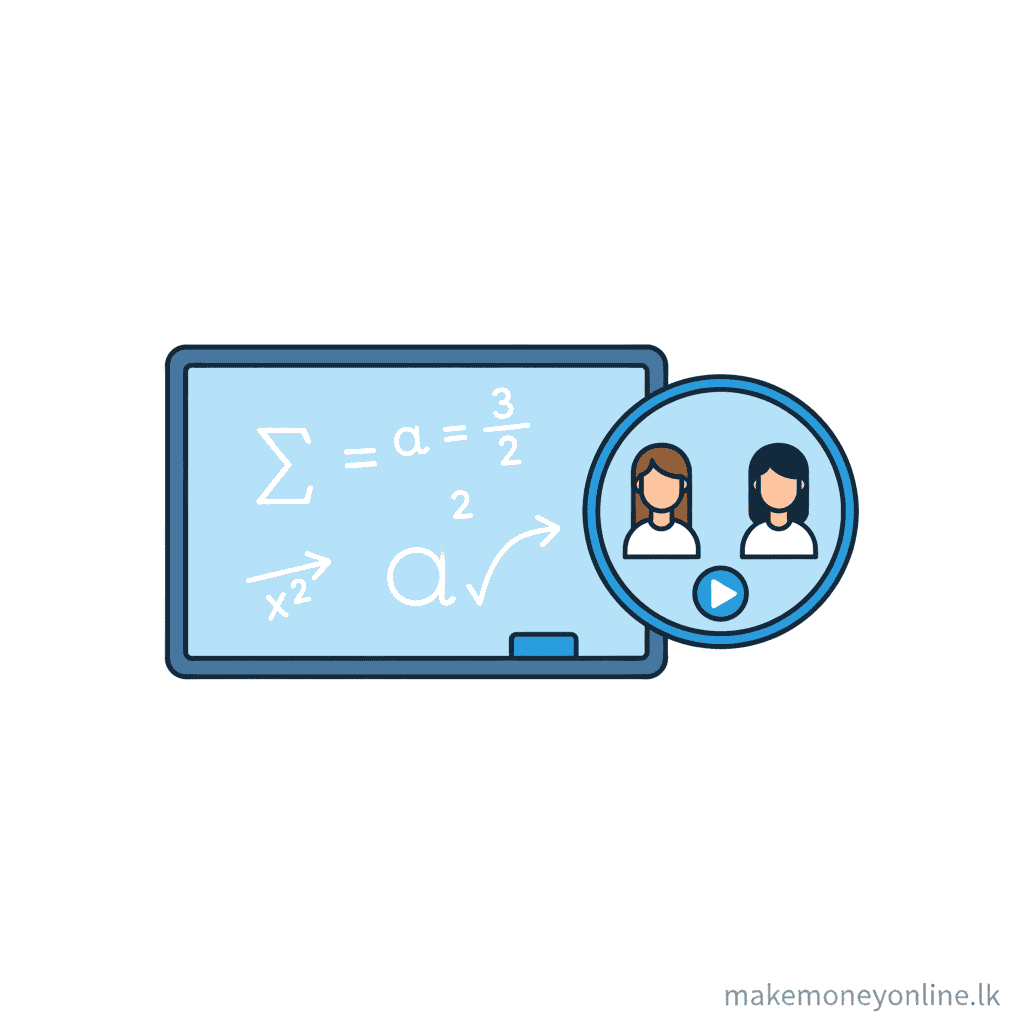
Online tutoring is typically conducted via Zoom, Google Meet, or platform-specific video tools. Interactive whiteboard tools (Bitpaper, Miro, or Google Jamboard) allow tutors to write equations, draw diagrams, and share visual explanations in real time.
The tutoring subject categories with the highest demand internationally include:
Mathematics: From primary school arithmetic to university calculus and statistics. The most consistently in-demand subject globally. Strong mathematical background from Sri Lanka’s O/L and A/L curriculum is directly applicable.
Sciences: Physics, chemistry, and biology for secondary and university levels. Sri Lankan A/L Combined Mathematics and Science graduates have strong subject knowledge that translates well to international curricula.
English language and writing: Essay writing, academic writing, grammar, reading comprehension, and language skills for non-native speakers. Strong demand from students in Asia, the Middle East, and Europe.
Accounting and finance: ACCA, CIMA, and CFA preparation. Financial accounting, management accounting, and economics for university students.
IT and programming: Python, data analysis, web development fundamentals. Growing demand from students in non-technical programs needing introductory support.
Test preparation: SAT, GMAT, IELTS, GRE, and A/L examination preparation. Structured, goal-oriented tutoring commands premium rates.
How Much Can You Earn from Online Tutoring in Sri Lanka?
Online Tutoring Income Benchmarks
| Subject / Level | Hourly Rate (USD) | Monthly Income (40 hrs) | LKR Equivalent |
|---|---|---|---|
| Primary / middle school (general subjects) | $15 to $25 | $600 to $1,000 | LKR 183,000 to LKR 305,000 |
| Secondary (O/L equivalent, GCSE, SAT) | $20 to $40 | $800 to $1,600 | LKR 244,000 to LKR 488,000 |
| A/L, IB, or AP subjects | $30 to $60 | $1,200 to $2,400 | LKR 366,000 to LKR 732,000 |
| University level (accounting, engineering) | $40 to $80 | $1,600 to $3,200 | LKR 488,000 to LKR 976,000 |
| Test prep (GMAT, GRE, IELTS) | $40 to $80 | $1,600 to $3,200 | LKR 488,000 to LKR 976,000 |
USD → LKR conversion notice. USD-to-LKR figures on this page use a reference rate of approximately LKR 305 per USD, last reviewed 2026-09-01. Actual conversion depends on your provider’s spread and the current market rate. See our methodology. 40 hours per month is a part-time workload. Many tutors handle 20 to 30 hours of weekly sessions once their student roster is full. A Sri Lankan tutor with 15 regular weekly students at $30 per hour earns $450 per week, or approximately $1,800 per month (LKR 549,000).
How Does Online Tutoring Work?
Step 1: A student or parent finds you through a tutoring platform, social media, or referral and contacts you about their subject, level, and goals.
Step 2: You conduct a free 20 to 30 minute introductory session to assess the student’s current level, identify their specific challenges, and discuss what they want to achieve.
Step 3: You agree on session frequency (typically one to three times per week), session length (45 or 60 minutes), and rate. For international students, quote in USD.
Step 4: Sessions are conducted via Zoom or the platform’s built-in video tool. You prepare session materials (worked examples, practice problems, reference sheets) in advance.
Step 5: After each session, send a brief summary of what was covered and what to practice before the next session. This demonstrates professionalism and keeps students engaged between sessions.
Step 6: Students pay weekly or monthly. Platforms handle payment automatically. Direct students pay via PayPal, Wise, or bank transfer.
Step 7: Transfer to your Sri Lankan Commercial Bank, Sampath, BOC, HNB, or People’s Bank account.
What Skills Do You Need for Online Tutoring?
Subject expertise: You must know your subject at a level substantially above the students you tutor. Teaching O/L Mathematics requires A/L-level or higher mathematics knowledge. Teaching university-level accounting requires professional accounting qualifications or equivalent experience.
Ability to explain clearly: Knowing something and being able to explain it to someone who does not understand it are different skills. Effective tutors adapt their explanations, use multiple approaches, and identify the specific point where a student’s understanding breaks down.
Patience: Students do not understand concepts immediately, often repeat the same mistakes, and require multiple explanations of the same material. Patient, encouraging tutoring builds student confidence alongside knowledge.
Online session management: Keeping a video session structured, maintaining student engagement, and managing time within the session to cover the planned material. Students on video calls are more easily distracted than in-person learners.
Basic digital whiteboard skills: Using Google Jamboard, Miro, or Bitpaper to write equations, draw diagrams, and annotate shared documents during sessions. This is learnable in under an hour.
English communication: For international tutoring work, lessons are conducted in English. Clear, confident spoken English is a prerequisite for teaching UK, US, and Australian students.
How to Get Started with Online Tutoring
Step 1: Define your subject and target student level. Being specific about what you teach and who you teach it to attracts the right students and allows you to set appropriate rates. “A/L Physics tutoring for students preparing for UK A-Level exams” is a clearer offer than “science tutoring.”
Step 2: Create a Preply profile. Preply is the largest online tutoring marketplace globally. Create a profile with a professional photo, a clear description of your subject expertise, your teaching approach, and your qualifications. Record a short video introduction if possible.
Step 3: Create a profile on Wyzant. Wyzant is the leading tutoring platform for US students. Strong demand for mathematics, sciences, and test preparation. Wyzant verifies tutor credentials, which adds credibility.
Step 4: Set your rate competitively initially. New tutors on platforms benefit from starting 20 to 30% below experienced tutors in their subject to attract early reviews. Raise rates after 10 to 15 completed sessions with positive feedback.
Step 5: Promote on LinkedIn. Connect with parents, secondary school students, and university students in your target markets. Post content demonstrating your subject knowledge (short solved problems, exam tips, subject guides) to build discoverability.
Step 6: Ask for referrals. A student who has improved their grades through your tutoring is a natural referral source. One committed student with a positive experience can bring two to three additional students from their school or social network.
How to Learn Tutoring Skills
Free resources:
- Khan Academy (khanacademy.org): Comprehensive subject content for school-level mathematics, sciences, economics, and more. Useful for refreshing your subject knowledge and understanding how different concepts are taught to a global audience.
- Preply and Wyzant help centers: Both platforms provide guides on profile optimization, setting rates, and conducting effective online sessions.
- YouTube: Channels on tutoring techniques, online teaching setup, and subject-specific pedagogy.
Paid learning:
- Tutor training courses on Udemy (USD 15 to USD 30 or LKR 4,575 to LKR 9,150): Courses covering online tutoring setup, student engagement, and building a tutoring business.
- Subject certification refresher courses: Relevant for tutors whose subject knowledge may be dated. Coursera and edX offer updated subject courses in mathematics, sciences, and professional subjects.
Pros of Online Tutoring
Recurring weekly income from committed students. Students preparing for examinations commit to weekly sessions for months. An O/L student preparing for GCSE exams may book weekly sessions for 6 to 12 months. Each committed long-term student generates stable, predictable income throughout their preparation period.
Sri Lankan subject knowledge is competitive. The Sri Lankan O/L and A/L curriculum is rigorous. Sri Lankan students who have completed A/L Combined Mathematics, Physics, or Chemistry have subject knowledge that directly prepares them to tutor international students in GCSE, A-Level, IB, and similar curricula.
No commute, no fixed schedule. Online tutoring sessions take place from your home at times you choose. Teaching sessions from 8am to noon Sri Lanka time reaches European students in early evening. Evening sessions from 8pm to 11pm Sri Lanka time reaches US East Coast students in morning.
High student lifetime value. A secondary school student who starts tutoring in Year 9 may continue through GCSE, A-Level, and university entrance examination preparation. A single student relationship can generate income for 4 to 5 years.
Multiple income streams from one subject. The same Mathematics expertise supports tutoring students directly, creating online courses, selling revision notes, and producing YouTube tutorial content, all from the same knowledge base.
Cons of Online Tutoring
Exam season dependency. Demand spikes significantly during examination preparation periods and drops in holiday periods. Planning finances around the natural rhythm of the academic calendar requires income smoothing strategies.
Technical requirements for quality sessions. A slow internet connection creates significant problems during interactive tutoring sessions. A minimum of 10 Mbps stable upload speed is needed for high-quality video. Power interruptions (a practical reality in Sri Lanka) require backup solutions such as a UPS.
Building initial reviews is slow on platforms. New tutors with no reviews on Preply or Wyzant compete against established tutors with hundreds of completed sessions. The first 10 to 15 sessions, often at reduced rates, build the profile credibility required to attract students organically.
Student cancellations reduce income. Students cancel sessions, particularly during busy academic periods. A clear cancellation policy (24-hour notice required for reschedule or refund) reduces last-minute income loss.
Time zone management. Teaching international students requires scheduling sessions outside typical Sri Lankan working hours. Morning sessions (6am to 10am Sri Lanka time) reach UK evening students. Late evening sessions reach US students. Managing this alongside other commitments requires deliberate scheduling.
Best Platforms for Online Tutoring
Preply
The largest online tutoring marketplace globally. Strong demand across all subjects and student levels. Platform handles scheduling and payment.
- Commission: 33 to 18% (decreasing as you accumulate hours)
- Payment for Sri Lanka: PayPal or Payoneer
- Best for: Building initial student roster, all subjects, global students
Wyzant
Leading US tutoring platform with strong demand for mathematics, sciences, and test preparation. Tutors set their own rates. Wyzant verifies credentials.
- Commission: 25% flat
- Payment for Sri Lanka: PayPal
- Best for: US students, mathematics and science tutoring, higher-rate subjects
Chegg Tutors
On-demand tutoring platform with instant connection to students needing help. Session-by-session rather than long-term commitment. Good for consistent hourly income.
- Commission: Platform sets base rates
- Payment for Sri Lanka: PayPal
- Best for: On-demand tutoring, consistent hourly sessions
Direct (LinkedIn + Referrals)
After building a reputation, direct students through LinkedIn outreach and referrals from existing students generate sessions with no platform commission.
- Commission: 0%
- Best for: Experienced tutors building a direct client base

Scam Alerts: Online Tutoring Red Flags
“Online Tutoring Agency” Upfront Fees
Emails or social media messages offering to list you with their “exclusive tutoring network” in exchange for a registration fee, background check fee, or training materials fee are almost always fraudulent. Legitimate tutoring platforms (Preply, Wyzant, Chegg) make money from commission on sessions, not from teacher registration fees. Any platform charging tutors to join is not a legitimate tutoring marketplace.
Academic Dishonesty Requests Disguised as Tutoring
A “student” contacts you claiming to need tutoring for an exam. The actual request, which becomes clear after initial contact, is for you to complete their assignment, take their online exam, or write their essay on their behalf. Participating in academic dishonesty exposes you to legal liability and violates the terms of service of every legitimate tutoring platform. Decline any request that involves completing work the student is supposed to do themselves.
Overpayment Scams from “Parents”
A person claiming to be a parent interested in tutoring for their child contacts you, agrees to a package of sessions, then sends a payment significantly above the agreed amount and asks you to refund the difference. Standard overpayment fraud. Never refund payment differences via wire transfer or gift cards. Always work through platform payment systems where possible.
Fake Tutoring Job Listings with Equipment Purchase Requirements
Job postings for “remote tutoring roles” with salaries of LKR 80,000 to LKR 150,000 per month that require purchasing a specific laptop, webcam, or software from an “approved supplier” before starting are scams. Legitimate employers never require equipment purchases from specified suppliers as a condition of beginning work.
Final Verdict: Is Online Tutoring Worth It for Sri Lankans?
Online tutoring is one of the strongest income methods available to Sri Lankans with academic qualifications and subject expertise. The combination of genuine global demand, Sri Lanka’s strong academic tradition, and the recurring nature of committed student relationships creates a sustainable, scalable income that compounds over time.
The startup phase requires platform profile building and initial below-market-rate sessions to attract reviews. Once a roster of 10 to 20 committed students is established, the income is predictable and the work is genuinely fulfilling.
This method suits you well if:
- You have strong subject knowledge in mathematics, sciences, English, or a professional subject
- You are comfortable teaching in English to international students via video call
- You have reliable internet and a consistent available schedule for sessions
- You want recurring income from a skill that reflects genuine expertise
This method may not suit you if:
- You do not have subject expertise at the level required for the students you want to teach
- Your internet connection is too unreliable for live video sessions
- You dislike the repetition of teaching the same material to different students over time
For related teaching income methods, see the guide on music lessons in Sri Lanka and the overview of teaching languages in Sri Lanka for complementary approaches to building a teaching income.

Related Ways to Earn Money Online in Sri Lanka
- Creating Online Courses — Scale tutoring into courses for passive income
- Teaching Languages Online — Specialize in language tutoring for global demand
- YouTube Channel — Create educational videos to attract tutoring clients
- Freelance Writing — Write educational content alongside tutoring
Looking for more ways to earn? Browse our complete guide to making money online in Sri Lanka with 63 online income methods reviewed for legitimacy, skill and time requirements, and payment access from Sri Lanka. See our methodology for how each method is assessed.