
Bookkeeping is one of the most underrated freelance income methods for Sri Lankans with a financial background. Every business that operates needs someone to record their transactions, reconcile their accounts, and keep their financial records accurate. Small businesses in the US, UK, and Australia often cannot afford a full-time in-house bookkeeper. They outsource the work to remote freelancers at $15 to $35 per hour, which is very competitive from their perspective and highly lucrative from a Sri Lankan perspective.
A Sri Lankan freelance bookkeeper working 20 hours per week at $20 per hour earns $400 per week, or approximately $1,600 per month (LKR 488,000). This is not a beginner rate. It is what a competent bookkeeper with QuickBooks or Xero proficiency commands on Upwork after six to twelve months of profile building.
This guide covers the realistic income from freelance bookkeeping in Sri Lanka, the software skills that matter most, the platforms that provide consistent work, and the scams that target bookkeepers seeking remote work.

What Is Freelance Bookkeeping?
Freelance bookkeeping means managing the financial records of businesses on a remote, contracted basis. A bookkeeper records income and expenses, reconciles bank and credit card statements, categorizes transactions, manages accounts payable and receivable, and prepares reports that give business owners a clear view of their financial position.
Bookkeeping is distinct from accounting. Accountants analyze financial data, prepare tax returns, and provide financial strategy. Bookkeepers maintain the day-to-day financial records that accountants later work with. The bookkeeper’s work feeds the accountant’s work.
Core bookkeeping tasks in freelance work:
Bank and credit card reconciliation: Matching each transaction in the accounting software against bank and credit card statements to ensure every record is accurate and complete.
Accounts payable: Recording and tracking invoices the business owes to suppliers. Ensuring timely payment and accurate records.
Accounts receivable: Recording customer invoices, tracking outstanding payments, and following up on overdue amounts.
Expense categorization: Assigning each transaction to the correct expense category so profit and loss reports are accurate and useful.
Payroll assistance: Some bookkeepers assist with payroll processing using software like Gusto or ADP.
Monthly reporting: Preparing profit and loss statements, balance sheets, and cash flow summaries for the business owner each month.
Software management: Setting up and maintaining the client’s accounting software (QuickBooks Online, Xero, Wave, or FreshBooks).
How Much Can You Earn from Freelance Bookkeeping?
Bookkeeping Income Benchmarks
| Experience Level | Hourly Rate (USD) | Monthly Income (80 hrs/month) | LKR Equivalent |
|---|---|---|---|
| Beginner (0–1 year, no certification) | $8 to $15 | $640 to $1,200 | LKR 195,200 to LKR 366,000 |
| Intermediate (1–3 years, software certified) | $15 to $25 | $1,200 to $2,000 | LKR 366,000 to LKR 610,000 |
| Advanced (3+ years, QuickBooks ProAdvisor) | $25 to $45 | $2,000 to $3,600 | LKR 610,000 to LKR 1,098,000 |
Exchange rate: 1 USD = approximately 305 LKR.
Monthly retainer pricing is also common: $300 to $800 per month per client for ongoing bookkeeping of a small business. Three to five retainer clients at $400 per month each generates $1,200 to $2,000 per month (LKR 366,000 to LKR 610,000) in predictable recurring income.
How Does Freelance Bookkeeping Work?
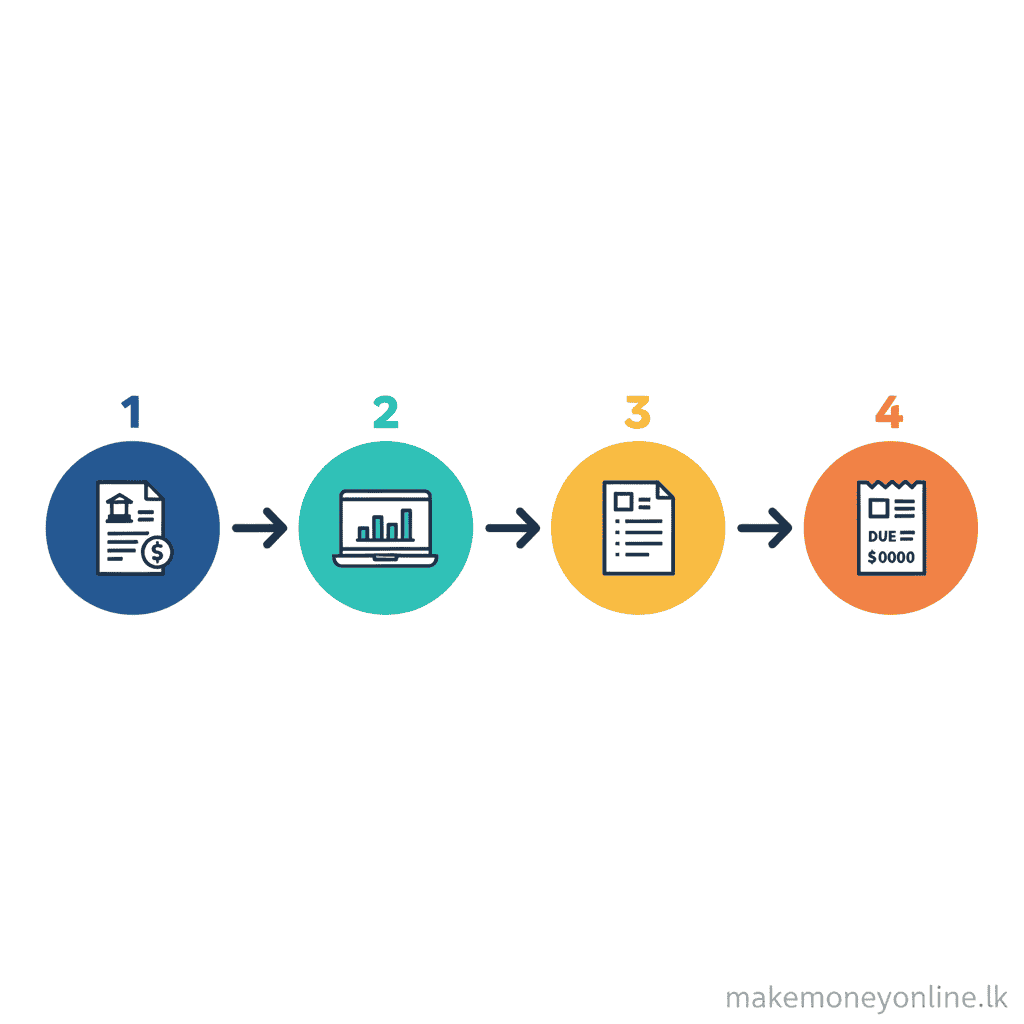
Step 1: A small business owner or startup hires you to manage their ongoing bookkeeping. They provide access to their accounting software (QuickBooks Online or Xero) and connect their bank accounts.
Step 2: You review the prior period’s transactions, categorize any uncategorized items, and reconcile all bank and credit card accounts.
Step 3: You record any additional transactions (expense receipts, sales invoices, purchase orders) provided by the client.
Step 4: At the end of each month, you prepare a profit and loss statement, balance sheet, and any other reports the client requests.
Step 5: You send the client a summary of the month’s financial activity, flag any unusual items or discrepancies, and note any action items (outstanding invoices, upcoming tax payments).
Step 6: Invoice the client monthly. Payment via Upwork escrow, Payoneer direct transfer, or bank wire.
Step 7: Transfer to your Commercial Bank, Sampath, BOC, HNB, or People’s Bank account.
What Skills Do You Need for Freelance Bookkeeping?
Double-entry bookkeeping fundamentals: Understanding debits and credits, the accounting equation (assets = liabilities + equity), and how transactions flow through financial statements. This is foundational knowledge that every bookkeeper must have before working with clients.
QuickBooks Online proficiency: QuickBooks Online is the dominant accounting software for US-based small businesses and is widely used in Australia and Canada. QuickBooks offers a free self-paced certification course (QuickBooks ProAdvisor certification) that is recognized by clients as proof of competence. Passing the ProAdvisor exam is the single most effective credential for attracting bookkeeping clients on Upwork.
Xero proficiency: Xero is preferred by UK, Australian, and New Zealand businesses. Xero also offers free certification (Xero Advisor Certification) through their education platform. Knowing both QuickBooks and Xero makes you competitive for a much wider client base.
Attention to detail: Financial records must be accurate. A misplaced decimal point, an incorrect categorization, or an unreconciled discrepancy compounds into larger problems. Bookkeeping requires a precise, methodical approach to every transaction.
Communication with clients: Explaining financial summaries to non-financial business owners, asking clear questions about ambiguous transactions, and flagging issues without causing unnecessary alarm. Clear written communication in English is essential for international clients.
Confidentiality and data security: Bookkeepers handle sensitive financial information. Understanding basic data security practices and maintaining strict confidentiality is a professional and legal requirement.
How to Get Started with Bookkeeping in Sri Lanka
Step 1: Learn double-entry bookkeeping fundamentals. If you do not have an accounting background, complete a free online bookkeeping course (Coursera, edX, or AccountingCoach.com) covering basic bookkeeping concepts before touching any software.
Step 2: Get QuickBooks ProAdvisor certified. The QuickBooks ProAdvisor certification is free through the QuickBooks Online Accountant platform. Create a free QBOA account, complete the self-paced training, and pass the exam. This certification appears on your Upwork profile and significantly increases credibility.
Step 3: Get Xero Advisor certified. Complete the free Xero certification at Xero Central (education.xero.com). The Xero Advisor certification covers the same certification benefit for UK/Australia-focused clients.
Step 4: Create an Upwork profile. List your QuickBooks and Xero certifications, any relevant financial background (accounting degree, finance work experience), and your availability. Start with a rate of $10 to $15 per hour to build reviews on the first three to five contracts.
Step 5: Apply to bookkeeping jobs on Upwork. Filter for bookkeeping, QuickBooks, Xero, and accounting jobs. Write proposals that address the client’s specific business type and mention your relevant certification. Specificity in proposals wins more interviews than generic templates.
Step 6: Raise rates after reviews. After five completed contracts with positive reviews, raise your rate by $3 to $5 per hour. Continue raising rates every 5 to 10 contracts as your Upwork job success score builds.
How to Learn Bookkeeping
Free resources:
- AccountingCoach.com: Comprehensive free bookkeeping and accounting reference covering every concept from basic debits and credits to advanced financial statements. The go-to reference for self-study.
- QuickBooks ProAdvisor training (accountants.intuit.com): Free self-paced training and certification for QuickBooks Online. The certification is globally recognized.
- Xero Central education (education.xero.com): Free certification courses for Xero. Covers setup, daily transactions, bank reconciliation, and reporting.
Paid learning:
- Udemy bookkeeping courses (USD 15 to USD 30 or LKR 4,575 to LKR 9,150 on sale): Practical courses covering QuickBooks Online, Xero, and bookkeeping fundamentals from beginner to advanced.
- Bookkeeper Business Launch (from USD 197 or LKR 60,085): Course specifically for building a freelance bookkeeping business, covering client acquisition, pricing, and service delivery.
Pros of Freelance Bookkeeping
Monthly retainer income. Bookkeeping is ongoing work. A business needs its books maintained every month. Once a client relationship is established, it generates recurring monthly income without repeat acquisition effort. Three retainer clients at $400 per month is LKR 366,000 per month in stable income.
Certifications are free and recognized. QuickBooks ProAdvisor and Xero Advisor certifications cost nothing to obtain and are recognized globally by clients. Few freelance skills have free, credible certifications that immediately improve client conversion.
Growing demand from global small businesses. The shift to cloud accounting software (QuickBooks Online, Xero) has made remote bookkeeping practical and accessible for small businesses worldwide. The addressable market for remote bookkeepers has grown substantially.
Less competition than tech skills. The bookkeeping section of Upwork has fewer applicants per job than software development or graphic design. Clients post bookkeeping jobs and receive fewer proposals. A well-written, certified applicant stands out more easily.
Scales with client volume. Going from LKR 150,000 to LKR 400,000 per month means adding two more retainer clients. You do not need to develop new skills or find a new model. The same skills generate proportionally more income with more clients.
Cons of Freelance Bookkeeping
Requires genuine financial literacy. Unlike social media management where skills can be learned within days, bookkeeping errors have real financial consequences for clients. An incorrect reconciliation or a miscategorized expense affects a business’s tax liability. The skill requires genuine learning before client work.
Client data security responsibility. You have access to sensitive financial records. A data breach or careless handling of client information creates professional and potentially legal liability. Basic data security practices (strong passwords, encrypted storage, VPN for public connections) are mandatory.
Tax and compliance nuances vary by country. A US client’s bookkeeping requirements differ from an Australian or UK client’s. Understanding the basic differences (US GAAP versus IFRS, VAT versus GST) is necessary for accurate work. Specializing by country simplifies this significantly.
Building initial reviews on Upwork takes time. The first three to five bookkeeping contracts on Upwork may require below-market rates to overcome the “no reviews” barrier. This phase typically takes two to four months before your profile has enough history to command $15 to $25 per hour rates.
Client acquisition requires patience. Bookkeeping is a trust-dependent service. Business owners are entrusting their financial records to a stranger. Building the profile credibility (certifications, reviews, a professional Upwork presence) that earns that trust takes consistent effort over months.
Best Platforms for Bookkeeping Work in Sri Lanka
Upwork
The primary platform for remote bookkeeping contracts. US, Australian, and UK small businesses post bookkeeping jobs regularly. Long-term retainer contracts dominate over one-time projects.
- Commission: 20% on first $500 per client, then 10%
- Payment for Sri Lanka: Payoneer or bank transfer
- Best for: Retainer contracts, ongoing monthly bookkeeping, QuickBooks and Xero clients
Fiverr
Works well for defined deliverables: bank reconciliation for a specific period, setting up QuickBooks for a new business, or cleaning up a messy set of books. Less suited to ongoing retainer work.
- Commission: 20% flat
- Payment for Sri Lanka: Payoneer
- Best for: One-time bookkeeping cleanups, software setup projects
LinkedIn Direct Outreach
Many small business owners are accessible on LinkedIn. A direct message offering a free 30-minute financial health review generates qualified inquiries from business owners aware they need bookkeeping help.
- Cost: Free
- Best for: Building direct client relationships without platform commissions
Scam Alerts: Bookkeeping Red Flags
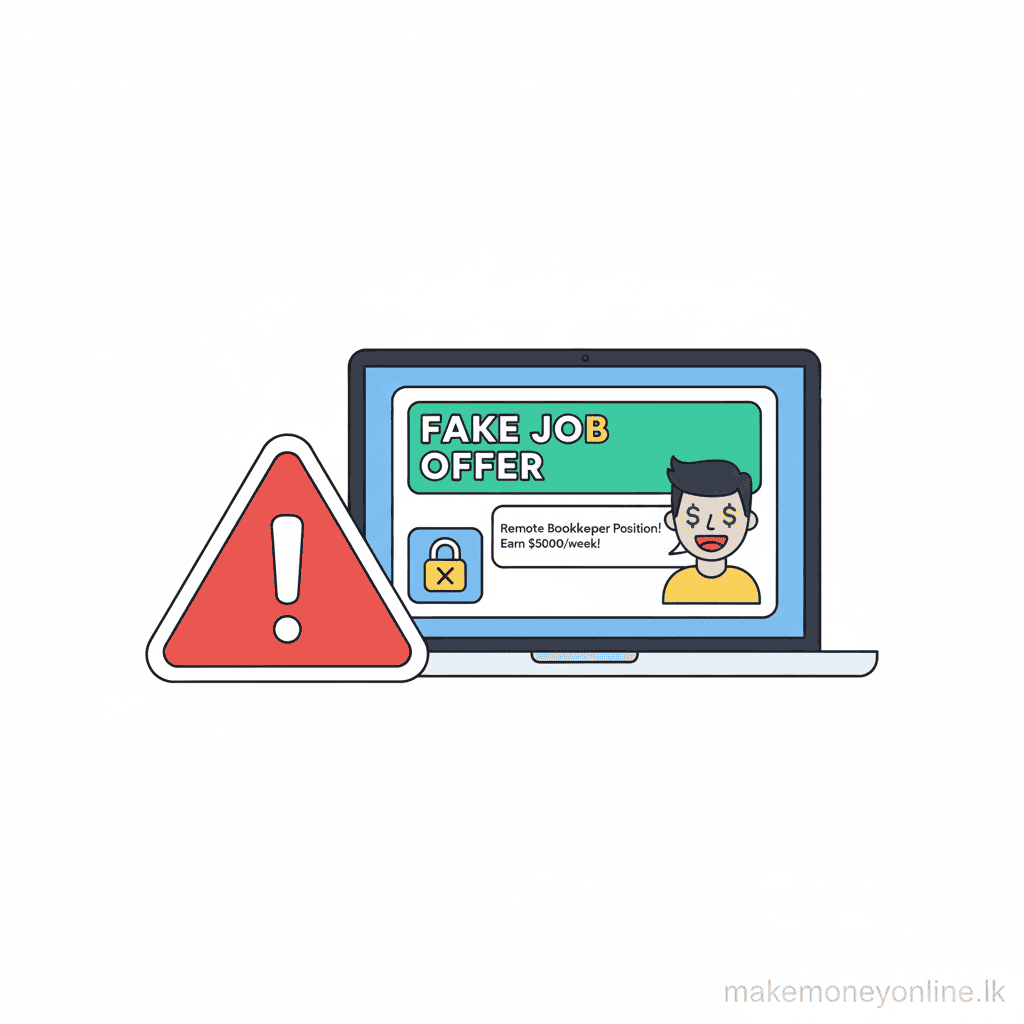
Money Mule Schemes Disguised as Remote Bookkeeping Jobs
The most dangerous scam targeting bookkeepers: a fake company hires you as a “remote bookkeeper” with an unusually high salary. They instruct you to receive payments into your personal bank account, deduct a “commission,” and forward the remaining funds to specified accounts. You are being used as an unwitting money mule in a money laundering operation. When the fraud is discovered, your bank account is frozen and you face potential legal consequences. Any bookkeeping job that involves receiving and forwarding money through your personal account is a money laundering scheme.
Overpayment Check Scams
A “client” sends a check for significantly more than the agreed bookkeeping fee and asks you to wire back the difference. The check bounces after you have sent the wire transfer. Never issue refunds via wire transfer or cash transfer services before confirming a payment has fully cleared.
Fake Bookkeeping Certification Schemes
Paid “certification” schemes promising proprietary bookkeeping credentials that will “guarantee” high-paying clients are not recognized by real clients. The only credentials that matter to international bookkeeping clients are QuickBooks ProAdvisor (free) and Xero Advisor (free). Any paid certification that is not from QuickBooks, Xero, or a recognized accounting body (AICPA, ACCA, ICASL) is unlikely to add real credibility.
“Trial Period” Work Without Pay
Clients who request a “trial period” of one to two weeks of real bookkeeping work to “assess quality” before agreeing to pay are getting free work. A legitimate quality assessment involves a brief paid test task or a paid trial month at standard rates. Do not perform real bookkeeping work without payment.
Final Verdict: Is Bookkeeping Worth It for Sri Lankans?
Freelance bookkeeping is an excellent income method for Sri Lankans with a financial background or the willingness to invest in learning. The combination of free certifications that provide immediate credibility, consistent demand for monthly retainer work, and lower competition on Upwork relative to many other freelance skills makes it more accessible than its income potential suggests.
The primary requirement is genuine competence. Bookkeeping done incorrectly harms clients. The investment in proper learning, free certifications, and careful early work builds a foundation for a sustainable, high-income freelance practice.
This method suits you well if:
- You have an accounting, finance, or business background
- You are detail-oriented and comfortable with financial data
- You are willing to invest in free certifications before seeking clients
- You want recurring monthly retainer income from a trust-based service
This method may not suit you if:
- You have no financial background and are not willing to invest significant time in learning
- You need income within 60 days and cannot build the certification and profile credibility required
- You dislike detailed, precise record-keeping work
For related finance-based income methods, see the guide on SEO consulting in Sri Lanka and the overview of virtual assistant work for remote professional service income approaches.