Saman had an IT job paying LKR 65,000 per month. He spent two evenings per week writing blog articles on Upwork. After eight months, his writing income surpassed his salary. Today he writes full-time, works from home, and earns LKR 180,000 per month serving three long-term clients in the US.
That trajectory is not unusual for Sri Lankan freelance writers who approach this seriously. Strong English, low competition from local talent, and the USD-to-LKR conversion advantage combine to make freelance writing one of the most accessible high-return methods available to Sri Lankans right now.
This guide covers exactly how to earn from freelance writing in Sri Lanka, what the realistic income looks like at each level, which platforms pay Sri Lankans, and how to avoid the scams targeting writers in this space.

What Is Freelance Writing?
Freelance writing means producing written content for clients who pay you per word, per article, or on a retainer. The content you write appears on their blogs, websites, newsletters, social media feeds, or marketing materials. You are not employed by them. You are a self-employed contractor who delivers a specific piece of writing, gets paid, and moves to the next client or project.
The range of writing types is wide: blog articles, product descriptions, website copy, email newsletters, LinkedIn posts, technical documentation, case studies, white papers, press releases, and social media content. Each type has a different pay rate, a different client pool, and different skill requirements.
For Sri Lankan writers, blog articles and web content are the most accessible entry points. These are the highest-volume categories on platforms like Upwork and Fiverr, and they require clear English prose rather than highly specialized technical knowledge.
How Much Can You Earn from Freelance Writing in Sri Lanka?
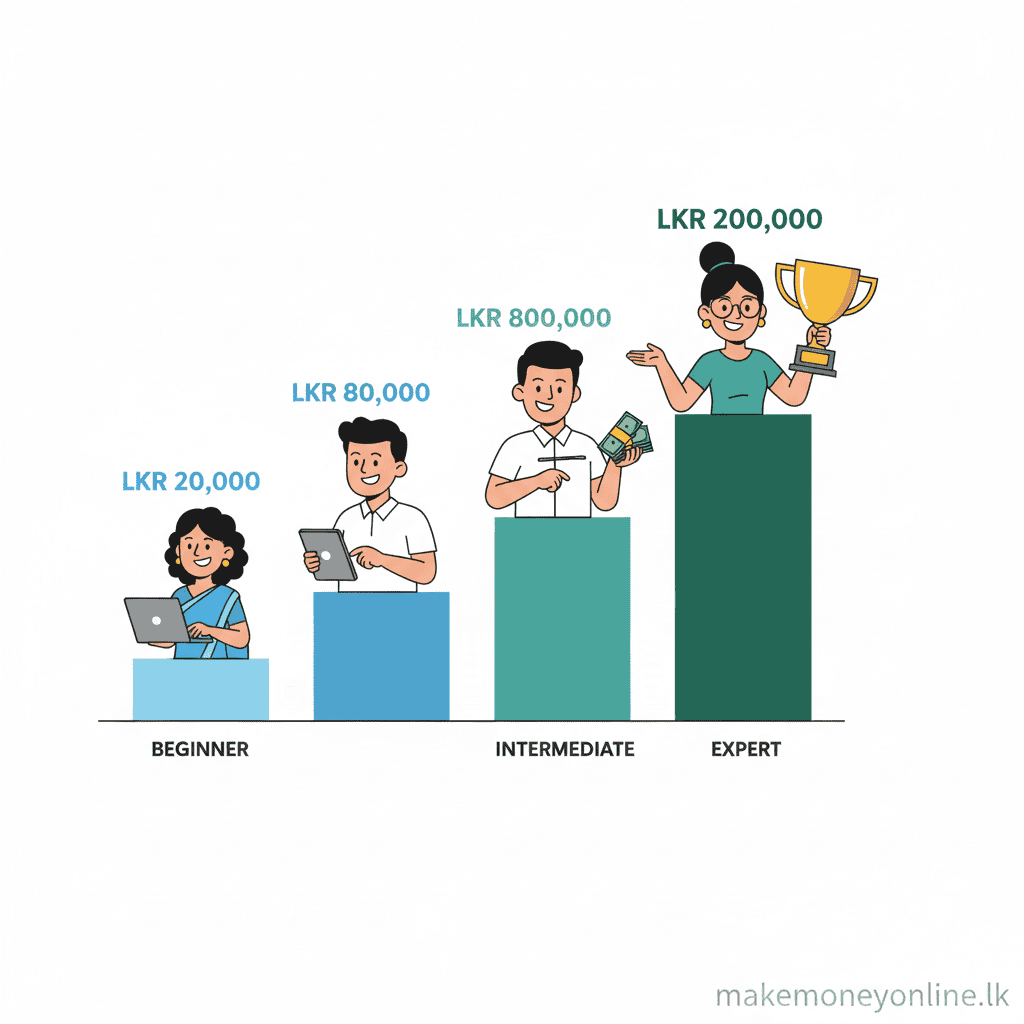
Sri Lankan freelance writers typically earn LKR 15,000 to LKR 45,000 per month in their first three to six months while building a profile and client base. Writers with six months to a year of consistent work and strong reviews earn LKR 60,000 to LKR 130,000 per month. Experienced writers with long-term client relationships and specialized niches earn LKR 150,000 to LKR 350,000 per month.
Per-Word and Per-Article Rates
The market pays writers based on experience, niche, and client type. These are realistic 2026 ranges:
| Writer Level | Per Word (USD) | Per 1,000-word Article | Monthly (LKR) |
|---|---|---|---|
| Beginner | $0.02 to $0.05 | $20 to $50 | LKR 15,000 to 45,000 |
| Intermediate | $0.06 to $0.12 | $60 to $120 | LKR 60,000 to 130,000 |
| Expert | $0.15 to $0.30 | $150 to $300 | LKR 150,000 to 350,000 |
| Specialist (tech, medical, legal, finance) | $0.20 to $0.50 | $200 to $500 | LKR 200,000 to 500,000+ |
Exchange rate: approximately 1 USD = 305 LKR.
The Volume Equation
A beginner writing three 1,000-word articles per day (achievable with practice) at $0.04 per word earns $120 per day or approximately $2,400 per month. That is LKR 732,000 per month at volume. However, beginners rarely have enough client work to fill that volume from the start. Expect one to three articles per day in months one to three as you build your profile.
A more realistic beginner scenario: two articles per day, five days per week, at $0.03 per word. That is 2,000 words per day × $0.03 × 20 working days = $1,200 per month or LKR 366,000. This is achievable by month six with consistent effort.
How Does Freelance Writing Work?
The process from first client to regular income follows a consistent path.
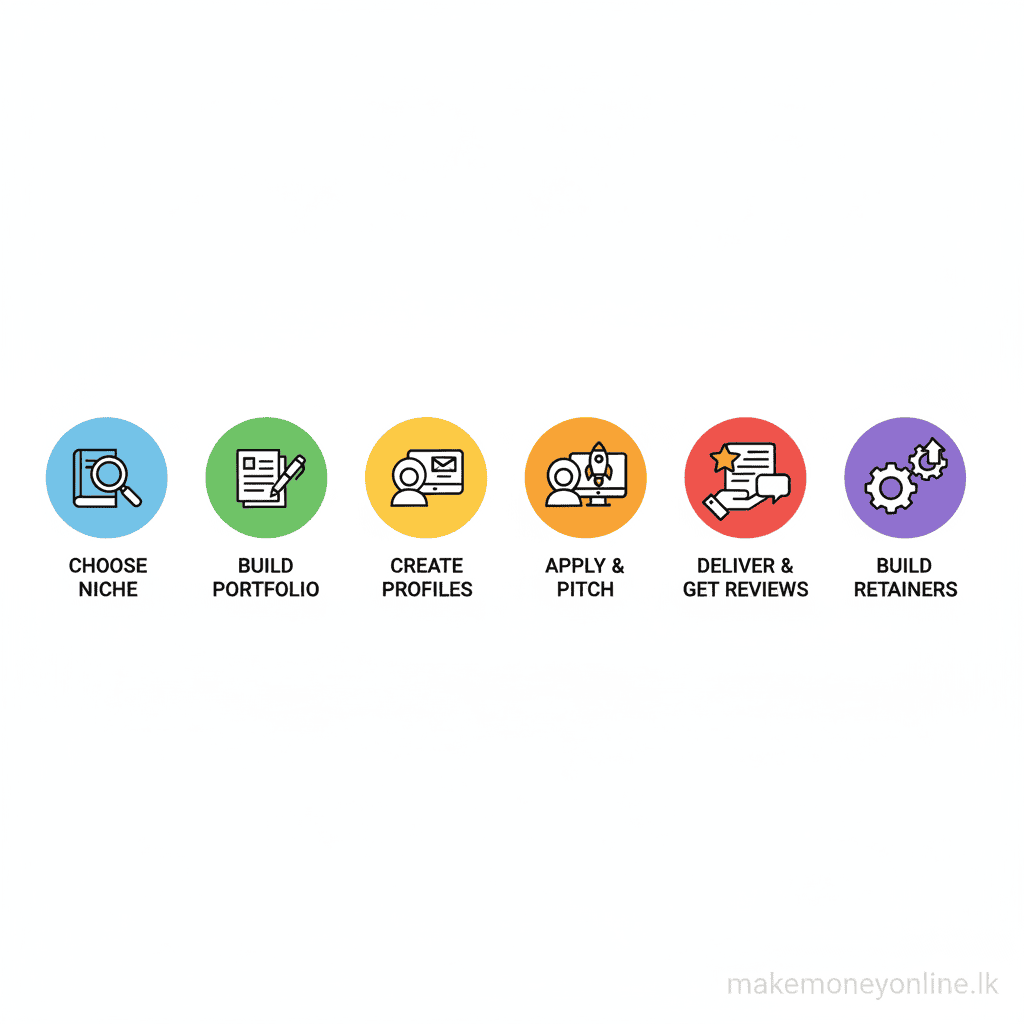
Step 1: Choose your niche. Generalist writers compete on price. Specialist writers compete on expertise. Choosing a niche you know well (technology, health, finance, travel, real estate, education) allows you to charge more and attract better clients.
Step 2: Build a writing portfolio. Clients check your samples before hiring you. Without samples, you cannot get clients. Without clients, you cannot get samples. Break this loop by writing three to five unpaid sample articles in your niche and publishing them on a free Medium account or a simple WordPress.com blog.
Step 3: Create platform profiles. Set up on Fiverr, Upwork, or both. Write a clear profile describing what you write, who you write for, and what makes your writing useful to clients. Upload your samples.
Step 4: Apply and pitch. On Upwork, apply to five to ten relevant jobs per day. Personalize every proposal. On Fiverr, optimize your gig title and tags for search. On both platforms, volume of applications in the first month determines how quickly you land your first client.
Step 5: Deliver, get reviewed, and raise rates. Your first few projects are about building reviews, not maximizing income. After ten positive reviews, increase your rates. After twenty, increase again.
Step 6: Build long-term client relationships. One client who gives you ten articles per month is more efficient than ten clients who each give you one. Pursue retainer arrangements where possible. A retainer means the client pays a fixed monthly amount for a fixed number of articles.
What Skills Do You Need for Freelance Writing?
Clear written English: The single most important skill. Clients need content their readers can understand without effort. Grammatical errors, confusing sentences, or unclear structure will cost you clients and reviews. If you are not confident in your English, spend one to two months actively improving it before pitching clients.
Research skills: Most articles require research. You need to find accurate information from credible sources, understand it, and explain it clearly. The ability to research quickly determines how many articles you can write per day.
Meeting deadlines: Freelance writing is a professional service. Clients rely on your delivery schedule to maintain their publishing calendars. Missing deadlines without notice is the fastest way to lose clients and damage your reputation.
SEO basics: Most blog content clients need SEO-optimized writing. This means using the target keyword naturally throughout the article, writing appropriate meta descriptions, and structuring content with clear headings. Basic SEO knowledge makes you significantly more valuable. Learn it for free at ahrefs.com/blog.
Ability to match a client’s voice: Many clients have an established tone and style. Your job is to write in their voice, not yours. Reading their existing content before starting a project and matching their style is a skill that separates good freelancers from great ones.
What you do not need: A journalism degree, a specific certification, or expensive equipment. A reliable internet connection, a laptop or desktop, and strong English are the core requirements.
How to Get Started with Freelance Writing in Sri Lanka
Step 1: Choose one primary niche. Spend 30 minutes identifying a topic you know well and that has writing demand. Technology, health and wellness, personal finance, digital marketing, travel, and real estate are consistently in demand. Do not try to write about everything at the start.
Step 2: Write three sample articles. Write three 800 to 1,200 word articles in your niche. Do not publish them for clients. Publish them on Medium.com (free) or a WordPress.com blog (free). These become your portfolio links.
Step 3: Create a Fiverr gig. Go to fiverr.com, sign up as a seller, and create a gig titled along the lines of “I will write SEO-optimized blog articles about [your niche].” Price your starter gig at $15 to $25 for a 500-word article. This is below market rate, but it gets you your first reviews within weeks.
Step 4: Create an Upwork profile. Go to upwork.com and create a freelancer profile. Write a 200-word overview describing your niche expertise, what types of content you write, and your experience. Upload two to three portfolio samples. Set your hourly rate at $8 to $12 for your first month, then raise it as reviews accumulate.
Step 5: Apply to jobs on Upwork daily. In your first month, apply to five to ten writing jobs per day. Tailor each proposal to the specific job posting. Reference something specific from the job description to show you read it. Proposals that start with “Dear Client, I am a professional writer…” are ignored. Proposals that start with “I see you need SEO articles for your pet food review site…” get replies.
Step 6: Set up Payoneer for payments. Create a Payoneer account at payoneer.com. Both Upwork and Fiverr pay Sri Lankan users through Payoneer. Once your Payoneer balance reaches $50, you can transfer to your Sri Lankan bank account (Commercial Bank, Sampath, BOC, HNB, or People’s Bank). Payoneer charges approximately 2% on currency conversion.
Step 7: Deliver quality work and ask for reviews. After completing each project, deliver on time or early. If the client is happy, politely ask them to leave a review. Reviews are the currency of freelancing platforms. Every positive review increases your visibility and justifies higher rates.
How to Learn Freelance Writing
Free learning resources:
- Ahrefs Blog (ahrefs.com/blog): The best free SEO writing resource. Read “How to Write a Blog Post” and “On-Page SEO: The Beginner’s Guide.” These two guides teach you everything a client expects from SEO-optimized content.
- Copyblogger (copyblogger.com): Classic resource on writing persuasive content. Their archives cover blog writing, email copy, headlines, and engagement.
- Google Developers Writing Guidelines (developers.google.com/tech-writing): Free technical writing course from Google. Excellent for writers targeting technology clients.
- Hemingway Editor (hemingwayapp.com): Paste your writing in and see readability scores instantly. Aim for Grade 8 or lower reading level.
- Grammarly (grammarly.com, free plan): Run every piece of work through Grammarly before delivery. The free plan catches most grammatical errors.
Paid courses worth considering:
- Elna Cain’s Write Your Way to Your First $1K (elnacain.com): USD 197 (LKR 60,100). Specifically designed for beginner freelance writers building their first client base. Practical and direct.
- Udemy content writing courses: USD 15 to USD 30 (LKR 4,575 to LKR 9,150) during sales. Search “freelance writing” and filter by highest rated.
Pros of Freelance Writing
Low barrier to entry. A laptop, internet access, and good English are all you need to start. Zero upfront investment required.
Scalable income. As your reputation grows, your rate per word grows. A writer who starts at $0.03 per word can reach $0.15 per word within two years without changing the type of work they do.
Consistent demand. Every business with a website needs content. The demand for quality writing is not going to disappear. Companies increase their content marketing budgets every year because it works.
USD earnings convert well. A writer earning $1,500 per month receives LKR 457,500 at current rates. That is a strong salary for Sri Lanka from home-based work.
Build toward other income streams. Many freelance writers eventually start their own blogs, create courses, or build agencies. The writing skills and client relationships you build are transferable assets.
Work from anywhere. All you need is internet access. Many Sri Lankan freelance writers work from home, cafes, or while traveling.
Cons of Freelance Writing
Income is not passive. Every article requires active writing time. There is no earning while you sleep unless you build passive assets alongside your writing work.
Highly competitive at entry level. The beginner tier on Fiverr and Upwork has writers from every country competing for the same low-priced jobs. Differentiating yourself through niche specialization and a strong portfolio is essential.
Content mills pay poorly and damage your career. Sites like Textbroker, iWriter, and similar platforms pay $0.01 to $0.02 per word. Working at those rates trains you to write fast but never to write well. Avoid them. The time spent at those rates is better spent building a real freelancing profile.
Client communication is ongoing work. Managing multiple clients means managing multiple communication channels, deadlines, and revision requests simultaneously. This becomes manageable with systems but adds overhead to pure writing time.
Platform fees reduce income. Fiverr takes 20%, Upwork takes up to 20% on new client relationships. Factor this into your pricing. A $50 article on Fiverr nets you $40.
Feast-or-famine cycles. Some months you have more work than you can handle. Others are slow. Managing cash flow during slow months requires discipline.
Best Platforms for Freelance Writing in Sri Lanka
Upwork
Upwork is the highest-earning platform for most experienced Sri Lankan freelance writers. Clients on Upwork have larger budgets and are more serious about long-term relationships.
- How it works: You apply to job postings with a proposal. Long-term contracts are common. Hourly and fixed-price projects both available.
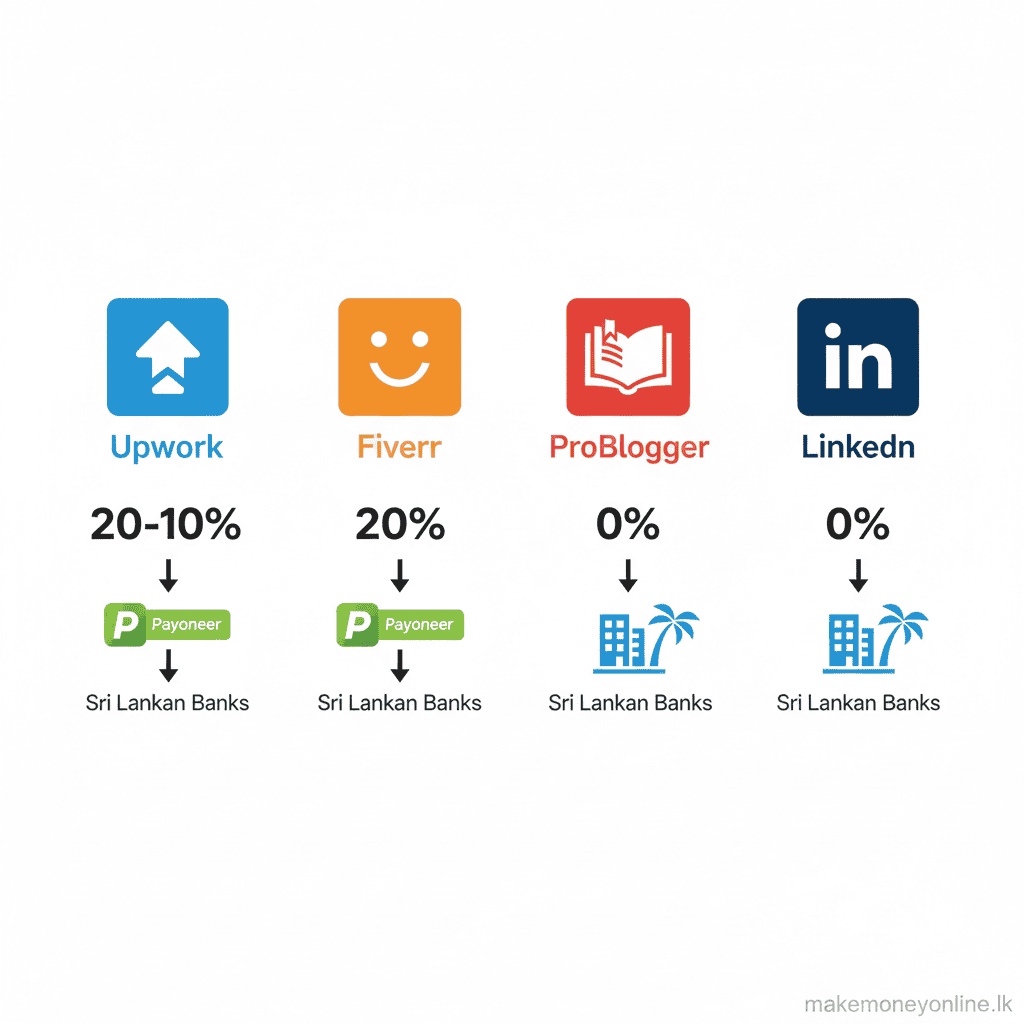
- Commission: 20% on first $500 with each client, dropping to 10% up to $10,000, then 5%
- Payment for Sri Lanka: Payoneer recommended. Direct bank transfer also available.
- Best for: Building long-term client relationships and growing hourly rates over time
Fiverr
Fiverr is the fastest way to get your first writing orders as a beginner. Buyers find you; you do not need to apply to jobs.
- How it works: Create a gig listing. Buyers search for writers and order directly.
- Commission: 20% flat on every order
- Payment for Sri Lanka: Payoneer recommended. Available once you reach the $50 withdrawal threshold.
- Best for: Getting first reviews fast and building a visible portfolio
ProBlogger Job Board (problogger.com/jobs)
ProBlogger lists content writing jobs from companies looking for blog writers. Many are remote positions with rates above typical Fiverr or Upwork starter rates.
- No platform fee: You apply directly to employers
- Best for: Writers with 6 months of experience looking to land higher-paying direct clients
LinkedIn is underused by Sri Lankan writers. Many US and UK companies post writing jobs on LinkedIn. Applying directly on LinkedIn bypasses platform fees entirely.
- Payment for Sri Lanka: Direct bank transfer or Payoneer depending on client preference
- Best for: Experienced writers targeting corporate clients or tech companies
Free Tools for Freelance Writing
Google Docs (free): Write all client work in Google Docs. Share via link for client review. Export to Word for clients who require it.
Grammarly (free plan): Grammar and spelling checking for every article before delivery. The free plan is sufficient for most writing work.
Hemingway Editor (free browser version at hemingwayapp.com): Readability analysis. Highlights complex sentences, passive voice, and adverbs. Aim for Grade 8 or lower.
Ahrefs Free SEO Tools (ahrefs.com/free-seo-tools): Free keyword difficulty checker and SERP overview. Useful for understanding what a client’s target keywords face in search.
Google Trends (trends.google.com): Check if a topic is growing or declining in search interest. Helps you pitch fresh content ideas to clients.
Copyscape (copyscape.com, limited free): Run your completed articles through Copyscape to verify they are original before delivery. The free version checks one URL at a time. Clients value plagiarism-free guarantees.
Notion (free plan): Organize your client list, deadlines, article briefs, and invoices in one place. The free plan is sufficient for freelancers managing up to five clients.
Paid Tools for Freelance Writing
Grammarly Premium (approximately USD 12 per month or LKR 3,660): Catches more complex errors than the free plan: tone inconsistencies, clarity issues, and engagement problems. Worth it once you are earning consistently and want to deliver higher-quality work faster.
Surfer SEO (approximately USD 89 per month or LKR 27,145): SEO writing assistant that shows you in real time how many times to use a keyword, which related terms to include, and how long the article should be relative to competitors. Excellent for writers specializing in SEO content. Only justified if you are earning LKR 100,000+ per month from SEO writing clients.
Jasper AI (approximately USD 39 per month or LKR 11,895): AI writing assistant for generating outlines, intro drafts, and section ideas. Speeds up the writing process for high-volume writers. Do not use it to generate full articles. Use it as a brainstorming tool.
Copyscape Premium (approximately USD 0.03 per check or LKR 9 per article): Unlimited plagiarism checking per article. At USD 0.03 per check, this is extremely affordable and gives clients confidence in your work.
Scam Alerts: Freelance Writing Red Flags in Sri Lanka
Clients Who Take Completed Work and Disappear
This is the most common scam targeting freelance writers. The client places a project, you complete it, deliver it, and they mark it as unsatisfactory or dispute the payment to get the work for free.
On Upwork and Fiverr, platform protections reduce this risk significantly. On direct projects outside platforms, always require 50% payment upfront before starting work. Never deliver completed work to a client who has not paid anything.
Fake Writing Job Ads Requiring Registration Fees
Job listings on Facebook and local job boards advertise content writing positions paying LKR 2,000 to LKR 5,000 per article and require a “training fee” or “registration deposit” of LKR 5,000 to LKR 20,000 before you start.
This is a scam. Legitimate writing employers never charge writers to work for them. Close and ignore any opportunity that requires upfront payment.
Content Mills Presented as Career Opportunities
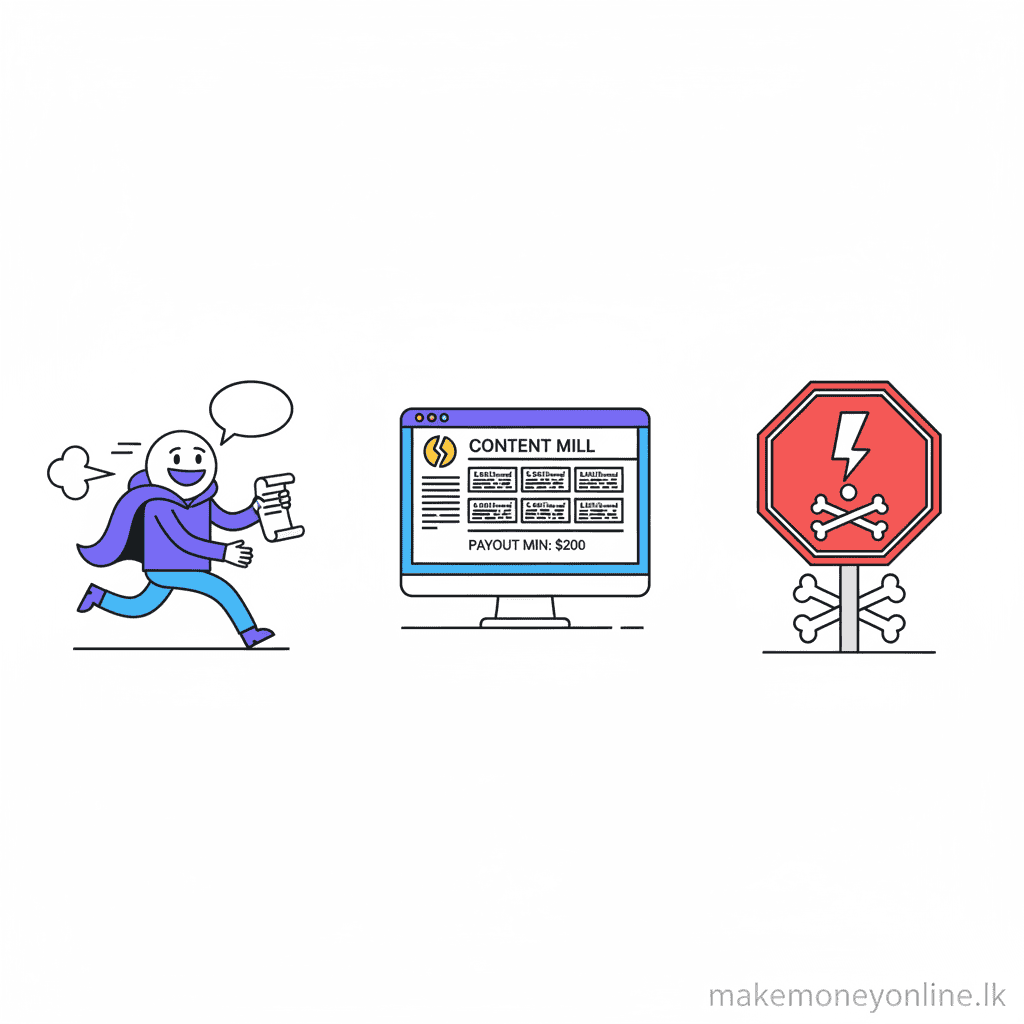
Sites like iWriter, Textbroker, and WriterAccess market themselves as legitimate platforms for getting started. The pay rates are LKR 600 to LKR 1,500 per 500-word article. At those rates, you earn less than LKR 100 per hour.
These platforms are not career launchpads. Spending six months on a content mill at $0.01 per word builds volume but not rates, portfolio, or reputation. Use the same time building a Fiverr or Upwork profile at better rates.
Test Articles That Are Actually Unpaid Work
Some clients ask for a “test article” of 500 to 1,000 words on a specific topic to evaluate your skills. Many of these test articles are published and used without paying the writer.
A legitimate client can evaluate your skills from your existing portfolio samples. If they insist on a test article on a specific topic they happen to need, require payment for it. Offer to write at a discounted rate, but never at zero.
Payment Outside the Platform
If a client on Upwork or Fiverr asks you to communicate via WhatsApp or email and accept payment outside the platform, decline. This bypasses platform protection. If a dispute arises, you have no recourse. All work and payment must happen within the platform until you have a long-term trust relationship with the client.
Fake “High-Paying Writing Jobs” WhatsApp Groups
WhatsApp groups circulate in Sri Lanka claiming to offer writing jobs paying LKR 1,000 per article from international companies. These groups typically lead to survey spam, data collection, or requests for payment to access the jobs. Real international writing clients use established platforms, not WhatsApp groups with unknown administrators.
Final Verdict: Is Freelance Writing Worth It for Sri Lankans?
Freelance writing is one of the most sustainable high-income methods available to Sri Lankans with strong English skills. It has a low start cost, a clear path from beginner to professional rates, and a growing global demand from companies that need quality content.
The critical variable is English quality. This method does not reward mediocre writing. Clients who pay $0.10 per word and above are paying for quality, consistency, and reliability. Sri Lankan writers who invest in improving their English, learn SEO basics, and specialize in a niche they know well can reach LKR 100,000 per month within 12 to 18 months of consistent work.
This method is well-suited for you if:
- Your English writing is strong and you can produce error-free content
- You are willing to start at lower rates while building reviews and raising them over time
- You can commit to writing two to four articles per day consistently
- You are interested in building long-term client relationships rather than one-off projects
This method may not suit you if:
- English writing is a significant challenge for you right now
- You want passive income that does not require daily active work
- You find deadline pressure stressful
For writers interested in expanding their services over time, see the guide on resume writing in Sri Lanka and the guide on creating online courses for ways to convert your writing expertise into additional income streams.