
Sri Lanka has a multilingual population fluent in English, Sinhala, and Tamil. Most Sri Lankans who grew up in educated households speak English at a professional level, studied in English-medium schools, and use English daily. That linguistic background, which feels ordinary to most Sri Lankans, is a premium credential in the global language teaching market where non-native English tutors from South Asia are in significant demand.
Teaching English online to students in Japan, South Korea, China, and Europe pays $15 to $40 per hour. Teaching Sinhala to diaspora communities in Australia, the UK, and Canada pays similar rates. Teaching Tamil to diaspora students in Western countries completes a triptych of language assets that most Sri Lankans already possess at some level.
This guide covers how language teaching income works, which platforms connect Sri Lankan teachers with paying students globally, what certifications help, and how to build a stable roster of regular students.
What Is Online Language Teaching?
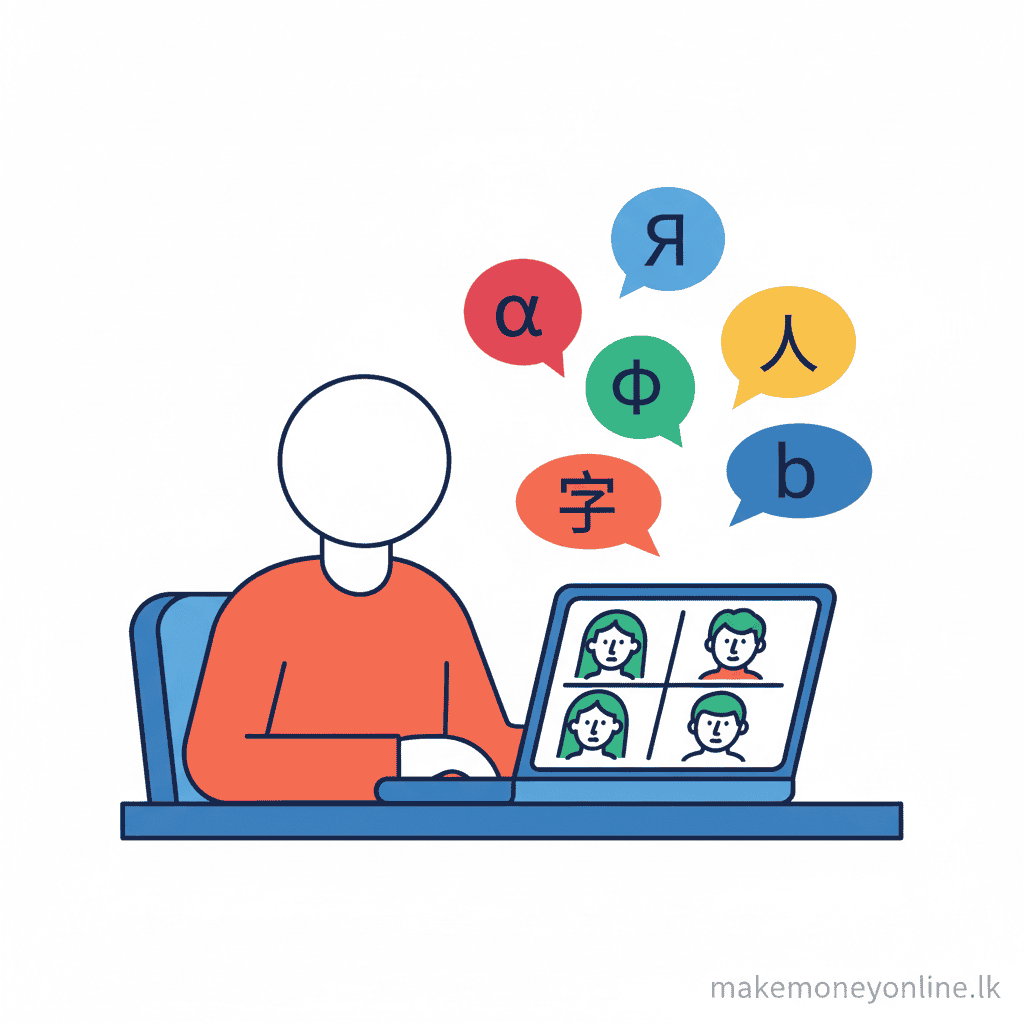
Online language teaching means providing one-on-one or small group language lessons via video call to students who want to learn a language you speak fluently. The teacher helps students improve their speaking, listening, reading, writing, or all four skills depending on their goals.
Language teaching is different from academic tutoring. The focus is communication and fluency, not exam preparation (though exam preparation is a subset of language teaching). Students range from beginners learning their first words to advanced speakers wanting to refine professional communication.
The language categories with the strongest market demand for Sri Lankan teachers:
English as a Second/Foreign Language (ESL/EFL): The largest global language teaching market. Students in Asia (Japan, South Korea, China, Taiwan, Vietnam), the Middle East, and Europe actively seek English tutors. Strong demand for conversational English, business English, and IELTS/TOEFL preparation.
Sinhala: Global diaspora communities in Australia, the UK, Canada, and the US have significant numbers of second-generation Sri Lankans who want to connect with their heritage language. Parents actively seek Sinhala tutors for their children. Supply of qualified Sinhala tutors online is very limited, which allows higher pricing.
Tamil: Tamil diaspora communities in the same Western countries, plus Sri Lankan Tamil communities worldwide, generate demand for Tamil language instruction. Tamil tutors are in shorter supply online than English tutors, creating pricing advantages for qualified teachers.
Sinhala/Tamil for tourists and researchers: International tourists, academics, and NGO workers planning extended time in Sri Lanka actively seek basic Sinhala or Tamil instruction before and during their visits.
How Much Can You Earn from Teaching Languages?
Language Teaching Income Benchmarks
| Language / Level | Hourly Rate (USD) | Monthly Income (20 hrs/wk) | LKR Equivalent |
|---|---|---|---|
| English (conversational) | $12 to $25 | $960 to $2,000 | LKR 292,800 to LKR 610,000 |
| English (business/IELTS prep) | $20 to $45 | $1,600 to $3,600 | LKR 488,000 to LKR 1,098,000 |
| Sinhala (diaspora students) | $15 to $35 | $1,200 to $2,800 | LKR 366,000 to LKR 854,000 |
| Tamil (diaspora students) | $15 to $35 | $1,200 to $2,800 | LKR 366,000 to LKR 854,000 |
Exchange rate: 1 USD = approximately 305 LKR.
20 hours per week is a manageable full-time language teaching workload. Most teachers start part-time (8 to 10 hours per week) and grow their student roster over 3 to 6 months before transitioning to full-time.
How Does Online Language Teaching Work?
Step 1: A student finds you on a language teaching platform (iTalki, Preply, or Cambly) or through LinkedIn and social media.
Step 2: The student books a trial lesson (usually 30 minutes at a discounted rate) to assess whether your teaching style matches their needs.
Step 3: If the trial is positive, you discuss their goals (conversational fluency, exam preparation, professional communication) and schedule regular lessons: typically one to three times per week.
Step 4: You conduct lessons via the platform’s video tool, Zoom, or Google Meet. You prepare lesson materials (conversation topics, grammar exercises, vocabulary lists, reading passages) tailored to the student’s level and goals.
Step 5: After each lesson, you send a brief summary of what was covered, the errors corrected, and homework or practice suggestions for before the next lesson.
Step 6: Students pay weekly or monthly. Platforms process payment automatically. Direct students pay via PayPal, Wise, or bank transfer.
Step 7: Transfer to your Commercial Bank, Sampath, BOC, HNB, or People’s Bank account.
What Skills Do You Need for Language Teaching?
Native or near-native fluency in the language you teach: For English teaching, Sri Lankans who attended English-medium schools and use English professionally are entirely competent. For Sinhala and Tamil teaching, native speakers of these languages can teach them without additional linguistic preparation.
Ability to explain language clearly: Knowing a language and being able to explain why something is grammatically correct (or incorrect) are different skills. An effective language teacher can explain the difference between “I have been to Kandy” and “I went to Kandy” in a way that makes sense to a non-English speaker. This pedagogical skill is learnable.
Patience and adaptability: Students make the same mistakes repeatedly and require multiple explanations from different angles. The ability to rephrase, use examples, and adapt to different learning styles without frustration is essential.
Lesson planning: Preparing structured lessons with clear objectives prevents sessions from becoming unproductive conversation sessions. Even conversational lessons benefit from a prepared topic, vocabulary list, and reflection period.
TEFL/TESOL certification (for English teaching): A TEFL (Teaching English as a Foreign Language) or TESOL (Teaching English to Speakers of Other Languages) certificate is not legally required to teach English online, but it significantly increases student trust and platform credibility. Many platforms give certified teachers higher search rankings and allow higher posted rates.
How to Get Started with Language Teaching in Sri Lanka
Step 1: Define what you teach and who you teach. “English” is too broad. “Business English for Japanese professionals” or “IELTS preparation for university applicants” or “Sinhala for second-generation diaspora children” is a specific offer with a defined audience. Specificity attracts the right students and supports premium pricing.
Step 2: Get TEFL certified (for English teaching). A 120-hour TEFL certificate from a recognized online provider takes 4 to 8 weeks to complete. It demonstrates commitment to professional teaching and is recognized by most online teaching platforms. 120-hour online TEFL courses are available for USD 20 to USD 200 depending on the provider.
Step 3: Create an iTalki profile. iTalki is the world’s largest online language tutoring marketplace. It has separate categories for “Professional Teacher” (certified, with teaching experience) and “Community Tutor” (native or fluent speaker, no certification required). Both can earn, but Professional Teacher status allows higher rates.
Step 4: Create a Preply profile. Preply is the second-largest language teaching platform. Strong demand for English, with a significant number of students seeking tutors in less common languages including Sinhala and Tamil. Preply pays per completed lesson hour.
Step 5: Record a strong introduction video. Both iTalki and Preply feature teacher introduction videos prominently. A 1 to 2 minute video showing your personality, teaching approach, and language fluency is your primary marketing tool on these platforms. Record in good lighting with clear audio.
Step 6: Set competitive initial pricing and raise after 20 reviews. New teachers on these platforms benefit from starting at the lower end of the rate range to attract early bookings and reviews. After 20 completed lessons with positive feedback, increase your rate by 20 to 30%.
How to Learn Language Teaching Skills
Free resources:
- iTalki Teacher Academy (teachers.italki.com): Free guides on lesson planning, student retention, and pricing strategy specifically for language teachers on the platform. Directly applicable to building a language teaching practice.
- British Council Teaching English resources (teachingenglish.org.uk): Free lesson plans, teaching tips, and professional development resources for English teachers. High quality and applicable to online teaching.
Paid learning:
- TEFL/TESOL certification (from USD 20 to USD 200 or LKR 6,100 to LKR 61,000): Online 120-hour courses from providers like ITTT, MyTEFL, or TEFL.org. The recognized providers are accredited by international TEFL bodies. Complete one of these before creating a professional teacher profile.
- Cambridge CELTA (from USD 1,500 or LKR 457,500): The gold standard English teaching qualification, recognized globally. More expensive and demanding than online TEFL, but provides the strongest credential for premium student acquisition.
Pros of Language Teaching
Unique competitive advantage for Sri Lankan Sinhala and Tamil teachers. The supply of qualified online Sinhala and Tamil tutors is genuinely limited. A diaspora parent in Sydney or Toronto searching for a Sinhala tutor for their child has very few options. This supply scarcity supports premium pricing and strong student loyalty.
Recurring weekly income from committed students. A student preparing for IELTS commits to 2 to 3 lessons per week for 3 to 6 months. A diaspora child taking Sinhala lessons commits for years. Each committed student generates stable, predictable weekly income.
No equipment beyond a computer and internet. Language teaching requires a webcam, microphone, reliable internet, and optionally a digital whiteboard (Google Jamboard, free). The startup cost is essentially zero for most Sri Lankans who already have a computer.
Schedule flexibility with global time zones. Teaching Japanese students in the morning (Japan is 3.5 hours ahead of Sri Lanka) and European students in the evening creates teaching sessions across the day without extreme early or late hours.
Multiple language assets compound. A Sri Lankan who teaches English in the morning, Sinhala in the afternoon, and Tamil in the evening is earning from three language assets simultaneously. This income diversification is unique to Sri Lanka’s multilingual profile.
Cons of Language Teaching
Platform commission reduces take-home pay. iTalki charges teachers approximately 15% on each lesson. Preply charges a higher commission initially (33%), decreasing to 18% as teaching hours accumulate. Direct student relationships eliminate commission but require self-marketing.
Early review building is slow. New profiles on language teaching platforms compete against teachers with hundreds of completed lessons and strong review histories. The first 20 to 30 lessons, often at reduced rates, build the profile credibility required for organic student discovery.
Student cancellations reduce income. Students cancel or reschedule, particularly during their own busy periods. A clear 24-hour cancellation policy reduces last-minute income loss. Platforms allow teachers to set cancellation policies that protect against habitual cancellers.
Teaching is mentally demanding work. Conducting 6 to 8 one-hour language lessons per day requires sustained focus, energy, and emotional engagement with students. Full-time language teaching is tiring in a way that desk-based knowledge work is not. Most teachers find 4 to 6 hours of teaching per day sustainable long-term.
Best Platforms for Language Teaching
iTalki
The world’s largest language tutoring marketplace. Operates in 130+ languages. Strong demand for English, with emerging demand for Sinhala and Tamil from diaspora communities. Community Tutor and Professional Teacher tiers.
- Commission: Approximately 15%
- Payment for Sri Lanka: PayPal or Payoneer
- Best for: All languages, building initial student roster
Preply
Second-largest language tutoring platform. Strong focus on English but lists tutors in 50+ languages. Higher initial commission that decreases with teaching hours.
- Commission: 33% initially, decreasing to 18% at higher hours
- Payment for Sri Lanka: PayPal or Payoneer
- Best for: English teaching, professional business English
Cambly
English conversation-only platform. No certification required. Students from Middle East, Asia, and Europe. Pays per minute of connection time (approximately $0.17/minute = $10.20/hour base). Simpler than iTalki for beginners.
- Commission: Platform-set rate
- Payment: PayPal
- Best for: English conversation beginners, flexible hours without scheduling

Scam Alerts: Language Teaching Red Flags
“Online English Teacher” Recruitment Requiring Upfront Payment
Advertisements recruiting English teachers for “international schools” or “online teaching agencies” that require payment for training materials, a starter kit, or a background check before beginning work are fraudulent. Legitimate teaching platforms earn commission from completed lessons and do not charge teachers to join. Any teaching opportunity requiring money upfront is a scam.
Fake Teaching Platform Clone Sites
Phishing websites that impersonate iTalki, Preply, or Cambly with near-identical domain names collect login credentials and payment information. Always navigate directly to platform websites and verify the URL before entering login details.
Exam Fraud Masquerading as Tutoring
A “student” contacts you to take their online English exam on their behalf, write their IELTS speaking answers, or complete their university English coursework for payment. Participating in academic dishonesty is illegal in most jurisdictions and violates all teaching platform terms of service. Decline all requests to complete academic work on behalf of students.
Overpayment Scams from “Parents”
A person claiming to be a parent wanting lessons for their child contacts you, agrees to a course package, then sends payment significantly above the agreed amount and asks for the difference to be refunded. Standard overpayment fraud. Always work through platform payment systems where possible, and never issue wire transfer refunds for overpayments.
Final Verdict: Is Language Teaching Worth It for Sri Lankans?
Language teaching is an excellent income method for Sri Lankans with strong English fluency and the willingness to invest in basic TEFL certification. The additional advantage of Sinhala and Tamil language assets creates income opportunities that no other nationality can replicate. The combination of recurring student income, global demand, and minimal startup costs makes it one of the most accessible high-quality income methods available.
The startup phase (building reviews, establishing a student roster) requires 2 to 4 months of patient profile building. Once 15 to 25 committed regular students are established, the income is predictable and the work is genuinely rewarding.
This method suits you well if:
- You have professional-level English fluency or are a Sinhala/Tamil native speaker
- You enjoy working with people and explaining things clearly
- You have reliable internet and a consistent available schedule for lessons
- You are patient enough to build a student roster over several months
This method may not suit you if:
- You need immediate high income before building platform reviews
- You dislike repetition or working with beginners
- Your internet connection is too unreliable for live video sessions
For related teaching income methods, see the guide on online tutoring in Sri Lanka and the overview of music lessons in Sri Lanka for complementary teaching income approaches.