Promoting digital products as an affiliate is one of the highest-margin ways to earn online. You do not create the product. You do not handle customer service. You do not process refunds. You send the right people to the right product, and when they buy, you earn a commission that is often 30% to 70% of the sale price.
A single sale of a $97 online course paying 50% commission earns you $48.50. That is LKR 14,793 from one referral. Generate three or four of those per day with targeted content or advertising and you have a substantial income from promoting products you did not create.
This guide covers exactly how digital product affiliate marketing works from Sri Lanka, which platforms accept Sri Lankan affiliates, what products earn the best commissions, and which scams to avoid.
What Is Promoting Digital Products?
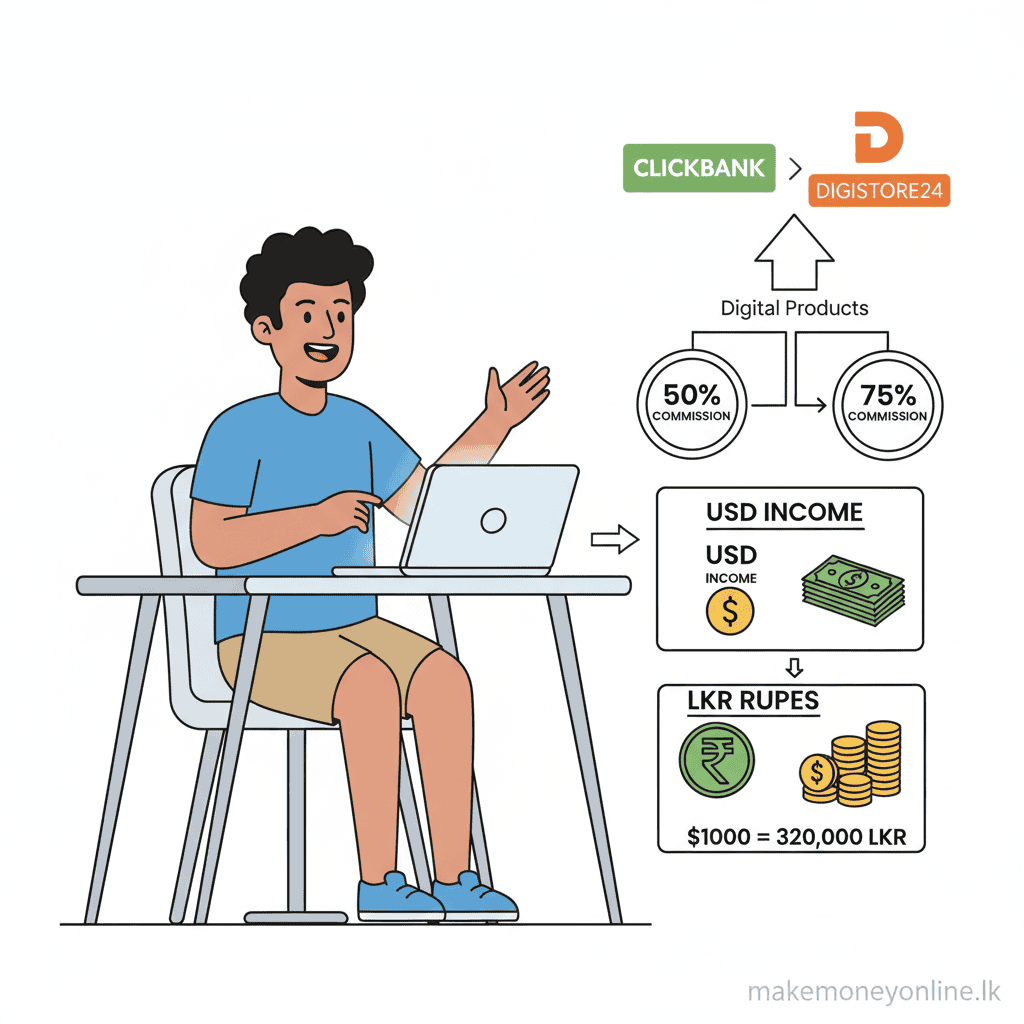
Promoting digital products means you become an affiliate for a product creator or marketplace and earn a commission each time someone buys through your unique referral link. The products are digital: online courses, ebooks, software subscriptions, membership sites, templates, and coaching programs.
The fundamental difference from physical product affiliate marketing is the commission rate. Digital products have no manufacturing or shipping cost, so creators can pay affiliates 30% to 75% of the sale price. A physical product on Amazon Associates might pay 3% to 8%. A digital course might pay 50%.
The mechanics are straightforward:
- You sign up as an affiliate on a marketplace (ClickBank, Digistore24, JVZoo, etc.)
- You select a product to promote
- You get a unique affiliate link
- You share that link through content (blog, YouTube, social media, email list, or ads)
- When someone clicks your link and buys, you earn a commission
- The marketplace tracks the sale and credits your account
The traffic source is where most of the work is. Affiliates who build a blog, YouTube channel, or email list around a specific niche generate free, compounding traffic. Affiliates who run paid ads require ad budget but can see faster results.
How Much Can You Earn Promoting Digital Products in Sri Lanka?
Sri Lankan affiliates promoting digital products typically earn LKR 15,000 to LKR 50,000 per month in their first six to twelve months when using content-based traffic (blog or YouTube). Affiliates with established content platforms or paid advertising skills earn LKR 60,000 to LKR 200,000 per month. Full-time affiliates with large audiences or optimized ad campaigns earn LKR 200,000 to LKR 600,000 per month.
Commission Rate Comparison
| Product Type | Average Commission Rate | Sale Price Range | Earnings Per Sale |
|---|---|---|---|
| Online courses | 30% to 50% | $27 to $497 | $8 to $248 |
| Software/SaaS | 20% to 40% recurring | $20 to $200/month | $4 to $80/month recurring |
| Ebooks | 50% to 75% | $7 to $47 | $3.50 to $35 |
| Coaching programs | 20% to 40% | $500 to $5,000 | $100 to $2,000 |
| Membership sites | 30% to 50% recurring | $27 to $97/month | $8 to $48/month recurring |
Recurring commissions from SaaS and membership products are particularly valuable because one referral earns monthly income for as long as the customer stays subscribed.
How Does Promoting Digital Products Work?
Step 1: Choose a Niche
Successful digital product affiliates pick one niche and build authority within it. Broad promotion of unrelated products across multiple niches rarely converts well.
Good affiliate niches for Sri Lankan promoters:
- Online education and courses: High demand from Sri Lankan and international students. Commission rates are strong on platforms like ClickBank and Digistore24.
- Digital marketing tools: Software and training products for marketers. Recurring commissions are common.
- Health and wellness: Weight loss, fitness, nutrition programs. ClickBank is particularly strong in this category.
- Personal finance: Budgeting apps, investment tools, financial education products.
- Make money online: Online business and income tools. Large audience of Sri Lankan buyers interested in this niche.
Step 2: Join Affiliate Networks
The major digital product affiliate networks that accept Sri Lankan affiliates:
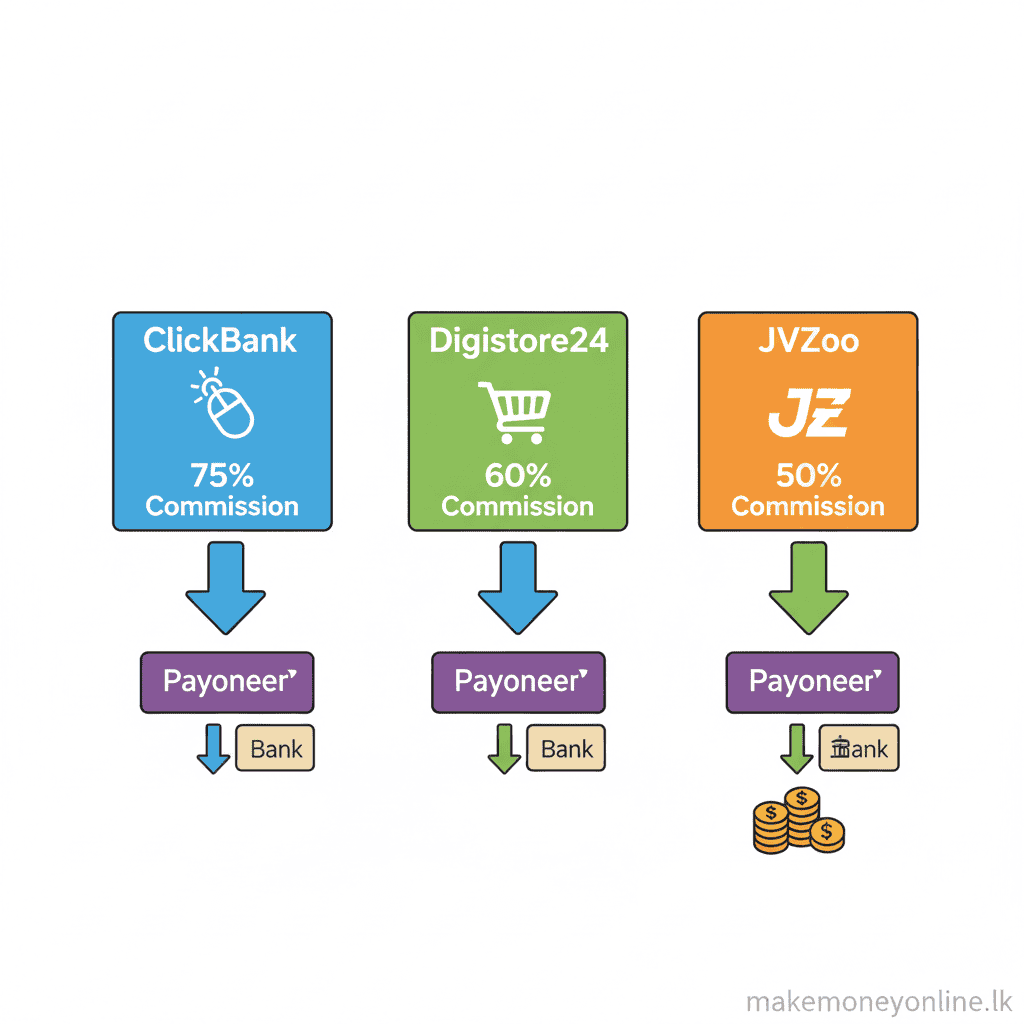
ClickBank (clickbank.com): The largest marketplace for digital product affiliates. Accepts Sri Lankan users. Pays via check, wire transfer, or Payoneer. Thousands of products across every niche. Commission rates average 50%.
Digistore24 (digistore24.com): European-based marketplace with strong digital products. Accepts Sri Lankan affiliates. Pays via PayPal, bank transfer, or Payoneer. Commission rates 25% to 70%.
JVZoo (jvzoo.com): Marketing-focused products and courses. Accepts Sri Lankan affiliates. Pays via PayPal primarily, with some products paying via Payoneer. Check individual product payment methods before promoting.
Impact (impact.com): Enterprise-level affiliate network with major brand products including software companies. Application required. Typically requires an established content platform.
Step 3: Choose Products to Promote
Not every product on ClickBank or Digistore24 is worth promoting. Evaluate products on:
- Gravity score (ClickBank): Indicates how many affiliates made a sale in the past 12 weeks. High gravity (50+) means the product converts but also has competition. Gravity of 10 to 40 is a good starting range.
- Commission percentage: Look for 40% or higher for strong margins
- Sales page quality: A well-designed sales page with video and clear copy converts better
- Product reviews: Search for honest reviews of the product before promoting it. Promoting low-quality products damages your audience’s trust.
- Refund rate: ClickBank shows refund rates for products. Avoid products with refund rates above 15%.
Step 4: Create Content That Sends Traffic
Most successful affiliates build content that ranks in Google search or YouTube for keywords related to the product or niche. This content educates potential buyers and includes affiliate links naturally.
Common content approaches:
- Review articles: “Product X Review: Is It Worth It?” A detailed, honest review that ranks for “[product name] review” searches
- Comparison articles: “Product X vs Product Y: Which Is Better for Beginners?” Targets buyers in decision stage
- How-to articles: “How to Lose Weight Without Going to the Gym” naturally promotes a relevant fitness program
- YouTube reviews: Video reviews with affiliate links in the description. Can rank both on YouTube and Google.
Step 5: Collect and Track Commissions
Log into your affiliate network dashboard daily to track clicks, conversions, and earnings. Most networks show these in real time. Analyze which content or ad campaigns generate the most conversions and scale those.
What Skills Do You Need?
Content creation or paid advertising: You need a way to send traffic to your affiliate links. Either content (writing or video) or paid ads (Facebook, Google) drives this. Content is slow but free. Paid ads are fast but costly.
Basic SEO knowledge: If you choose content marketing, understanding keyword research and on-page SEO determines whether your content gets found on Google. Free courses at ahrefs.com/blog cover this well.
Copywriting basics: The language you use to describe a product and encourage clicks affects your conversion rate significantly. Learn the fundamentals from Copyblogger (copyblogger.com, free).
Analytical thinking: Reading conversion data and making decisions based on what the numbers show is essential. Which traffic sources convert? Which products earn more per click? This data guides where to focus effort.
Patience for content building: A blog or YouTube channel takes six to twelve months to generate significant organic traffic. Affiliates who quit before this time often miss the compound growth that happens after consistent content publication.
How to Get Started Promoting Digital Products in Sri Lanka
Step 1: Create a ClickBank account. Go to clickbank.com and sign up as an affiliate. Sri Lanka is an accepted country. No approval is needed to join the platform. Browse the marketplace to explore product categories.
Step 2: Create a Digistore24 account. Go to digistore24.com and sign up. European-based with strong software and course products. Some products pay better on Digistore24 than ClickBank.
Step 3: Set up your Payoneer account. Both ClickBank and Digistore24 pay via Payoneer for non-US affiliates. Payoneer is the most reliable payment method for Sri Lanka. Set up your Payoneer account at payoneer.com and link it as your payout method.
Step 4: Choose your traffic method. If you have writing skills, start a blog in your chosen niche on WordPress.com (free) or a self-hosted site. If you prefer video, start a YouTube channel. If you have an advertising budget (LKR 30,000 or more per month), you can test paid ads directly.
Step 5: Create your first piece of content. Write a detailed, honest review of a product in your niche. Include your genuine assessment, who the product is for, what it costs, what you like and dislike about it, and your conclusion. Insert your affiliate link naturally in the review. Publish and optimize the article for the keyword “[product name] review.”
Step 6: Build your content library. Publish one to two pieces of content per week consistently. Over 12 months, a 50 to 100 article blog in a specific niche will generate consistent organic traffic if well-optimized.
How to Learn Digital Product Affiliate Marketing
Free resources:
- Authority Hacker (authorityhacker.com): Detailed free guides and podcast on building affiliate websites. One of the most trusted free resources in this space.
- Niche Pursuits (nichepursuits.com): Spencer Haws’ site covers affiliate niche sites with real income case studies. Free.
- Ahrefs Blog (ahrefs.com/blog): SEO guides for driving organic traffic to affiliate content. Free.
- ClickBank University (clckbank.com): Free training resources from ClickBank on affiliate marketing within their platform.
Paid learning:
- Authority Hacker Pro: USD 997 to USD 2,997 (LKR 304,085 to LKR 914,355). Comprehensive but expensive. Only worth it if you are serious about building a full-time affiliate business.
- Udemy affiliate marketing courses: USD 15 to USD 30 (LKR 4,575 to LKR 9,150) during sales. Good for foundational concepts.
Pros of Promoting Digital Products
High commission rates. Earning 40% to 75% per sale from digital products is far higher than physical product affiliate programs. The economics make content-based affiliate marketing viable even with moderate traffic.
Passive income potential. A well-written review article can generate affiliate commissions for years after publication. Once the content ranks in Google, it earns without further daily work.
No product creation required. You focus entirely on promotion and audience building. The product creator handles delivery, customer service, and updates.
Recurring commissions available. SaaS and membership products pay recurring monthly commissions for as long as the customer you referred remains subscribed. One referral can earn LKR 3,000 to LKR 10,000 per month indefinitely.
Low startup cost. A blog on free platforms (Medium, WordPress.com) and free affiliate accounts costs zero. Paid advertising is optional, not required.
USD earnings. All major affiliate platforms pay in USD. At current rates, $200 per month is LKR 61,000, a meaningful income in Sri Lanka.
Cons of Promoting Digital Products
Traffic takes time to build. Organic traffic from a new blog or YouTube channel takes six to twelve months to reach meaningful levels. Income in the first three months is typically very low.
Commission structures can change. Product owners can reduce commission rates, end affiliate programs, or remove products at any time. Build your audience around your niche, not around a single product.
High-quality products are needed for trust. Promoting low-quality products damages your audience’s trust and increases refund rates, which some platforms hold against you. Always review products before promoting.
Paid advertising requires testing budget. Affiliates who rely on paid ads to drive traffic need LKR 30,000 to LKR 100,000 per month in testing budget before finding a profitable combination of product and audience. Without this budget, paid advertising is not viable.
Saturated niches. Popular ClickBank niches like weight loss, make money online, and dating have enormous competition. Finding lower-competition sub-niches within these categories is necessary for new affiliates.
Best Platforms for Promoting Digital Products
ClickBank
ClickBank is the largest digital product affiliate marketplace globally, with products in every major niche.
- Accepts Sri Lankan affiliates: Yes
- Commission rates: Average 50% across the marketplace
- Payment for Sri Lanka: Payoneer, wire transfer, or check. Select Payoneer in your account settings.
- Minimum payout: $10 for Payoneer, $100 for wire transfer
- Payment schedule: Weekly or biweekly depending on your account tier
Digistore24
Digistore24 is European-based with high-quality software and business training products.
- Accepts Sri Lankan affiliates: Yes
- Commission rates: 25% to 70%
- Payment for Sri Lanka: PayPal or bank transfer. Confirm Payoneer availability at sign-up.
- Minimum payout: EUR 50
JVZoo
JVZoo specializes in marketing-related digital products: software, courses, and tools for internet marketers.
- Accepts Sri Lankan affiliates: Yes (standard account)
- Commission rates: Varies by product, typically 40% to 75%
- Payment for Sri Lanka: PayPal primarily. Some products support Payoneer. Check per-product payment options.
- Note: JVZoo requires seller approval for some products before you can promote them as a new affiliate.
ShareASale
ShareASale includes a mix of digital and physical product programs. Many software companies have affiliate programs through ShareASale.
- Accepts Sri Lankan affiliates: Yes
- Payment for Sri Lanka: Check or Payoneer. Verify current Payoneer availability.
- Best for: Software and SaaS affiliate programs
Free Tools for Promoting Digital Products
Google Keyword Planner (free): Research which keyword terms people search for related to products in your niche. Helps identify what content to create.
ClickBank Marketplace search (free within ClickBank): Browse products by category, filter by gravity score and commission rate. Use the analytics to identify products with proven conversion.
Google Search Console (free): Track which of your blog posts are showing up in Google searches and which keywords bring traffic. Essential for optimizing affiliate content.
Hemingway Editor (free, hemingwayapp.com): Check readability of review articles. Clear, easy-to-read content converts better.
Canva (free plan): Create social media posts, Pinterest graphics, and blog header images to drive traffic to your affiliate content.
Paid Tools for Promoting Digital Products
Ahrefs (from USD 129 per month or LKR 39,345): Comprehensive keyword research and competitor analysis for building affiliate content. Expensive but the most complete tool. Only justified at intermediate or advanced level when earning consistently.
Surfer SEO (from USD 89 per month or LKR 27,145): On-page SEO optimizer for affiliate review articles. Shows exactly what to include in your content to rank competitively. Useful for affiliates producing multiple articles per month.
ConvertKit (free up to 10,000 subscribers, then USD 29 per month or LKR 8,845): Email marketing for building a subscriber list from your blog visitors. Email lists allow you to promote new affiliate products to an existing warm audience. Highly recommended for serious affiliates.
Scam Alerts: Digital Product Affiliate Red Flags
Affiliate Programs Requiring Upfront Payment to Join
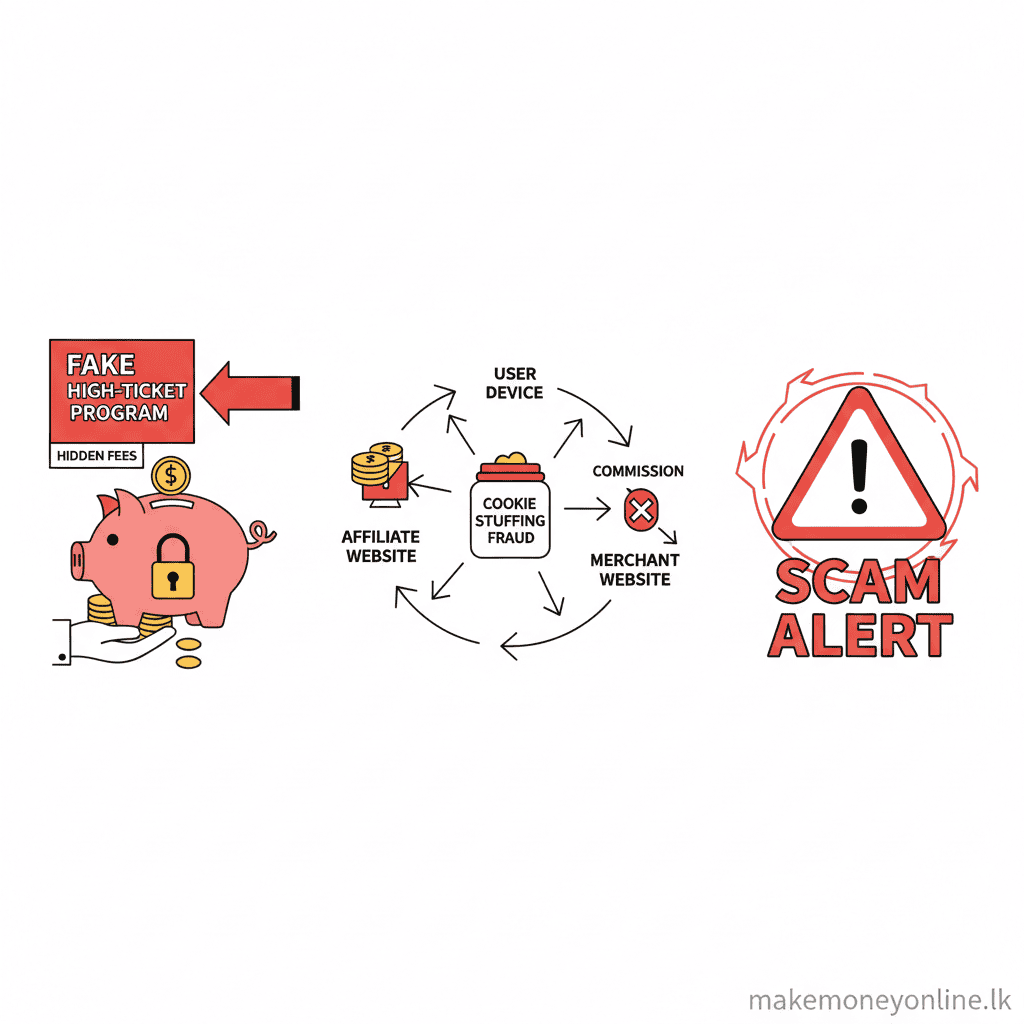
Legitimate affiliate programs are free to join. ClickBank, Digistore24, ShareASale, Impact, and all major networks have zero joining fee. Any program that charges you a “registration fee” or “affiliate starter kit” to access their affiliate links is not a legitimate affiliate program. It is a multi-level structure or scam.
MLM Programs Disguised as Affiliate Programs
Some multi-level marketing schemes disguise themselves as digital product affiliate programs. The red flags are:
- Earning money primarily by recruiting other affiliates rather than by promoting the actual product
- Required to purchase the product yourself to become an affiliate
- Bonuses structured around team size rather than product sales
Legitimate affiliate marketing means you earn commissions from product sales to customers. If the primary earning mechanism is recruiting, it is MLM.
Products With False Income Claims
Some products on ClickBank and similar networks make exaggerated income claims on their sales pages: “Earn $500 per day in your first week.” Promoting these products to your audience puts your credibility at risk. When buyers do not achieve the promised results, they request refunds and leave negative reviews. High refund rates (above 15%) on a product are a signal that the sales page overpromises.
Check ClickBank’s “gravity” and “refund rate” metrics before promoting any product.
Fake Affiliate Managers Asking for Personal Details
Scammers sometimes contact affiliates pretending to be product owners or affiliate managers, offering exclusive high-commission deals. They ask you to click outside the platform’s tracking system or provide personal financial details directly.
All legitimate commission tracking happens within the affiliate network platform. Do not click modified tracking links or share banking details outside the official network.
Commission Theft via Cookie Stuffing
Some websites employ “cookie stuffing” techniques that overwrite your affiliate tracking cookies with theirs on a buyer’s browser, stealing your commission on sales you sourced. This typically happens when you use browser toolbars or third-party tracking services from unknown sources. Stick to official affiliate network tracking links and avoid adding third-party marketing scripts to your website from unverified sources.
Final Verdict: Is Promoting Digital Products Worth It for Sri Lankans?
Promoting digital products is one of the highest-potential income methods available to Sri Lankans who are willing to invest in building content or advertising skills. The commission rates are exceptional compared to physical product affiliate programs, the income is genuinely scalable, and recurring commissions from SaaS and membership products create compounding passive income over time.
The honest challenge: this method requires patience for content-based approaches, or real advertising budget for paid traffic. The first three to six months of a new affiliate blog generate minimal income. Most people who try this method and fail do so because they give up before the compound growth phase.
This method suits you well if:
- You enjoy writing, researching, or creating video content
- You can commit to publishing consistent content for at least six months before expecting meaningful income
- You have interest in a specific niche you can build authority in
- You understand basic SEO or are willing to learn it
This method may not suit you if:
- You need immediate income (look at freelance writing or data entry jobs for faster returns)
- You want income without creating any content or running ads
- You dislike the idea of publishing regular content over a long period
For those interested in the related approach of promoting online courses specifically, see the guide on promoting courses in Sri Lanka. For those who want to combine their own content creation with affiliate income, see the guide on blogging in Sri Lanka.