Podcasting rewards patience more than almost any other income method in this guide. The Sri Lankan podcasters earning consistent money did not monetize in month one. They built an audience first, then the income followed from multiple directions: sponsorships, Patreon supporters, digital product sales, and consulting clients who found them through their show.
What makes podcasting an unusually good long-term play for Sri Lankan creators is the same thing that makes it slow to monetize: a real audience that trusts your voice is an asset worth far more than traffic alone. Listeners who subscribe to a podcast episode regularly and return week after week are a more engaged audience than website visitors. Sponsors and advertisers pay a premium for that relationship.
This guide covers how podcasting income actually works, what equipment you need, which monetization methods are viable in Sri Lanka, and the honest timeline from launch to meaningful income.
What Is Podcasting as an Income Method?
Podcasting means creating audio (or video) content distributed as episodes through podcast platforms like Spotify, Apple Podcasts, and Google Podcasts. Listeners subscribe, and new episodes are delivered automatically.
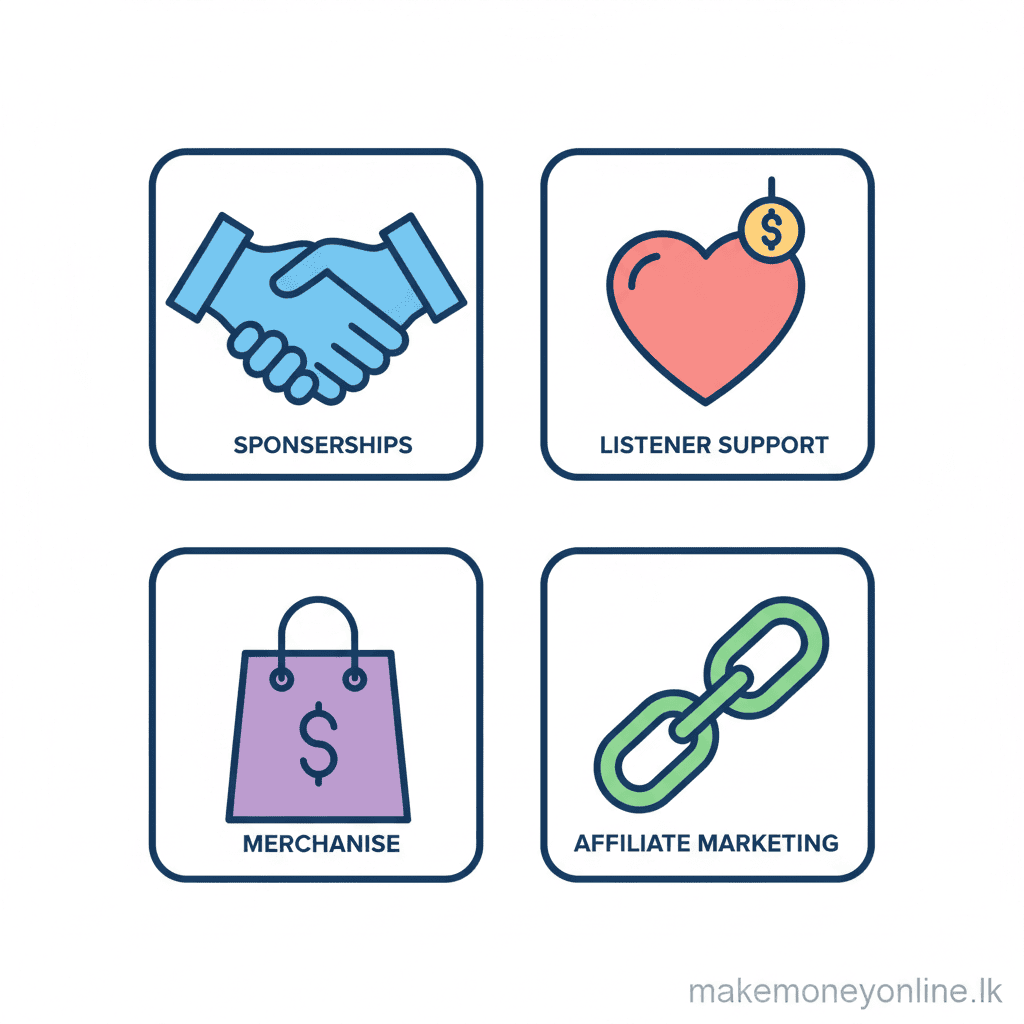
Income from podcasting comes from multiple sources rather than a single revenue stream:
Sponsorships and advertising: Brands pay to have their product or service mentioned in your episodes. Rates are based on your download count and audience size. A podcast with 1,000 downloads per episode can earn $20 to $50 per 1,000 downloads (CPM rate). A podcast with 10,000 downloads per episode earns $200 to $500 per episode from a single mid-roll sponsor mention.
Listener support (Patreon/Buy Me a Coffee): Engaged listeners pay a monthly subscription (typically $3 to $10 per month) for bonus content, early access, or community access. 100 paying Patreon supporters at $5 per month = $500 per month (LKR 152,500).
Digital product sales: Many podcasters sell courses, e-books, templates, or consulting services to their audience. An audience that trusts your expertise in a specific niche converts to product buyers at significantly higher rates than cold website traffic.
Affiliate marketing: Recommending relevant products or services with your affiliate link. Per-episode income from affiliate recommendations compounds as back-catalogue episodes continue generating downloads.
Premium content/membership: Offering ad-free episodes, extended interviews, or exclusive content behind a paywall on platforms like Supercast or Patreon.
How Much Can You Earn from Podcasting in Sri Lanka?
Podcast income scales directly with your audience size and the trust your listeners have in your recommendations.
Podcasting Income Benchmarks
| Monthly Downloads | Sponsor CPM Income | Patreon Potential (2% conversion) | LKR Equivalent (Combined) |
|---|---|---|---|
| 1,000 | $20 to $50 | $30 to $100 | LKR 15,250 to LKR 45,750 |
| 5,000 | $100 to $250 | $150 to $500 | LKR 76,250 to LKR 228,750 |
| 10,000 | $200 to $500 | $300 to $1,000 | LKR 152,500 to LKR 457,500 |
| 50,000 | $1,000 to $2,500 | $1,500 to $5,000 | LKR 762,500 to LKR 2,287,500 |
Exchange rate: 1 USD = approximately 305 LKR.
Reaching 1,000 monthly downloads in Sri Lanka is achievable within 6 to 12 months of consistent weekly publishing in a niche with genuine audience demand. Reaching 10,000 monthly downloads typically requires 18 to 36 months of consistent growth. These are realistic ranges, not guarantees.
How Does Podcast Monetization Work?
Step 1: Build an audience first. Sponsorships only become viable above 1,000 downloads per episode for niche B2B topics and 5,000+ downloads for general consumer topics. Patreon works at any audience size if your listeners are highly engaged.
Step 2: Set up a Patreon page (patreon.com) or Buy Me a Coffee page (buymeacoffee.com) from episode 1. Both platforms accept Sri Lankan creators. Sri Lankan creators receive payments via Payoneer (Patreon) or bank transfer (Buy Me a Coffee’s international options).
Step 3: Apply for sponsorships once you reach a consistent download threshold. Approach brands that already advertise on podcasts in your niche. Alternatively, join podcast ad networks like Podcorn or AdvertiseCast, which connect sponsors with smaller podcasts (1,000+ downloads).
Step 4: Add affiliate links in episode show notes. Recommend tools and products you genuinely use. Each time a listener clicks and purchases, you earn a commission.
Step 5: Launch a digital product once your audience trusts you. Your podcast listeners are your warmest potential customers for a course, e-book, or consulting offer in your niche.
Step 6: Receive payment. Patreon pays via Payoneer (works for Sri Lanka). Sponsor payments arrive via international bank transfer or Payoneer. Affiliate commissions via platform-specific payment (most support Payoneer). Transfer to Commercial Bank, Sampath, BOC, or HNB.
What Equipment Do You Need for Podcasting?
Minimum viable setup (LKR 8,000 to LKR 20,000):
A USB condenser microphone is the single most important investment. The Audio-Technica ATR2100x (approximately LKR 15,000 to LKR 20,000) or a Samson Q2U (approximately LKR 10,000 to LKR 15,000) produce professional-quality audio sufficient for commercial podcast production. Both are available from electronics importers in Colombo or through Daraz.lk.
Free recording software: Audacity (Windows/Mac) is completely free and adequate for recording, editing, and exporting podcast episodes. GarageBand (Mac) is the alternative for Apple users.
Free hosting: Spotify for Podcasters (formerly Anchor) is completely free. It hosts your audio files, distributes your podcast to Spotify, Apple Podcasts, Google Podcasts, and other platforms simultaneously. Adequate for most Sri Lankan podcasters.
Paid hosting (optional, for growth): Buzzsprout (from $12/month or LKR 3,660) and Podbean (from $9/month or LKR 2,745) provide better analytics and monetization tools once you are earning and need more data.
What you do NOT need to start:
- A studio or soundproofed room (a room with carpets, curtains, and soft furnishings reduces echo adequately)
- A mixer or audio interface (USB microphones bypass this requirement)
- Professional editing software (Audacity handles all editing needs)
What Skills Do You Need for Podcasting?
Clear, engaging verbal communication: The ability to explain ideas, tell stories, or conduct interviews in a way that keeps listeners engaged for 20 to 60 minutes per episode. This is the core skill. It improves with practice.
Audio editing basics: Trimming silence, removing filler words, adjusting volume levels, and adding intro/outro music. All learnable in one to two days using Audacity tutorials.
Content planning and consistency: Deciding on your format (solo, interview, co-host), episode topics, and publishing schedule, then maintaining that schedule week after week. Consistency matters more than perfection.
Niche knowledge: Podcasts that attract sponsors and loyal audiences are typically focused on a specific topic where the host has genuine expertise or genuine curiosity. A Sri Lankan podcast about personal finance, technology, mental health, career development, or local entrepreneurship has a clearly defined potential audience.
Basic marketing: Promoting episodes through social media, writing show notes for SEO, and growing your subscriber base through cross-promotion with other podcasters.
How to Get Started with Podcasting in Sri Lanka
Step 1: Choose your niche and format. A solo educational format (you teach something each episode) is the simplest to start. Interview formats build audience faster through guest promotion but require coordination. Pick a topic you can discuss for 100 episodes without running out of material.
Step 2: Buy a USB microphone. Audio quality is the single most important technical factor for listener retention. A decent microphone makes the difference between listeners staying and leaving in the first two minutes.
Step 3: Record your first three episodes before publishing. Having three episodes ready before launch allows new listeners to binge and build the habit of listening to your show.
Step 4: Create a Spotify for Podcasters account (free). Upload your episodes, fill in your podcast description with relevant keywords, and publish. Spotify for Podcasters distributes to all major platforms automatically.
Step 5: Set up Patreon or Buy Me a Coffee from episode 1. Even if you earn nothing initially, having a support option available means your earliest, most engaged listeners can support you from the start.
Step 6: Publish consistently for 12 months. Weekly or bi-weekly publishing for a year builds the backlog, SEO presence, and audience trust required for meaningful monetization. Most podcasts that monetize have been running for at least a year.
How to Learn Podcasting
Free resources:
- Spotify for Podcasters help center: Official guides on setup, distribution, and growing a podcast on Spotify.
- Buzzsprout blog (buzzsprout.com/blog): The most comprehensive free resource for podcast production, marketing, and monetization. Covers everything from microphone setup to getting sponsors.
- YouTube: Channels like Pat Flynn’s Smart Passive Income and Buzzsprout’s YouTube channel cover podcast launch, growth, and monetization in detail.
Paid learning:
- Podcraft courses (podcraft.com, from USD 15 or LKR 4,575): Practical courses on podcast production and growing an audience.
- Udemy podcasting courses (USD 15 to USD 30 or LKR 4,575 to LKR 9,150 on sale): Covers recording, editing, distribution, and monetization from beginner to intermediate level.
Pros of Podcasting
Deep audience trust creates high-value monetization. Podcast listeners spend 20 to 60 minutes with a host per episode, repeatedly. This creates a trust relationship that converts to sponsorship value, product sales, and consulting clients at rates that blog readers and social media followers cannot match.
Compounding back catalogue. Every episode you publish continues generating downloads, sponsorship impressions, and affiliate clicks indefinitely. A 50-episode back catalogue earns more per month than a 10-episode back catalogue, even if you stop publishing.
Growing medium with low local competition. Sri Lankan English-language podcasts on most topics have very little competition. A first-mover in a niche like Sri Lankan personal finance or technology entrepreneurship has significant advantages.
Multiple income streams from one asset. Sponsorships, Patreon, affiliate commissions, and product sales all flow from the same audience. Diversification is built into the medium.
Platform distribution handles discovery. Spotify and Apple Podcasts have built-in discovery mechanisms. A well-titled, well-described podcast in a popular category gets discovered without paid promotion.
Cons of Podcasting
Long time to meaningful income. Reaching the audience size required for sponsorships (5,000+ monthly downloads for most niches) typically takes 18 to 36 months of consistent publishing. Patreon and affiliate income start earlier but remain small until the audience grows.
Requires consistent long-term commitment. A podcast that publishes 20 episodes then stops loses its audience and its search ranking. The medium rewards sustained consistency over bursts of effort.
Audio quality expectations are high. Poor audio (echo, background noise, low volume) causes listeners to abandon episodes regardless of content quality. The microphone investment is mandatory, not optional.
Monetization is indirect. Unlike freelancing, where you bill for work delivered, podcast income depends on building and maintaining an audience first. Income is not guaranteed and not immediate.
Time investment per episode is significant. Recording, editing, writing show notes, creating episode artwork, and promoting each episode takes 3 to 6 hours per episode for most solo podcasters.

Scam Alerts: Podcasting Red Flags
Paid Podcast Distribution Services
Spotify for Podcasters (formerly Anchor) distributes your podcast to every major platform for free. Any service charging an upfront fee to “get your podcast on Spotify and Apple Podcasts” is charging for something that is entirely free. The only legitimate paid hosting costs are optional premium hosting platforms (Buzzsprout, Podbean) chosen for their analytics or monetization features, not for basic distribution.
Fake Sponsorship Offers to New Podcasts
Scammers send emails to new podcasters (sometimes scraped from podcast directories) claiming to represent brands willing to pay $500 to $2,000 for a sponsored mention. They request your bank details or Payoneer information to “process payment.” The payment never arrives. Real sponsors contact podcasts through legitimate podcast ad networks (Podcorn, AdvertiseCast) or through detailed outreach that references your specific content. Any sponsorship offer arriving via email with no reference to your specific show is suspicious.
“Podcast Promotion” Services Selling Fake Downloads
Services offering to increase your download count for a fee are selling fake traffic. Inflated download numbers do not represent real listeners. They do not convert to sponsor revenue, Patreon support, or product sales. Platform algorithms detect and filter fake downloads. Legitimate audience growth comes from content quality, SEO, and cross-promotion.
Exclusive “Podcast Network” Membership Fees
Legitimate podcast networks (Wondery, Spotify’s podcast network, Acast) do not charge podcasters to join. They take a revenue share from sponsorships they place. Any “podcast network” requiring an upfront membership fee to gain access to sponsors or a premium audience is not a legitimate network.
Final Verdict: Is Podcasting Worth It for Sri Lankans?
Podcasting is a legitimate long-term income method for Sri Lankans with a specific area of expertise or a compelling perspective, the patience to build an audience over 12 to 24 months, and the discipline to publish consistently.
It is not a quick income method. The first six months will likely generate no meaningful revenue. The podcasters who reach LKR 50,000 to LKR 200,000 per month are those who treated the first year as audience-building, not income-generating.
This method suits you well if:
- You have genuine knowledge or perspective in a niche with an audience
- You are comfortable with audio recording and verbal communication
- You are willing to publish consistently for 12 to 24 months before expecting significant income
- You want to build a platform that supports multiple income streams simultaneously
This method may not suit you if:
- You need income within 90 days
- You are not comfortable with verbal communication or audio production
- You want a single-transaction income model rather than an audience-building investment
For related content creation income methods, see the guide on blogging in Sri Lanka and the overview of creating online courses as complementary platforms for monetizing expertise.