Every small business needs an app. Most cannot afford to hire a full-time developer. That gap is where Sri Lankan mobile app developers earn their most consistent income, from clients who need a working app delivered on budget and on time, and who do not care whether the developer is in Colombo or California.
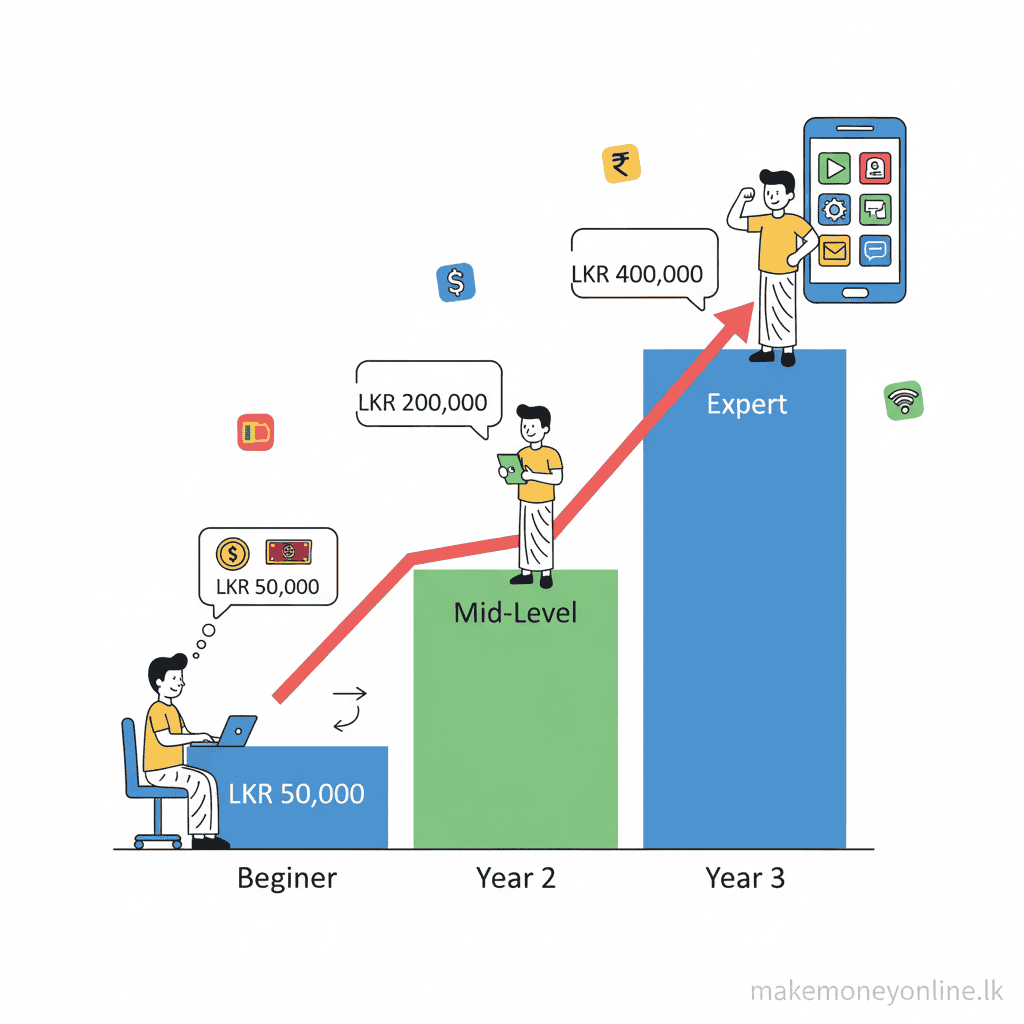
Mobile app development is among the highest-paid technical freelancing skills available to Sri Lankans. A developer who can build a functional Android or iOS app, communicate clearly with clients, and deliver projects reliably can earn LKR 150,000 to LKR 400,000 per month from two or three ongoing client relationships.
This guide covers the realistic income, the most practical paths to becoming a marketable app developer in Sri Lanka, which platforms and clients pay best, and what to watch out for.
What Is Mobile App Development?
Mobile app development means building applications that run on smartphones and tablets. The two primary platforms are Android (used by approximately 72% of Sri Lankan smartphone users) and iOS (iPhone and iPad).
Freelance mobile app developers build apps for clients who have an idea but not the technical skill to execute it. Common client types include:
Small and medium businesses: Restaurants wanting a food ordering app, salons wanting appointment booking, retailers wanting a loyalty app.
Startups: Early-stage companies needing an MVP (Minimum Viable Product) app to demonstrate their concept to investors.
Enterprises: Larger organizations needing internal apps for field staff, inventory management, or customer service.
International clients on Upwork and Toptal: The highest-paying segment. Foreign companies outsource app development to lower-cost countries. Sri Lankan developers with strong portfolios compete effectively in this market.
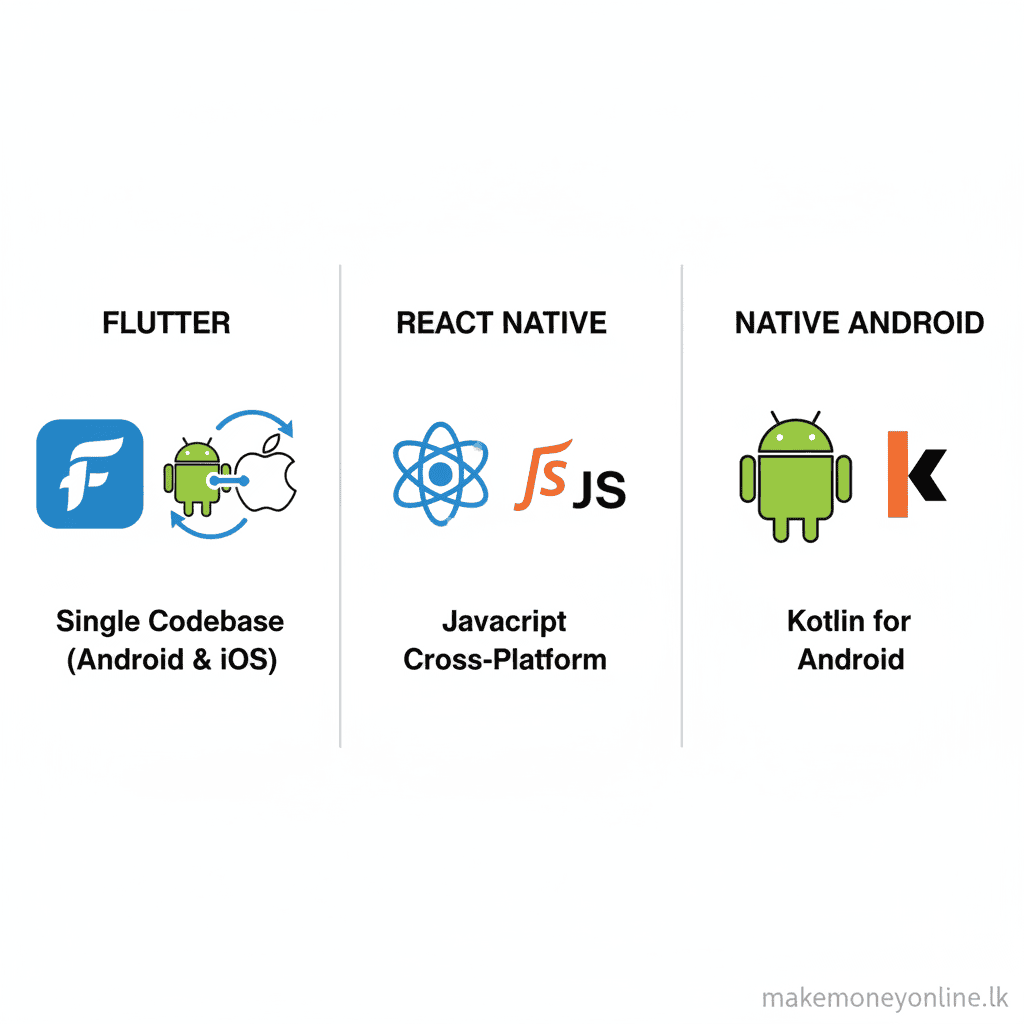
The most important skill distinction is between native development (writing separate code for Android using Kotlin/Java and for iOS using Swift) and cross-platform development (writing one codebase that runs on both platforms using Flutter or React Native). Cross-platform is the dominant choice for most freelance work due to cost efficiency.
How Much Can You Earn from Mobile App Development in Sri Lanka?
Mobile App Development Rate Benchmarks
| Experience Level | Freelance Hourly Rate (USD) | Monthly Income (20hr/week) | LKR Equivalent |
|---|---|---|---|
| Beginner (0–1 year) | $10 to $20 | $800 to $1,600 | LKR 244,000 to 488,000 |
| Intermediate (1–3 years) | $25 to $50 | $2,000 to $4,000 | LKR 610,000 to 1,220,000 |
| Experienced (3+ years) | $50 to $100+ | $4,000 to $8,000+ | LKR 1,220,000 to 2,440,000+ |
Per-project rates are more common than hourly for fixed-scope apps:
| Project Type | Price Range (USD) | LKR Equivalent |
|---|---|---|
| Simple utility app (Android only) | $500 to $1,500 | LKR 152,500 to 457,500 |
| Business app with backend (cross-platform) | $2,000 to $8,000 | LKR 610,000 to 2,440,000 |
| E-commerce app with payment integration | $3,000 to $12,000 | LKR 915,000 to 3,660,000 |
| MVP for startup | $5,000 to $20,000 | LKR 1,525,000 to 6,100,000 |
Exchange rate: 1 USD = approximately 305 LKR.
A Sri Lankan developer delivering two small business apps per month at $800 each earns $1,600 per month (LKR 488,000). One medium-complexity app at $3,000 generates LKR 915,000. These figures are achievable with 2 to 3 years of skill development and portfolio building.
How Does Freelance App Development Work?
Step 1: Client describes what the app needs to do. You scope the work: how many screens, what features, what integrations (payment, login, maps, notifications), and what timeline.
Step 2: You provide a fixed-price quote or an hourly estimate. For most freelance app projects, fixed-price is preferred by clients.
Step 3: You build the app, testing on both real devices and emulators. Milestones-based payment is standard: 30 to 50% upfront, remainder on delivery.
Step 4: You deliver source code and APK (Android) or IPA (iOS). The client tests the app and requests revisions.
Step 5: Client approves and releases final payment. You provide a handover package: documentation, source code, and instructions for uploading to the App Store or Play Store.
Step 6: Payment via Upwork, Toptal, or direct transfer to your Payoneer account, then to Commercial Bank, Sampath, BOC, HNB, or People’s Bank.
What Skills Do You Need for Mobile App Development?
One cross-platform framework: Flutter (Dart language) or React Native (JavaScript) is the practical choice for most freelance work. Flutter has the stronger growth trajectory and is increasingly preferred for new projects. React Native is more established and has a larger existing codebase in enterprise environments.
Backend basics: Most apps need a server-side component (API, database, authentication). Firebase (Google’s backend-as-a-service) covers most needs for small to medium apps without requiring full backend development knowledge. REST API integration and JSON data handling are essential.
UI/UX fundamentals: Understanding how to build intuitive mobile interfaces. Screen layout, navigation patterns, responsive design for different screen sizes.
Version control with Git: All professional development work uses Git for version control. GitHub is standard. Clients expect to receive code in a Git repository.
App Store deployment knowledge: Publishing to Google Play Store and Apple App Store. Each has its own submission process, required assets (icons, screenshots, metadata), and review periods.
Client communication: Scoping projects accurately, setting realistic timelines, managing revision requests, and delivering on commitments. Technical skill alone is not enough, client management distinguishes developers who build long-term businesses from those who constantly chase new clients.
How to Get Started with Mobile App Development in Sri Lanka
Step 1: Choose Flutter as your starting point. Flutter is Google’s cross-platform framework using the Dart language. It has the best documentation, the most active learning community, and is used by major companies (Google, BMW, Alibaba). It builds for Android, iOS, web, and desktop from a single codebase.
Step 2: Complete the official Flutter documentation tutorial. Flutter.dev has a free, comprehensive “getting started” guide that takes you from installation to a functioning app. Complete this before watching any third-party tutorials.
Step 3: Build three portfolio apps over three to four months. Do not apply for client work before you have a portfolio. Build:
- A simple utility app (weather app, calculator, to-do list)
- A multi-screen app with navigation (recipe app, news reader)
- An app with backend integration (Firebase login + database)
Step 4: Create a GitHub profile with your portfolio apps. All professional developers maintain a GitHub profile. Potential clients check GitHub. Clean, commented code in public repositories demonstrates your skill level.
Step 5: Create Upwork and Fiverr profiles. On Upwork, complete your profile with your tech stack, portfolio links, and a clear description of what you build. On Fiverr, create a gig for “Flutter app development” or “Android app development”. Price your first projects competitively to build reviews.
Step 6: Set up Payoneer. Both Upwork and Fiverr pay Sri Lankan developers via Payoneer. Direct clients can pay via Payoneer direct transfer or bank wire.
How to Learn Mobile App Development
Free resources:
- Flutter.dev (official documentation): The most comprehensive and up-to-date learning resource for Flutter. Includes codelabs (step-by-step guided projects) for every skill level.
- The Net Ninja YouTube channel: Free Flutter tutorial series covering basics to advanced features including state management and Firebase integration.
- CS50 (cs50.harvard.edu): Harvard’s free introduction to computer science. Essential foundational knowledge for new developers before specializing in mobile.
Paid learning:
- Udemy Flutter courses (USD 15 to USD 30 or LKR 4,575 to LKR 9,150 during sales): Angela Yu’s “The Complete Flutter Development Bootcamp” is the most highly rated paid Flutter course. Covers building full-featured apps from scratch.
- Zero to Mastery Flutter course (from USD 23 per month or LKR 7,015): Structured curriculum from basics to professional-level development.
Pros of Mobile App Development
Among the highest freelance rates available. Mobile app development is paid at rates that few other digital skills match. Even beginner-level developers earn more per hour than most other freelance categories.
Persistent demand. Every year, millions of new businesses worldwide need apps. The demand for mobile app developers exceeds supply globally, and Sri Lankan developers with strong portfolios compete in this global market effectively.
Cross-platform skills are highly efficient. Learning Flutter once allows you to deliver Android apps, iOS apps, and web apps from a single skill set. Clients pay for all three outputs while you maintain one codebase.
Significant project-based income potential. A single well-scoped app project can earn LKR 600,000 to LKR 2,000,000. One or two projects per month represents very strong income.
Cons of Mobile App Development
Long skill-building phase. Reaching client-ready proficiency in Flutter takes 6 to 12 months of dedicated study and project building. This is a genuine investment before income begins.
Platform policy changes affect clients. Apple and Google regularly update App Store and Play Store policies. Apps that previously functioned may require updates to comply with new requirements. Client maintenance contracts help manage this recurring demand.
Project scope creep. Clients who do not have technical backgrounds frequently expand project scope beyond the original agreement (“can you just add one more feature?”). Clear written scope documents and change request processes protect your time and income.
Support and maintenance expectations. Clients often expect ongoing bug fixes and updates after delivery. Setting clear post-delivery support terms (what is included, what is billable) prevents misunderstandings.
Best Platforms for Mobile App Development Work in Sri Lanka
Upwork
The best platform for landing ongoing mobile development work and long-term client relationships. Corporate clients post app development projects regularly at $25 to $100+ per hour.
- Commission: 20% on first $500 per client, then 10%
- Payment for Sri Lanka: Payoneer or bank transfer
- Best for: Fixed-price app projects, hourly long-term contracts
Toptal
The most selective freelance platform for developers. Acceptance requires passing a rigorous technical screening. Rates are the highest available for freelance developers.
- Commission: Toptal sets the client rate; you receive your agreed rate
- Payment for Sri Lanka: Bank wire transfer
- Best for: Experienced developers with strong portfolios seeking premium rates
Fiverr
Good for smaller, well-defined app projects and for building initial reviews. Lower average project values than Upwork but easier to get first client.
- Commission: 20% flat
- Payment for Sri Lanka: Payoneer
- Best for: Defined-scope smaller apps, building beginner portfolio and reviews
Direct Clients (LinkedIn and referrals)
Established developers increasingly find clients directly through LinkedIn and referrals, eliminating platform commissions entirely.
- Payment: Direct bank transfer or Payoneer
- Best for: Experienced developers with a reputation and referral network
Scam Alerts: App Development Red Flags
Spec Theft
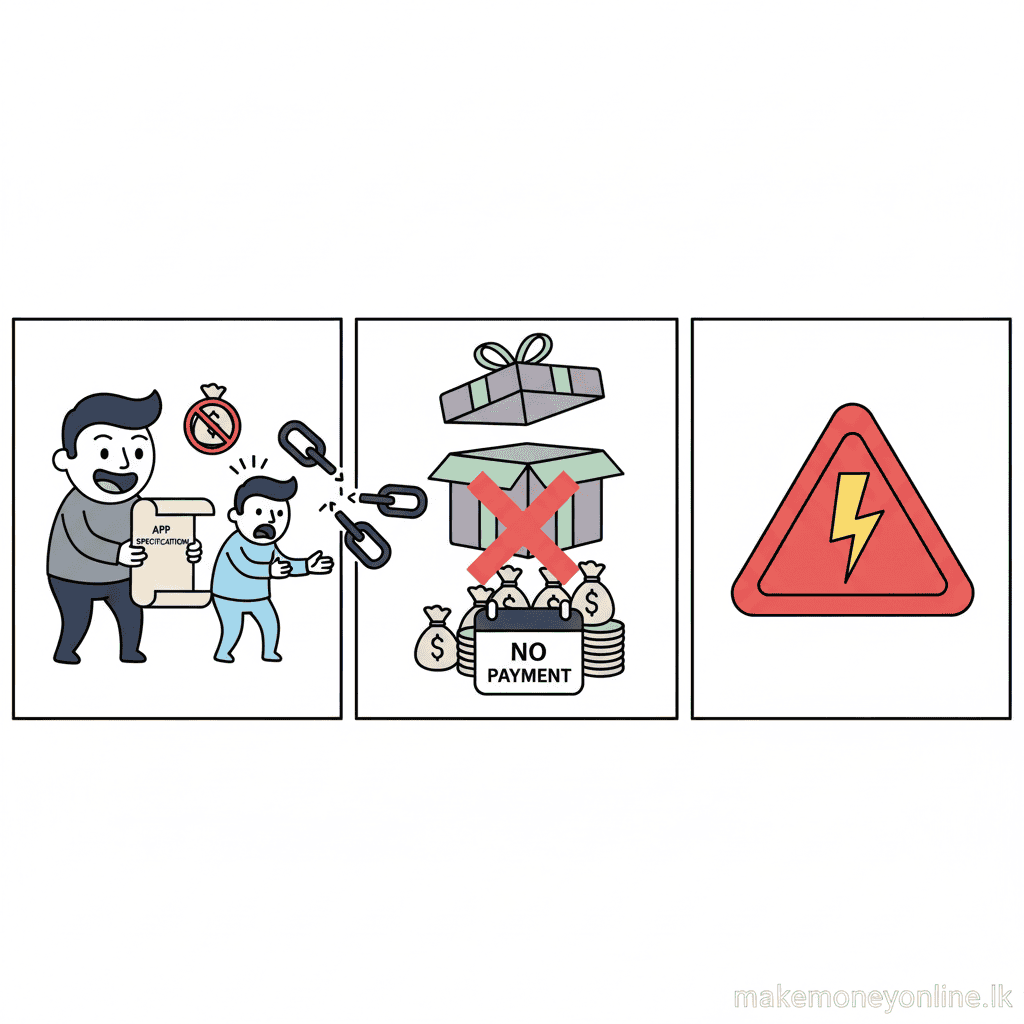
Some “clients” spend hours having you write detailed technical specifications for an app, screen flows, feature lists, database structures, and then disappear after receiving the document. They use the specification to hire a cheaper developer or to build it themselves. Charge for detailed technical specification writing as a separate, paid deliverable. Do not provide comprehensive specifications for free.
Upfront Payment for Tools or Software
Any client who requires you to purchase specific development tools, plugins, or services as a condition of starting the project is running a scam. Professional app development requires only freely available tools (Flutter SDK, Android Studio, VS Code). No client should require you to spend money before you can begin work for them.
Payment on Delivery Only With No Deposit
Legitimate app development contracts include a deposit (30 to 50% upfront) before development begins. A client who refuses any upfront payment and insists on “payment on delivery only” for a multi-month project is either unwilling to commit or planning to dispute payment after receiving the work. Always require a deposit.
Unrealistic Project Complexity for Budget
Clients requesting a “full e-commerce app with payment integration, user accounts, live chat, and admin dashboard” for $200 are either misinformed about development costs or attempting to extract maximum work for minimum pay. Scope projects accurately. If a client’s budget cannot realistically fund the work they are requesting, explain the gap clearly rather than accepting and delivering something incomplete.
Final Verdict: Is Mobile App Development Worth It for Sri Lankans?
Mobile app development is the highest-income potential freelancing skill in this guide for those willing to invest in the skill-building phase. The rates are genuinely competitive with global market standards, the demand is strong and growing, and Sri Lankan developers compete effectively once they have a demonstrated portfolio.
The honest challenge is that becoming client-ready takes 6 to 12 months of dedicated learning. The investment is real. But the income ceiling is among the highest available to Sri Lankan freelancers, and the skills compound, each project makes you faster, and faster developers can handle more projects per month.
This method suits you well if:
- You have or want to develop strong technical and logical problem-solving skills
- You are willing to invest 6 to 12 months in learning Flutter before expecting client income
- You are comfortable with client communication and project management
- You want to build toward LKR 200,000 to LKR 600,000+ per month within 2 to 3 years
This method may not suit you if:
- You need income within 30 to 60 days
- You have no programming background and are unwilling to invest in deep technical learning
- You dislike client communication or project-based work
For related tech income methods, see the guide on web development in Sri Lanka and the overview of UI/UX design for complementary skills that often combine with mobile development in client projects.