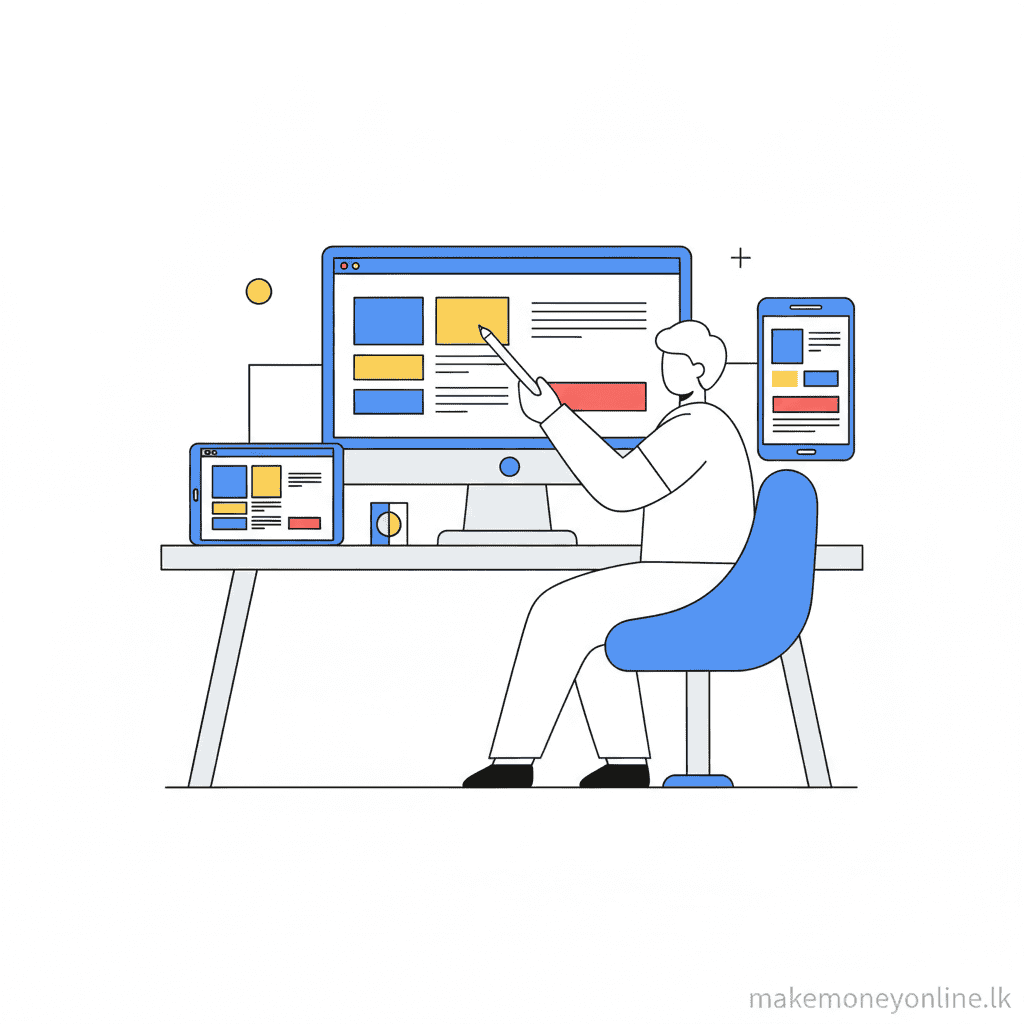
UI/UX design is among the highest-paying freelance skills available to Sri Lankans with the right training and portfolio. The global demand for product designers who can make digital products usable, intuitive, and visually clear has grown consistently as every business builds apps, websites, and digital tools. A competent UI/UX designer commands rates of USD 25 to USD 80 per hour on international platforms, translating to LKR 762,500 to LKR 2,440,000 per month at full-time commitment.
Sri Lanka has a growing technology sector and an increasing number of companies building digital products domestically. Combined with access to international clients through Upwork, Toptal, and direct project work, Sri Lankan UI/UX designers compete effectively in both the domestic and international market. The primary barrier to entry is not talent but portfolio: clients hire UI/UX designers based on demonstrated work, not credentials.
This guide covers what UI/UX design work involves, how income works in practice, what tools you need, how to build a portfolio from zero, and where to find clients at rates that make the skill worth the investment.

What Is UI/UX Design?
UI and UX design are related but distinct disciplines that together cover how digital products look and how they work.
UX (User Experience) design focuses on the overall experience a user has with a product. A UX designer researches user needs, maps out user journeys, creates wireframes (skeletal screen layouts), and designs the information architecture that determines how content and features are organized. The goal of UX design is making products easy and satisfying to use.
UI (User Interface) design focuses on the visual elements users interact with: buttons, icons, typography, color systems, spacing, and the visual design of every screen. A UI designer takes UX wireframes and translates them into polished, pixel-accurate visual designs that developers build from.
In practice, most freelance designers work across both disciplines and are called “product designers” or “UI/UX designers.” Large technology companies may have separate UI and UX specialists, but for freelance clients and smaller companies, one designer typically handles both.
The main deliverables of UI/UX design work:
Wireframes: Low-fidelity skeletal layouts of screens, typically in black and white, showing structure and content placement without visual design. Created in Figma, Sketch, or even paper.
Mockups: High-fidelity screen designs with full visual treatment: colors, typography, images, and final component styling. These look like the finished product.
Prototypes: Interactive, clickable versions of the design that simulate how the product will function. Clients and developers use prototypes to test flows before development begins. Figma’s prototyping feature is the industry standard.
Design systems: A documented library of reusable components (buttons, form fields, navigation patterns, color tokens) that ensures visual consistency across all screens of a product. Essential for larger projects.
User research reports: Documentation of research findings, user interview summaries, and usability testing reports that inform design decisions. More common in larger projects with formal research budgets.
How Much Can You Earn from UI/UX Design?
UI/UX Design Income Benchmarks
| Experience Level | Hourly Rate (USD) | Monthly Income (40 hrs/wk) | LKR Equivalent |
|---|---|---|---|
| Entry-level (0–1 year, portfolio building) | $15 to $30 | $2,400 to $4,800 | LKR 732,000 to LKR 1,464,000 |
| Mid-level (1–3 years, strong portfolio) | $30 to $55 | $4,800 to $8,800 | LKR 1,464,000 to LKR 2,684,000 |
| Senior (3+ years, specialized niche) | $50 to $100+ | $8,000 to $16,000+ | LKR 2,440,000 to LKR 4,880,000+ |
| Project-based (app design, LKR equivalent) | $500 to $3,000/project | Variable | LKR 152,500 to LKR 915,000/project |
Exchange rate: 1 USD = approximately 305 LKR.
UI/UX design income is portfolio and client quality dependent. Sri Lankan designers who have built strong portfolios and secured mid-level clients on Upwork regularly earn LKR 200,000 to LKR 500,000 per month from 2 to 3 ongoing clients. The entry-level phase (building portfolio, acquiring first clients) takes 6 to 12 months of focused work before hitting these rates.
How Does UI/UX Design Work?
Step 1: A client (a startup, a software company, an e-commerce business, or a digital agency) needs a mobile app, web application, or website designed. They post a job on Upwork or approach you directly, outlining their requirements.
Step 2: You conduct a discovery process: understanding the product’s purpose, target users, existing brand guidelines (if any), technical constraints, and project scope. This is done through a client briefing call or written questionnaire.
Step 3: You create wireframes in Figma. For a mobile app, this typically means designing 10 to 30 screen layouts showing the complete user flow. Wireframes are reviewed and approved by the client before moving to visual design.
Step 4: You create high-fidelity mockups based on approved wireframes. This includes the visual design system: color palette, typography, icon style, component library. Each screen is designed with precise spacing, sizing, and interaction states (default, hover, active, disabled).
Step 5: You build a clickable prototype in Figma linking all screens together in the intended user flow. The client and their development team review the prototype and provide feedback.
Step 6: You make revisions based on feedback, then hand off the completed design to developers with a detailed design spec (spacing, color codes, asset exports, component documentation).
Step 7: Invoice the client. Most UI/UX design work is either fixed-price per project (for defined scope) or hourly for ongoing retainer work. Payment via Upwork escrow, PayPal, Wise, or bank transfer.
Step 8: Transfer to your Commercial Bank, Sampath, BOC, HNB, or People’s Bank account.
What Skills Do You Need for UI/UX Design?
Figma proficiency: Figma is the industry-standard design tool for UI/UX work globally. Proficiency in Figma — including components, auto-layout, prototyping, and design handoff features — is a baseline requirement for professional UI/UX design in 2026. Figma has a free tier sufficient for freelance work.
Visual design principles: Understanding typography, color theory, visual hierarchy, spacing, and grid systems is the foundation of strong UI design. These principles separate designs that look professional from those that look amateurish, regardless of tool proficiency.
UX thinking: The ability to approach design problems from the user’s perspective: What is the user trying to accomplish? What is the simplest path to that goal? What confusions or friction points might arise? This mindset is developed through practice, user research exposure, and studying UX case studies.
Wireframing and information architecture: The ability to structure complex information and features into logical, navigable screen flows. This is a planning skill that precedes visual design and determines whether a product is genuinely usable.
Communication and client management: Presenting designs, explaining design decisions, handling feedback professionally, and managing scope creep are communication skills that affect client relationships as much as design quality does. Sri Lankan designers who communicate clearly and professionally retain clients better than those who disappear between deliveries.
Understanding of development constraints: Knowing what is technically feasible and what creates development complexity helps design work that can actually be built. Designers who understand basic development concepts (responsive breakpoints, standard interaction states, asset formats) create more useful handoff documentation.
How to Get Started with UI/UX Design in Sri Lanka
Step 1: Learn Figma through free resources. Figma’s own YouTube channel, Figma Academy, and free courses on YouTube (Juxtopposed, AJ&Smart, Design Course) provide comprehensive Figma skill development. Spend 30 to 60 days learning Figma before anything else.
Step 2: Study UI/UX fundamentals. Google’s UX Design Certificate on Coursera (approximately USD 49 per month) is one of the most accessible structured introductions to UX design. Free alternatives include Nielsen Norman Group’s articles, Interaction Design Foundation, and UX Collective on Medium.
Step 3: Build a portfolio of 3 to 5 case studies. Without a portfolio, no client will hire you. Create portfolio pieces for real or imaginary products: redesign an existing app, design a hypothetical mobile app for a local business, or create a web application concept. Each case study should show your process: problem definition, wireframes, final mockups, and the thinking behind decisions.
Step 4: Create profiles on Behance and Dribbble. These platforms are used by design clients and agencies to discover designers. Upload your case studies. Active presence on Behance and Dribbble contributes to inbound client enquiries over time.
Step 5: Apply for UI/UX jobs on Upwork. Position your Upwork profile specifically for UI/UX design, not general design. List your Figma proficiency, attach portfolio work, and apply to projects actively. Accept lower rates for the first 3 to 5 clients to build reviews, then raise rates.
Step 6: Network with Sri Lankan tech companies. Colombo’s growing tech startup ecosystem (Wavenet, Sysco LABS, 99x, Dialog Axiata’s digital division) hires UI/UX designers both full-time and on project basis. LinkedIn is the primary channel for connecting with these companies. Local professional connections can open project work that pays at local rates but provides excellent portfolio material.
How to Learn UI/UX Design
Free resources:
- Figma YouTube channel (youtube.com/@Figma): Official tutorials covering every aspect of Figma for professional design work. Free and comprehensive.
- Google UX Design Certificate preview (coursera.org): The first week of Google’s UX course is auditable for free. It provides a structured introduction to UX thinking and processes.
- Laws of UX (lawsofux.com): Free reference covering the psychological and design principles behind effective UX decisions. Essential foundational knowledge.
Paid learning:
- Google UX Design Certificate on Coursera (USD 49/month or LKR 14,945/month, typically 6 months): The most recognized structured UX education for self-taught designers. Certificate carries weight with employers and clients.
- Interaction Design Foundation (USD 13/month or LKR 3,965/month): Comprehensive UX and UI design courses with certificates. The most cost-effective structured learning platform for UI/UX design.
Pros of UI/UX Design
Among the highest-paying freelance skills for Sri Lankans. At USD 25 to USD 80 per hour, UI/UX design is at the top end of the freelance income spectrum accessible without a computer science degree. The income potential significantly exceeds transcription, data entry, customer service, and most content creation roles.
Global demand with no geographic limitation. Digital products need design globally. Sri Lankan UI/UX designers work for clients in the US, Europe, the Middle East, and Southeast Asia. Client geography does not limit income.
Tools are free or low-cost. Figma’s free tier is sufficient for most freelance UI/UX work. Adobe XD and Sketch are alternatives, but Figma has become dominant. There is no expensive software subscription required to start.
Growing domestic market in Sri Lanka. The Sri Lankan tech sector’s expansion creates local demand for UI/UX designers. App development agencies, startups, and enterprise digital transformation projects all require design talent. Local clients may pay lower rates than international clients but provide accessible early-career projects.
Portfolio compounds over time. Each project adds to a designer’s portfolio. A strong portfolio of 5 to 8 case studies from real clients opens doors to significantly higher-paying opportunities. The quality of your portfolio directly determines the clients and rates you can access.
Cons of UI/UX Design
Portfolio-building phase is unpaid or low-paid. Building the first 3 to 5 portfolio pieces through real or practice projects takes 3 to 6 months before serious client work begins. During this phase, income is minimal. The investment of time before earning is real.
Competitive market requires differentiation. General UI/UX design is competitive on Upwork. Designers who specialize in a niche (SaaS product design, healthcare UX, fintech UI, mobile-first e-commerce) command higher rates and face less competition than generalists.
Client feedback management is challenging. Design is subjective, and clients sometimes request changes that compromise design quality. Managing client expectations, explaining design decisions clearly, and navigating revision requests without losing scope control requires both communication skill and confidence.
Learning curve is significant. Reaching professional-quality output in Figma with strong visual design and UX skills takes 3 to 9 months of consistent learning and practice. There is no shortcut to the foundational knowledge required for work that clients will pay professional rates for.
Best Platforms for UI/UX Design Work
Upwork
The largest marketplace for freelance UI/UX design. Consistent volume of projects from startups, agencies, and companies globally. Entry-level designers build review history here before moving to higher rates.
- Commission: 20% on first $500 per client, then 10%
- Payment for Sri Lanka: Payoneer or bank transfer
- Best for: Building client base, review history, entry and mid-level work
Toptal
Accepts the top 3% of applicants through a rigorous screening process. Significantly higher rates than Upwork (USD 60 to USD 150/hour is common). Requires demonstrated portfolio and passes a multi-stage technical interview.
- Commission: Platform sets rates
- Best for: Senior designers with strong portfolio seeking premium clients
99designs
Project-based design platform where clients post design briefs and designers submit concepts. Winner-takes-all model for contests, but also has direct hire options. Useful for building portfolio pieces with real briefs.
- Commission: Platform fee varies
- Best for: Building portfolio pieces, contest-based early exposure
Scam Alerts: UI/UX Design Red Flags
Unpaid Portfolio Project Extraction
Clients who post detailed “spec work” briefs asking designers to create complete app designs or website redesigns as part of an unpaid “audition” are extracting free design work. A legitimate client assessment is reviewing your existing portfolio or commissioning a small, paid test project (one screen, clearly scoped). Full project designs submitted unpaid in a competition without guaranteed payment are free labor for the client.
“Design Certification” Scams Targeting Sri Lankans
Social media advertisements promoting expensive “UI/UX certification programs” from unrecognized institutions with promises of “guaranteed job placement” at specific salary levels are not credible credentials. The legitimate certifications in UI/UX design (Google UX Design Certificate through Coursera, Interaction Design Foundation certificates) are from recognized, verifiable sources. Any “certification” from a private company promising job placement at a specific company or specific salary is making claims that cannot be guaranteed and likely cannot be delivered.
Stock Template Reselling Disguised as Design Work
Clients who want you to take a pre-existing template from a design marketplace (ThemeForest, Creative Market) and “customize” it for a fraction of original design cost are not actually commissioning design work. Delivering purchased templates with minor modifications as original design work constitutes misrepresentation and creates intellectual property issues. Be clear about the distinction between template customization (a lower-value service) and original UI/UX design.
Fake Job Offers from “International Design Agencies”
Unsolicited messages on LinkedIn or email from companies claiming to offer remote UI/UX design positions with very high salaries that require “equipment purchase,” “registration fees,” or “security deposits” are fraudulent. Legitimate employers do not ask candidates to pay any fees as part of the hiring process. Any job offer requiring upfront payment before employment begins is a scam.
Final Verdict: Is UI/UX Design Worth It for Sri Lankans?
UI/UX design is one of the strongest long-term income investments available to Sri Lankans in the digital skills space. The combination of high international rates, consistent global demand, low tool costs, and a clear portfolio-based path to client acquisition makes it a compelling skill for people willing to invest 6 to 12 months in learning and portfolio building.
The path requires real patience. The first 6 months are portfolio development, not income generation. The first 12 months are low-rate client building. By month 18 to 24, a disciplined learner with a strong portfolio is positioned to earn LKR 200,000 to LKR 400,000 per month from 2 to 3 ongoing international clients.
This method suits you well if:
- You have an eye for visual design and enjoy solving usability problems
- You are willing to spend 6 to 12 months learning before significant income arrives
- You are comfortable with client communication and presenting your work
- You want a high-ceiling skill that can scale to very high LKR income
This method may not suit you if:
- You need income within 3 to 6 months
- You have no interest in visual aesthetics or user-centered thinking
- You prefer work with more immediate income feedback than portfolio building provides
For related design income methods, see the guide on graphic design in Sri Lanka and the overview of selling digital art in Sri Lanka for related visual design income approaches.