Running a Shopify store from Sri Lanka is genuinely possible. Sri Lankan entrepreneurs are operating stores that sell to customers in the United States, UK, Australia, and across Europe. They are earning in USD and AUD while paying LKR for operating costs. The exchange rate advantage is significant.
The honest challenge is that Shopify’s native payment infrastructure has limitations for Sri Lankan merchants that require specific workarounds. Payment gateways that work seamlessly for US and UK sellers are unavailable or restricted in Sri Lanka. Getting payments flowing reliably is the first real obstacle, and knowing how to solve it before you start saves weeks of frustration.
This guide covers how Shopify stores actually work for Sri Lankan sellers, the income potential, the payment gateway solutions that are currently viable, the most common store models, and the mistakes that cost beginners money.
What Is a Shopify Store?
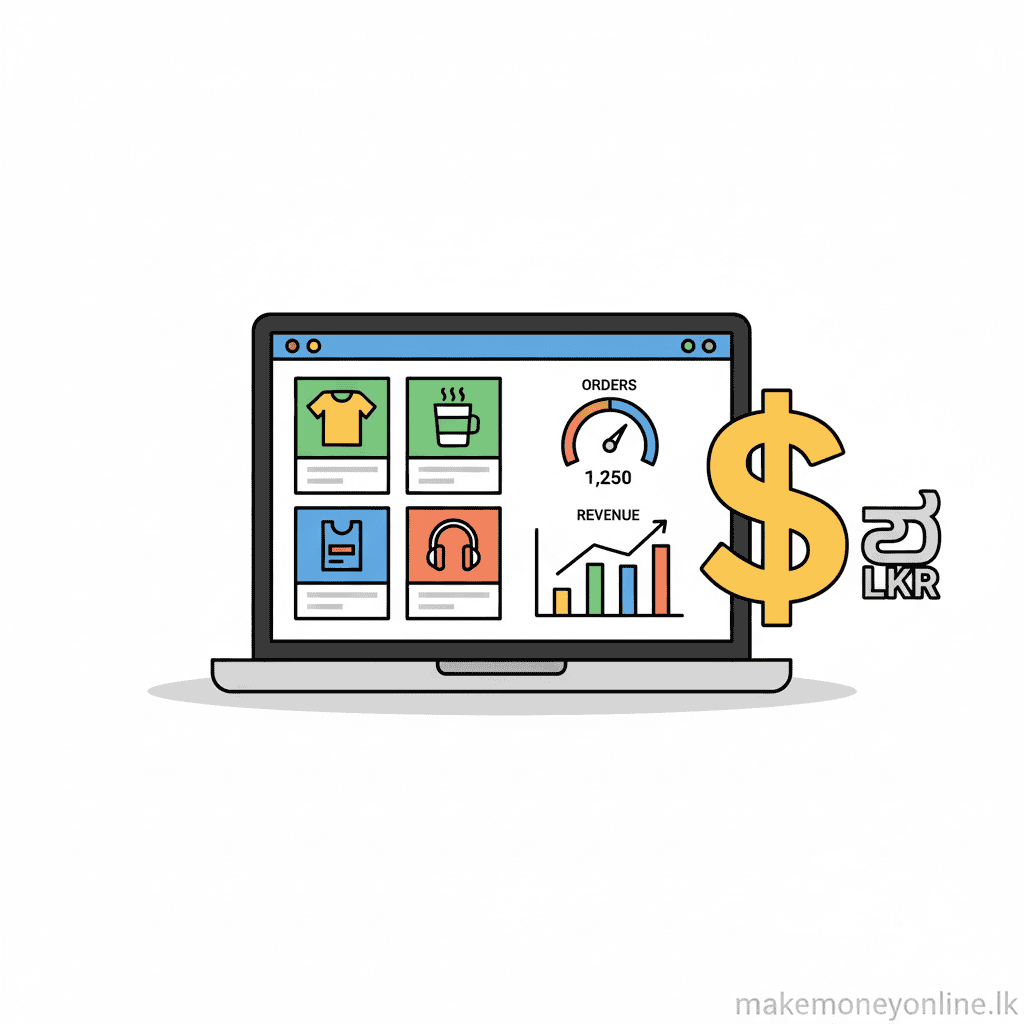
Shopify is an e-commerce platform that allows anyone to create an online store and sell products globally. You pay a monthly subscription to use the platform. Shopify handles the storefront, product listings, checkout, and order management. You handle sourcing products, marketing, and customer service.
Sri Lankan sellers use Shopify in three primary models:
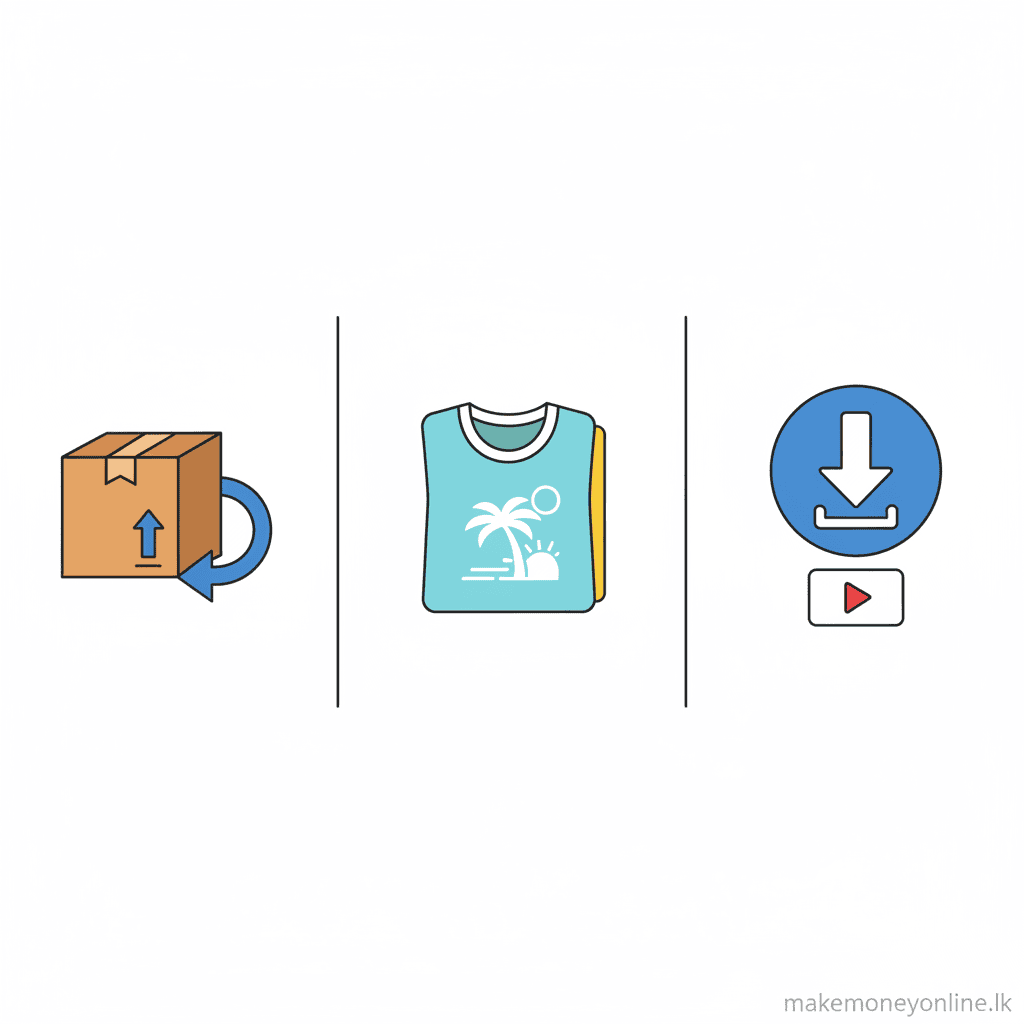
Dropshipping: You list products from a third-party supplier (usually AliExpress or a US/EU-based supplier). When a customer orders, the supplier ships directly to them. You never touch the inventory. Margin is the difference between what the customer pays and what the supplier charges. Low risk, thin margins.
Print on demand: You sell custom-designed products (t-shirts, mugs, phone cases, posters) through a print-on-demand partner like Printful or Printify. When an order comes in, the partner prints and ships it. You design the products; they handle production.
Physical product store: You source or create products locally or internationally and ship them yourself or through a fulfillment service. Higher control, higher margins, higher operational complexity.
Digital product store: You sell downloadable files: e-books, templates, software, presets, and courses through Shopify. No shipping. Instant delivery. High margin.
Each model has different startup costs, margin potential, and operational requirements. Dropshipping and print-on-demand have the lowest barriers to entry for Sri Lankan sellers.
How Much Can You Earn from a Shopify Store in Sri Lanka?
Shopify store income varies enormously by niche, traffic volume, conversion rate, and margin. No two stores are directly comparable. The figures below reflect realistic ranges based on store models.
Shopify Store Income Benchmarks
| Store Model | Startup Cost (USD) | Avg. Profit Margin | Monthly Revenue to Reach LKR 100,000 |
|---|---|---|---|
| Dropshipping | $100 to $500 | 10 to 30% | $1,000 to $3,000 in sales |
| Print on demand | $50 to $200 | 20 to 40% | $820 to $1,640 in sales |
| Physical products | $500 to $3,000 | 30 to 60% | $545 to $1,090 in sales |
| Digital products | $50 to $150 | 80 to 95% | $345 to $410 in sales |
Exchange rate: 1 USD = approximately 305 LKR.
A Sri Lankan dropshipping store generating $2,000 in monthly revenue at a 20% margin earns $400 profit (LKR 122,000). After Shopify’s monthly fee ($32/month on the Basic plan) and any ad spend, net income might be LKR 80,000 to LKR 100,000.
A print-on-demand store with 20 to 30 strong designs that appears in Etsy and Google Shopping search results can reach $800 to $2,000 per month in revenue with 30% margins, generating LKR 73,000 to LKR 183,000 per month without significant ongoing ad spend.
The Sri Lanka Payment Gateway Problem (And Solutions)
This section is unique to Sri Lankan Shopify sellers and must be understood before starting.
The problem: Shopify Payments (Shopify’s native payment processing) is not available in Sri Lanka. This means Sri Lankan merchants cannot use the default checkout payment system that Shopify offers sellers in the US, UK, Canada, and Australia.
Viable solutions for Sri Lankan merchants:
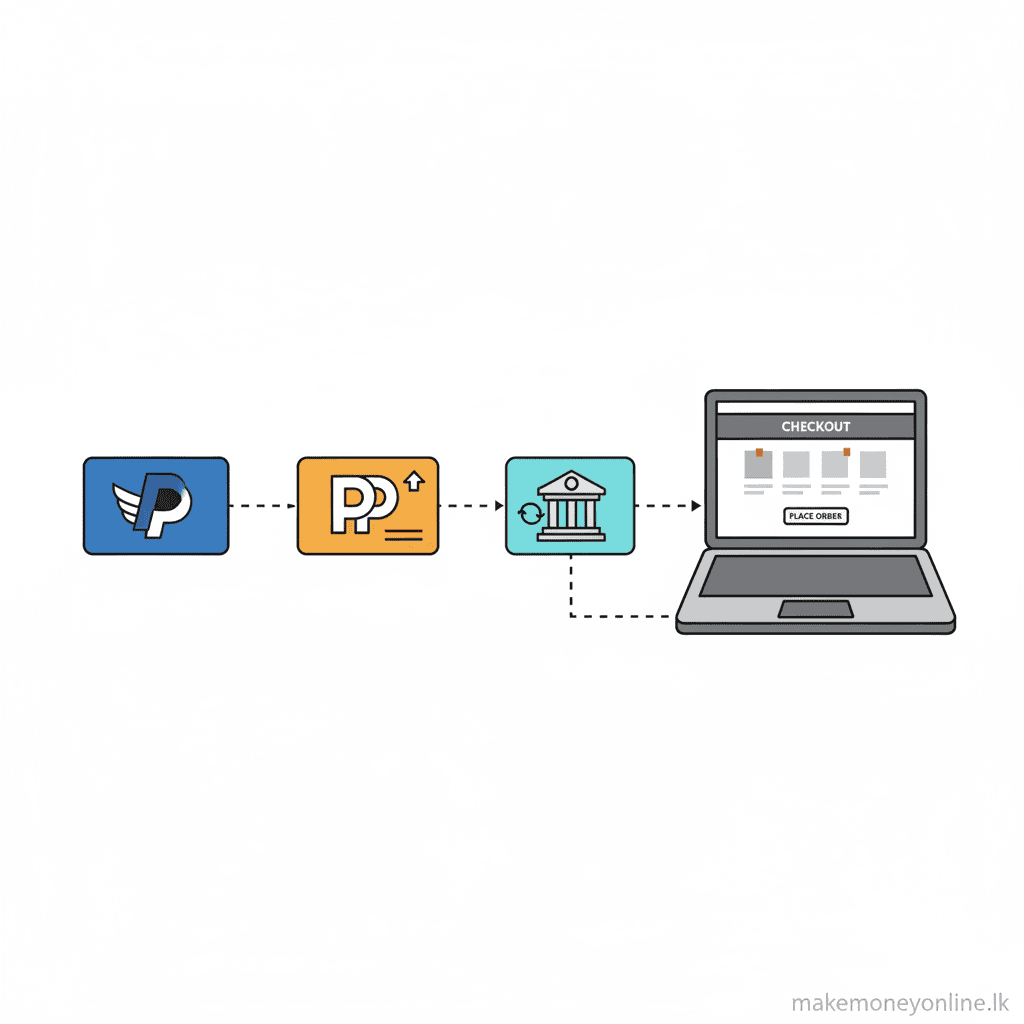
PayPal: PayPal business accounts work in Sri Lanka for receiving payments. Sri Lankan merchants can add PayPal as a payment gateway in Shopify. However, PayPal’s personal account withdrawal process in Sri Lanka has been inconsistent. Business accounts with properly set up entities have better withdrawal reliability.
Stripe (via international business entity): Stripe is not directly available for Sri Lankan-registered businesses. However, Sri Lankans who have registered a business entity in a Stripe-supported country (US LLC formation services are available from Sri Lanka for approximately $100 to $200 USD per year) can use Stripe. This is a common workaround used by Sri Lankan and South Asian Shopify sellers.
PayHere.lk (for selling to Sri Lankan customers): If your Shopify store sells primarily to Sri Lankan buyers (which limits your market size), PayHere is a Sri Lankan payment gateway that integrates with Shopify and supports LKR transactions.
Wise Business account: Some Sri Lankan sellers use a Wise (formerly TransferWise) business account registered in an eligible country to receive Shopify payment gateway proceeds, then transfer to their Sri Lankan bank account.
Payoneer: Payoneer can be used to receive payments from certain Shopify-integrated payment methods and marketplaces. Less direct than Stripe or PayPal for a standalone Shopify store.
The practical recommendation for most Sri Lankan Shopify sellers targeting international customers: use PayPal as the primary gateway for your Shopify store, set up a Payoneer account as a secondary option, and consider a US LLC or similar structure once your store generates enough revenue to justify the cost.
How Does Running a Shopify Store Work?
Step 1: Choose your business model and niche. Decide whether you are dropshipping, using print on demand, or selling your own products. Choose a specific niche rather than a general store. A niche store (e.g., outdoor camping gear, minimalist jewelry, pet accessories) converts better than a general store because the branding is coherent and the audience is specific.
Step 2: Set up your Shopify store. Shopify offers a 3-day free trial, then plans from $32/month (Basic) to $92/month (Shopify) to $399/month (Advanced). The Basic plan is sufficient for stores under $10,000 per month in revenue.
Step 3: Configure your payment gateway. Follow the payment solutions section above. This is the step most Sri Lankan sellers struggle with. Resolve your payment configuration completely before driving any traffic.
Step 4: Source or set up your products. For dropshipping, use Oberlo (now DSers) to import products from AliExpress suppliers. For print on demand, connect Printful or Printify to your store. For physical products, source inventory and set up shipping rates.
Step 5: Design your store. Use a free Shopify theme (Dawn is Shopify’s well-designed free theme). Write compelling product descriptions that address buyer concerns and highlight benefits. Add high-quality product images.
Step 6: Drive traffic. Organic traffic from SEO takes months. Paid traffic (Facebook ads, TikTok ads, Google Shopping) produces immediate results but requires ad budget. Organic social media (TikTok, Instagram, Pinterest) is a cost-effective traffic source for product-based stores.
Step 7: Manage orders and customer service. Process orders promptly, communicate shipping timelines accurately, and handle returns and refunds professionally. Review scores and customer feedback directly affect repeat business and social proof.
Step 8: Receive payment. Once your store is generating revenue, payments accumulate in your payment gateway account (PayPal or via your gateway of choice). Transfer to Payoneer or directly to your Sri Lankan bank account at regular intervals.
What Skills Do You Need for a Shopify Store?
Product research: Finding products with strong demand but manageable competition. Tools like SaleHoo, Ecomhunt, or manual research on Facebook’s Ad Library and AliExpress best-sellers inform product selection.
Basic store design and copywriting: Writing product descriptions that convert. Understanding what information buyers need (dimensions, materials, shipping times, return policy) and presenting it clearly.
Marketing fundamentals: Understanding how to target audiences with paid ads, or how to build organic social media content that drives traffic to your store. Marketing is the most important skill for store growth.
Customer service communication: Handling inquiries about shipping, returns, and product quality professionally. Customer service quality directly affects reviews, repeat sales, and dispute rates.
Data analysis: Reading Shopify analytics to understand where traffic comes from, which products convert, and what ad spend is profitable. Basic numeracy and attention to unit economics prevents running a busy store that loses money.
How to Get Started with a Shopify Store in Sri Lanka
Step 1: Start with a free trial. Shopify’s 3-day free trial is enough to set up a basic store, verify your payment configuration works, and import test products.
Step 2: Choose dropshipping or print on demand initially. Both models require minimal upfront investment and allow you to test products without purchasing inventory. Start with one model and one niche.
Step 3: Solve your payment gateway before launching. Set up your PayPal business account. Test a real transaction through your store using a test purchase before driving any marketing traffic. A broken checkout kills sales before they start.
Step 4: Research your niche thoroughly. Spend one week researching your niche: browse competitor stores, check Facebook Ad Library for active ads in your niche, and analyze AliExpress best-seller lists. Product selection is the most important decision in dropshipping.
Step 5: Set up your store with five to ten products. A focused store with a small number of well-presented products outperforms a store with 200 poorly described items. Quality over quantity in the initial setup.
Step 6: Start with organic marketing. Create a TikTok or Instagram account for your store niche. Post product demonstrations, unboxing videos, or lifestyle content. Organic social media traffic is free and sustainable.
Step 7: Test paid advertising with a small budget. Once your store has made its first 5 to 10 organic sales and you understand your conversion rate, test Facebook or TikTok ads with LKR 15,000 to LKR 30,000 per month. Analyze results before scaling.
How to Learn Shopify
Free resources:
- Shopify Learn (shopify.com/learn): Shopify’s official free training covers everything from store setup to marketing to growth. The foundational courses are excellent and free.
- YouTube: Channels like Shopify itself, Arie Scherson, and Jordan Welch cover dropshipping strategy, product research, and paid advertising with practical case studies.
- Shopify Help Center: The official documentation answers virtually every setup and configuration question, including specific payment gateway setup steps.
Paid learning:
- Udemy Shopify dropshipping courses (USD 15 to USD 30 or LKR 4,575 to LKR 9,150 on sale): Practical courses covering niche selection, product research, store setup, and Facebook advertising.
- eCom Elites by Franklin Hatchett (USD 197 or LKR 60,085): One of the most recommended paid dropshipping courses that covers the full workflow from store setup to profitable advertising.
Pros of Running a Shopify Store
Global market access. A Sri Lankan seller can reach customers in the United States, Australia, and Europe without a physical business presence in those countries. Your store operates 24 hours a day to buyers in every time zone.
Exchange rate advantage. Earning in USD while paying LKR for your time and local costs creates a structural profit advantage. A $100 sale generates LKR 30,500, which goes significantly further in Sri Lanka than it does for a seller operating in the US.
Low physical infrastructure. Dropshipping and print-on-demand stores require no warehouse, no physical shop, and no inventory investment. A laptop and a reliable internet connection are the primary tools.
Scalable with systems. A Shopify store that is profitable at $2,000 per month in revenue can scale to $10,000 per month without proportionally more work, provided the systems (advertising, fulfillment, customer service) are automated or outsourced appropriately.
Multiple income paths. Once you understand e-commerce, you can build multiple stores, flip profitable stores (Shopify stores sell for 2 to 4x annual profit on Flippa), or offer Shopify store setup as a service to other businesses.
Cons of Running a Shopify Store
Payment gateway friction for Sri Lankan sellers. The absence of Shopify Payments in Sri Lanka is a real operational hurdle. Setting up reliable payment infrastructure takes more time and potentially more cost (US LLC formation) than it does for sellers in supported countries.
High competition in popular niches. Dropshipping in commodity product categories (phone cases, generic clothing, gadgets) faces intense competition from established stores with larger ad budgets. Niche specificity and product differentiation are essential.
Advertising costs can exceed margins. Profitable dropshipping requires constant testing of products and ad audiences. Most tested products do not generate profitable ad returns. The testing cost before finding a winning product is a real expense that beginners underestimate.
Shipping times from AliExpress suppliers can damage reviews. Many dropshipping suppliers ship from China with 15 to 30 day delivery times. Customers accustomed to Amazon’s 2-day delivery find this unacceptable. Using AliExpress Express Shipping, US-based dropshipping suppliers, or print-on-demand partners with US fulfillment centers reduces this problem.
Shopify monthly fees apply even when sales are low. The $32/month Basic plan fee applies regardless of whether your store generates any revenue. In the early months while building traffic, this is a fixed cost against zero income.
Scam Alerts: Shopify Red Flags

Courses Promising LKR 500,000/Month in 30 Days
High-priced Shopify and dropshipping courses (often priced LKR 50,000 to LKR 200,000) promising first-month income of LKR 200,000 to LKR 500,000 are misrepresenting the timeline and difficulty. Shopify stores require months of product testing, traffic building, and optimization before generating consistent profit. Any course claiming otherwise is selling a fantasy, not a system.
Dropshipping Supplier Scams
Suppliers who require upfront payment for inventory before you have sold anything, who request unusually large minimum orders, or who disappear after receiving payment are common in the dropshipping supplier market. Use only suppliers with verified track records: AliExpress sellers with 1,000+ positive reviews, DSers-verified suppliers, or established US-based print-on-demand partners (Printful, Printify).
Fake Shopify Store \”Done For You\” Services
Services offering to set up a complete, profitable Shopify store for you for LKR 30,000 to LKR 100,000, guaranteeing profits within 30 days, are scams. They build low-quality generic stores, provide no real traffic or products strategy, collect the fee, and disappear. Building a profitable store requires your own product research, brand development, and marketing effort. It cannot be outsourced to a stranger for a flat fee.
Shopify Payment Scams Targeting New Sellers
Scam emails claiming to be from Shopify support or Shopify’s payment team, asking you to click a link and verify your store’s payment details, are phishing attempts. Shopify communicates through your store dashboard (admin.shopify.com), not via unsolicited emails requesting credential verification.
Final Verdict: Is a Shopify Store Worth It for Sri Lankans?
A Shopify store is one of the higher-effort, higher-potential income methods in this guide. It is not passive in the early stages, requires problem-solving around payment infrastructure, and demands consistent marketing effort to drive traffic.
The potential is real. Sri Lankan sellers are running profitable Shopify stores targeting global markets right now. The combination of low LKR operating costs, high USD sales prices, and Shopify’s robust e-commerce infrastructure creates a genuine opportunity for sellers willing to invest time in product research and marketing.
This method suits you well if:
- You are willing to invest 3 to 6 months of consistent effort before expecting reliable profit
- You can solve the payment gateway setup challenge (PayPal business account or US LLC)
- You have a budget for testing: Shopify fees ($32/month) plus an initial advertising test budget
- You are interested in e-commerce, marketing, and building a scalable online business
This method may not suit you if:
- You need income within 30 to 60 days and cannot sustain early losses
- You are not willing to engage with product research, marketing, and customer service
- You cannot resolve the payment gateway situation for Sri Lankan sellers
For related e-commerce methods, see the guide on dropshipping in Sri Lanka for a similar but inventory-free model, and the overview of selling digital products for a Shopify store variation with higher margins and no shipping complexity.