The most scalable way to earn money online has nothing to do with trading time for money. It involves creating something once and selling it to thousands of buyers with no additional production cost per sale. That is the digital products model.
A Sri Lankan graphic designer selling a Canva business card template bundle for $12 on Etsy can sell the same file to 500 different buyers. Each sale is $12. There is no additional work per customer. The bundle was created once.
Selling digital products is not passive from day one. It requires building an audience or finding the right marketplace, creating products people actually want, and promoting consistently. But once the system is working, income scales with audience size rather than hours worked.
This guide covers the most viable digital product types for Sri Lankan sellers, which platforms pay reliably, and how to avoid the common mistakes that prevent most beginners from ever making a first sale.
Sri Lanka platform-availability notice. Two of the platforms most commonly recommended for digital products have real Sri Lanka-specific access problems that a beginner needs to know about before investing time. Etsy Payments is not currently available for Sri Lankan sellers — Sri Lanka is not on Etsy’s eligible-countries list, and Sri Lanka is not on Etsy’s Payoneer-eligible list either. Gumroad does not support Payoneer, Wise, or wire-transfer payouts for any seller — payouts are direct bank deposit in supported countries or PayPal where deposit is unavailable, and PayPal withdrawal from Sri Lanka is restricted. Read the platform section below carefully before choosing where to list.

What Are Digital Products?
Digital products are files or digital access that customers pay for and receive instantly, with no physical shipping. The seller creates the product once and sells it repeatedly.
The most commercially successful digital product categories for independent sellers include:
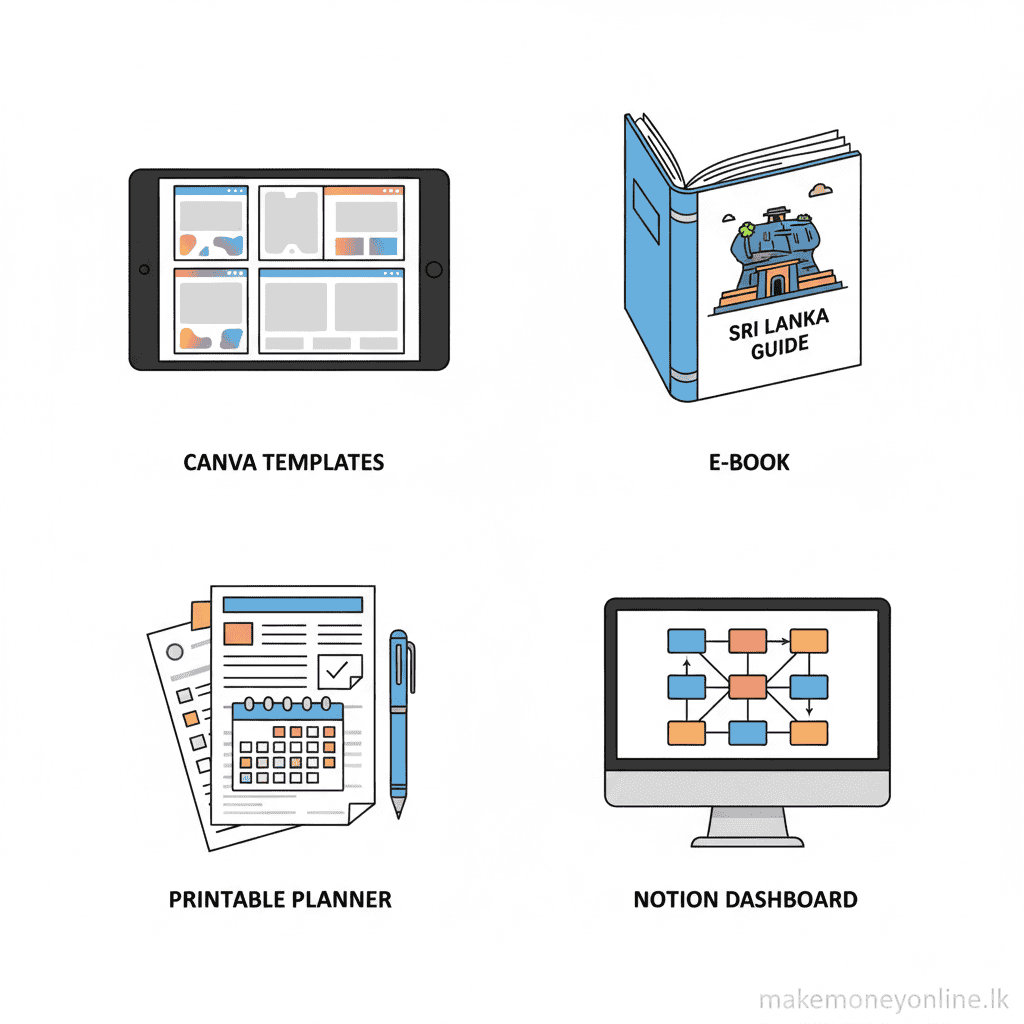
Templates: Canva social media templates, PowerPoint presentation decks, Excel spreadsheet templates, resume templates, business card designs. Buyers use these as starting points for their own work.
E-books and guides: PDF guides on specific topics (how to start freelancing, photography basics, recipe collections, language learning guides). Short, actionable guides (3,000 to 15,000 words) sell better than lengthy academic-style books.
Printables: PDF planners, wall art, budget trackers, habit trackers, calendars, wedding checklists, kids activity sheets. Buyers download and print at home. A bestselling printable planner on Etsy can generate thousands of dollars per month.
Presets and filters: Lightroom photo editing presets, Photoshop actions, video LUTs (color grading presets for video). Popular among photographers and videographers.
Digital courses and workshops: Pre-recorded video courses, webinars, or structured PDF courses on teachable skills.
Software and tools: Spreadsheet tools, Notion templates, Figma UI kits, website themes, browser extensions. Higher technical barrier but significantly higher price points.
Music and audio: Royalty-free background music, sound effects, sample packs. Licensed to content creators who need audio for videos.
How Much Can You Earn from Selling Digital Products in Sri Lanka?
Earnings depend entirely on product quality, marketing effort, and marketplace choice. The range is extremely wide.
Digital Product Income Benchmarks
| Product Type | Beginner (per month) | Intermediate (per month) | LKR Equivalent (Intermediate) |
|---|---|---|---|
| Canva templates (Etsy) | LKR 5,000 to LKR 20,000 | LKR 40,000 to LKR 120,000 | Direct LKR |
| E-books / PDF guides (Gumroad) | $20 to $80 | $150 to $600 | LKR 45,750 to 183,000 |
| Printable planners (Etsy) | $30 to $100 | $200 to $1,000+ | LKR 61,000 to 305,000+ |
| Lightroom presets | $20 to $60 | $100 to $400 | LKR 30,500 to 122,000 |
| Notion templates | $30 to $100 | $200 to $800 | LKR 61,000 to 244,000 |
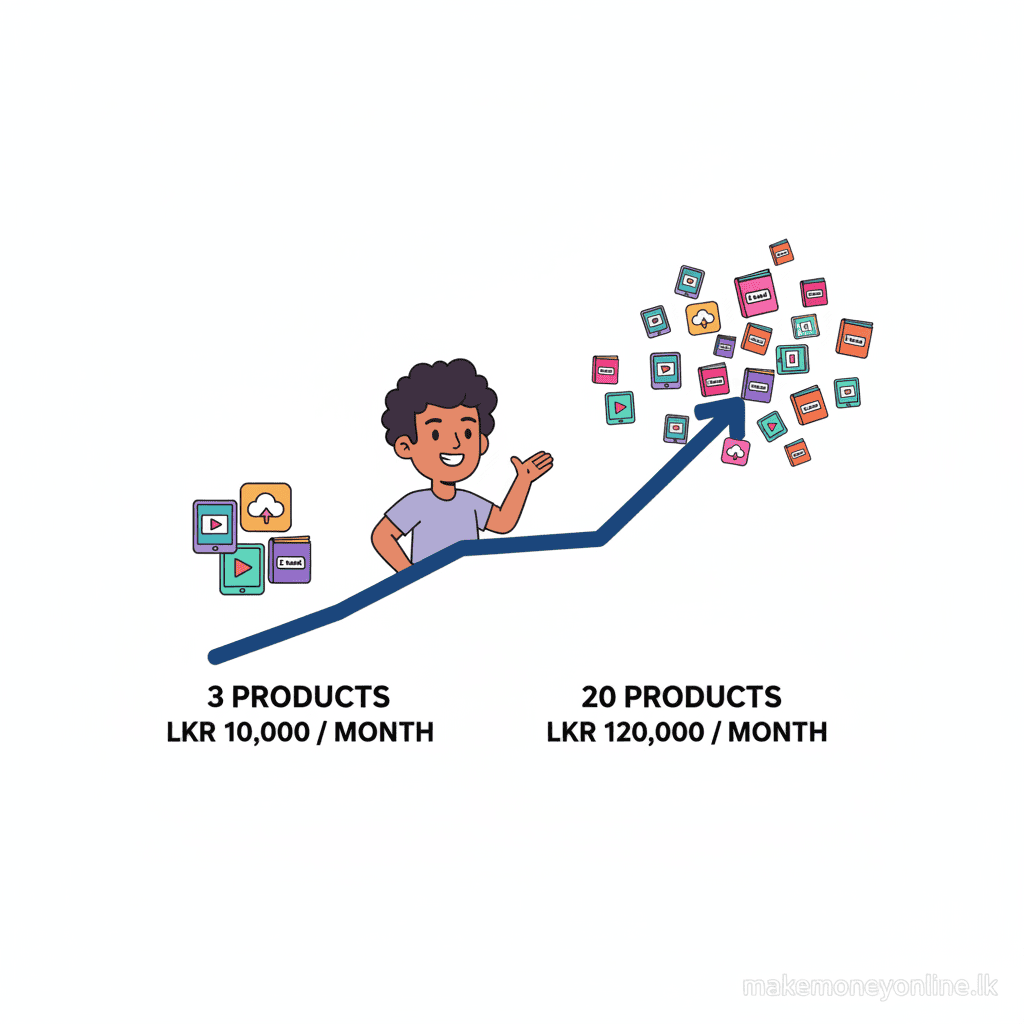
USD → LKR conversion notice. USD-to-LKR figures on this page use a reference rate of approximately LKR 305 per USD, last reviewed 2026-09-01. Actual conversion depends on your provider’s spread and the current market rate. See our methodology. A Sri Lankan seller with three high-quality Canva template packs on Etsy and two e-books on Gumroad can realistically earn LKR 60,000 to LKR 120,000 per month after 6 to 12 months of marketplace optimization and consistent promotion.
How Does Selling Digital Products Work?
Step 1: Create the product. This is the most time-intensive step. A well-made Canva template bundle takes 8 to 20 hours to create. A quality 30-page e-book takes 10 to 20 hours. A Lightroom preset pack takes 4 to 8 hours per preset.
Step 2: Create mockup images. Buyers cannot physically hold or preview a digital product before purchasing. High-quality mockup images showing the product in use drive sales. Canva, Placeit, and Adobe Express all have mockup templates for digital products.
Step 3: List on your chosen platform. Etsy for templates and printables. Gumroad or Payhip for e-books and courses. Your own website for a long-term branded store.
Step 4: Write an optimized listing. Title and description must include keywords buyers search for. Product description should answer: What is included? What format? What software do I need? What problem does this solve?
Step 5: Drive traffic. On Etsy, the platform provides some organic discovery. On Gumroad, you must drive your own traffic via social media, YouTube, email list, or Pinterest. Pinterest is particularly effective for driving traffic to digital product stores, especially printables.
Step 6: Receive payment. Automatic delivery to the buyer. You receive payment via Payoneer (Etsy) or Payoneer/PayPal (Gumroad, Payhip).
What Skills Do You Need to Sell Digital Products?
Product creation skills: Varies by product. Canva templates require design sense and Canva proficiency. E-books require writing ability. Lightroom presets require photo editing knowledge. Notion templates require familiarity with Notion and productivity workflows. Choose a product type aligned with skills you already have.
Marketplace SEO: Etsy is driven by search. Understanding which keywords buyers use to find your product type, and integrating those keywords into your title, tags, and description, directly determines how many people discover your listing.
Product photography and mockup creation: Your listing images are your only sales asset. Clear, professional mockup images showing the product in use convert browsers to buyers. This skill is learnable quickly with Canva mockup templates.
Email list or social audience building: On platforms like Gumroad that have minimal built-in discovery, you need an external traffic source. Pinterest boards, Instagram posts, TikTok product demonstrations, or a YouTube channel that sends viewers to your product page.
Basic understanding of licensing: Selling Canva templates requires understanding what buyers can and cannot do with them (personal use vs commercial use). Pricing and listing terms must clearly communicate the license you are providing.
How to Get Started Selling Digital Products in Sri Lanka
Step 1: Choose one product type to start. Do not try to create e-books, templates, and courses simultaneously. Pick one and create three to five products in that category before listing.
Step 2: Research what is selling. On Etsy, search your product category and filter by “Most Recent” then “Most Reviews” to understand what the most successful sellers are offering. On Gumroad’s Discover section, browse top-selling products in your category.
Step 3: Create your first product. Use Canva (free tier works) for templates. Use Google Docs or Notion for e-books and guides. Use Procreate or Photoshop for art-based products.
Step 4: Choose your platform carefully — Sri Lanka access is the constraint. Verified against each platform’s own current documentation (see the platform section below for the full breakdown):
- Etsy is not directly accessible for Sri Lankan sellers. Sri Lanka is not on Etsy Payments’ eligible-country list, and Sri Lanka is not on Etsy’s Payoneer-eligible list. Sri Lankans who list on Etsy do so via a US LLC (Stripe Atlas) or a bank account in an eligible country — a real setup step, not a formality.
- Gumroad is technically open, but its payout options do not include Payoneer, Wise, or wire transfer. Payouts are direct bank deposit (in supported countries) or PayPal (where deposit is unavailable). Sri Lanka’s PayPal withdrawal is restricted, so verify Gumroad’s payout status inside your account before building a strategy on it.
- Payhip and Creative Market are the alternatives most Sri Lankan digital-product sellers can use directly. See platform-section below for the current facts.
Step 5: Set up the right payout method for your chosen platform. Do this before creating your first product — a platform with fees and reach that don’t match your Sri Lanka payout options wastes weeks of production work.
Step 7: Create a Pinterest profile. Pinterest drives massive organic traffic to digital product listings, particularly printables, planners, and templates. Each product gets its own pin. Pins continue driving traffic for months or years.
How to Learn Digital Product Creation and Sales
Free resources:
- YouTube: Channels like Hannah Narvey, Gold City Ventures, and Dylan Jahraus cover Etsy digital product strategy, template creation, and printable optimization in detail.
- Canva Design School (canva.com/learn): Free tutorials specifically for creating Canva templates and understanding design principles.
- Etsy Seller Handbook (etsy.com/seller-handbook): Official guides on listing optimization, SEO, and shop setup.
Paid learning:
- Etsy-specific courses on Udemy (USD 15 to USD 30 or LKR 4,575 to LKR 9,150): Courses covering niche research, template creation, and Etsy SEO.
- Gold City Ventures e-book or printable courses (from USD 47 or LKR 14,335): Detailed courses specifically for building Etsy digital product businesses. One of the most respected training resources for this niche.
Pros of Selling Digital Products
No inventory, no fulfillment. Once the product file exists, every sale is automated. Delivery is instant. You have no physical goods to store, ship, or manage.
True passive income potential. A well-optimized Etsy listing or Gumroad product can generate sales for years from a single creation effort. This is one of the few genuine passive income models available online.
Low startup cost. Canva (free tier), Google Docs (free), and Gumroad (free to start) mean you can create and sell your first digital product with zero upfront cost.
High margin on every sale. Unlike physical products where materials and shipping reduce profit, digital products have nearly 100% gross margin per sale (minus platform fees of 6 to 20%).
Scalable without staffing. Going from 10 sales to 1,000 sales per month requires no additional employees, no warehouse, and no operational complexity. The same automated delivery system handles any volume.
Cons of Selling Digital Products
Etsy marketplace is competitive. Popular categories like planners, templates, and wall art have thousands of competing listings. Differentiating through design quality, niche specificity, and listing optimization is critical and takes time to develop.
Self-hosted stores require your own marketing. On Gumroad or your own site, there is no built-in marketplace traffic. You must build an audience (social media, email list, YouTube, Pinterest) to drive traffic to your products. This is a significant ongoing effort.
Product updates can be required. Templates built for a specific software version may need updating when the software changes. Canva updates frequently. Buyers expect current, working files.
Copyright and IP risks. Creating templates or designs too similar to existing popular products creates copyright infringement risk. Original creation is both legally and commercially important.
Digital piracy. Successful digital products sometimes get shared or resold without authorization. While this is difficult to prevent entirely, selling through reputable platforms (Etsy, Gumroad) provides some protection and reporting mechanisms.

Best Platforms for Selling Digital Products in Sri Lanka
Etsy — not directly accessible for Sri Lankan sellers
The largest marketplace for digital templates, printables, and art. But Sri Lanka is not on Etsy Payments’ eligible-country list, and Sri Lanka is also not on Etsy’s Payoneer-eligible list (which currently includes only a specific set of countries such as Argentina, Brazil, Egypt, Georgia, Kazakhstan, Pakistan, Serbia, South Korea, Thailand, Ukraine, and the UAE). Sri Lankan sellers who list on Etsy do so through a workaround — most commonly a US LLC via Stripe Atlas, or a personal bank account in a supported country.
- Fees (verified 2026-09-02, seller aggregation of Etsy’s fee schedule): $0.20 per listing (lasts 4 months or until the item sells; digital downloads also pay $0.20 per sale) + 6.5% transaction fee on the total sale (including shipping) + payment processing (~3% + $0.25 for US-account sellers) + 2.5% currency conversion if listing currency differs from payout currency + 12–15% offsite ads fee if the sale is attributed to an offsite ad. Effective total is roughly 9.5% + $0.45 on a typical sale before any offsite ads.
- Payment for Sri Lanka: not directly supported. Only via a US LLC (Stripe Atlas) or a supported-country bank account.
- Best for: Canva templates, printable planners, digital art, photography presets — for sellers willing to set up a US LLC or eligible-country bank first.
- Source: Etsy — countries eligible for Etsy Payments.
Gumroad
Simple, creator-focused platform with minimal setup. Good for e-books, guides, mini-courses, and software tools.
- Fees (verified 2026-09-02): 10% + $0.50 per transaction on Gumroad’s website sales (raised from the earlier 9%), plus credit-card processing fees (2.9% + $0.30) or PayPal fees on top. Marketplace-discovery sales attract a flat 30% that includes processing.
- Payout methods (verified 2026-09-02): direct bank deposit in supported countries, or PayPal where bank deposit is unavailable. Payoneer, Wise, wire transfer, cheque, and money orders are NOT supported. Sri Lankan sellers should verify inside their account whether direct-deposit-to-LKR-bank or PayPal is the offered path — PayPal withdrawal from Sri Lanka is restricted (see payment methods guide).
- Best for: e-books, PDF guides, software tools — where you drive your own traffic.
Payhip
Similar to Gumroad with slightly lower fees and VAT handling for EU buyers.
- Fees: 5% of each sale on the free plan; lower on paid plans (from ~$29/month). Payhip supports PayPal and Stripe as buyer payment gateways.
- Payment for Sri Lanka: PayPal on the seller side is the practical rail (Stripe direct is not available for Sri Lankan account holders). Same PayPal-withdrawal caveat as Gumroad.
- Best for: e-books, courses, digital downloads with EU customer base.
Creative Market
Design-specific marketplace for fonts, templates, graphics, and UI kits. Higher average sale prices but requires application to join as a seller.
- Commission: Creative Market takes 40% on each sale (you keep 60%).
- Payment for Sri Lanka: PayPal is the standard payout method — verify in-account before building a strategy.
- Best for: professional-grade design assets, font files, UI/UX kits.
Free Tools for Selling Digital Products
Canva (free tier): Create templates, e-book layouts, social media graphics, and product mockup images. The free tier covers most digital product creation needs.
Google Docs / Slides (free): Write and format e-books, guides, and presentation templates. Export as PDF for delivery.
Notion (free tier): Create Notion templates. Sellers export as shareable template links.
Placeit (limited free, from USD 14.95/month or LKR 4,560): Professional mockup generator for showing digital products in context. More realistic mockups than Canva.
Paid Tools for Selling Digital Products
Canva Pro (approximately USD 13 per month or LKR 3,965): Unlocks premium elements, brand kits, and additional export options useful for high-quality template creation.
Adobe Illustrator (approximately USD 23 per month or LKR 7,015): For professional-grade vector templates and design assets that command higher prices.
ConvertKit or Mailchimp (free to start): Build an email list of past buyers and interested prospects to promote new product launches directly.
Scam Alerts: Digital Product Selling Red Flags
“Done for You” Product Creation Services
Services offering to create and list digital products for you in exchange for a share of future revenue (plus an upfront setup fee) are almost always scams. They collect the upfront fee, create low-quality products that generate no sales, and disappear. Creating your own products is the only reliable path.
Fake Digital Product Reselling Schemes
Multi-level style schemes where you pay LKR 10,000 to LKR 50,000 to receive “master resale rights” to a set of digital products, which you then sell and recruit others to also buy resale rights, are pyramid structures. The products have no genuine market value and income comes only from recruiting new buyers, not from real product sales.
Etsy Automation Services
Tools or services claiming to automate your Etsy store, generate fake reviews, or manipulate Etsy’s algorithm for a fee violate Etsy’s terms of service. Using them risks permanent shop suspension. Build your store through genuine product quality and legitimate optimization.
Plagiarized Template Claims
If you sell Canva templates, some buyers will claim your template looks identical to a competitor’s and demand a refund while keeping the file. Create original designs. Document your design process. Etsy’s case resolution system handles disputes, but original creation is your strongest protection.
Final Verdict: Is Selling Digital Products Worth It for Sri Lankans?
Selling digital products is one of the highest-potential passive income methods available to Sri Lankans with a creative or knowledge-based skill. The economics are genuinely compelling: create once, sell repeatedly, keep 80 to 95% of revenue, no fulfillment required.
The realistic challenge is that getting to meaningful income requires either strong marketplace SEO (Etsy) or your own audience (Gumroad). Building either takes consistent work over 6 to 12 months. Products that do not match what buyers are searching for will not sell regardless of quality.
This method suits you well if:
- You have a skill you can turn into templates, guides, or tools (design, writing, photography, productivity, teaching)
- You can invest time upfront to create quality products and learn marketplace optimization
- You are willing to build an audience or learn Etsy SEO over 6 to 12 months
- You want income that scales without trading additional time per customer
This method may not suit you if:
- You need income within 30 days
- You do not have a specific skill that translates into a product people would pay for
- You are unwilling to promote your products through social media, Pinterest, or other channels
For those exploring related methods, see the guide on selling digital art and the overview of creating online courses as complementary digital product income streams.
Related Ways to Earn Money Online in Sri Lanka
- Creating Online Courses — Create courses as your highest-value digital product
- Graphic Design — Design templates and assets to sell digitally
- Blogging — Drive product sales through blog content and SEO
- Email Marketing — Sell digital products through email campaigns
Looking for more ways to earn? Browse our complete guide to making money online in Sri Lanka with 63 online income methods reviewed for legitimacy, skill and time requirements, and payment access from Sri Lanka. See our methodology for how each method is assessed.