Music teachers in Sri Lanka earn from two very different markets simultaneously. Local students pay LKR rates for in-person or local online lessons. International students pay USD rates for lessons conducted via Zoom or Skype. A Sri Lankan music teacher with a decent camera, a reliable internet connection, and the ability to teach effectively in English can access both markets at once.
The income from music teaching is more predictable than most freelance work. Students book recurring weekly or bi-weekly lessons and pay monthly. Three to five committed students on weekly hour-long lessons at $30 to $50 per lesson generates $360 to $1,000 per month from international students alone. Add local students at LKR 2,500 to LKR 5,000 per lesson and the combined income grows further.
This guide covers how music teaching income works in Sri Lanka, which instruments and skill levels command the best rates, which platforms connect teachers with students, and how to avoid the scams targeting music teachers looking for online work.
What Is Teaching Music as an Income Method?
Teaching music means providing structured instruction to students in playing an instrument, music theory, vocal technique, or music production. Lessons are delivered one-on-one (private lessons) or in small groups.
The primary income models for Sri Lankan music teachers include:
Private in-person lessons: Teaching individual students at your home studio, a music school, or the student’s home. Common in Colombo and major cities. Limited by geography and travel.
Online private lessons: Teaching via Zoom, Skype, or Google Meet. Removes geographic limitations. Access both local online students and international students. Growing significantly since 2020.
Music school employment: Teaching at established music schools (Trinity College affiliated, ABRSM-affiliated, or local music institutes). Fixed salary or per-lesson income. Less flexibility but consistent work.
Group classes: Teaching small groups in person or online. Lower per-student rate but higher total income per hour than one-on-one.
YouTube channel or course creation: Creating instructional content as a passive income stream alongside active teaching. Long-term play.
The instruments with the highest demand for private lessons in Sri Lanka and internationally include guitar (acoustic and electric), piano and keyboard, violin, drums, vocals, bass guitar, and ukulele. Music theory and sight-reading are in demand as add-on subjects.
How Much Can You Earn from Teaching Music in Sri Lanka?
Music Teaching Income Benchmarks
| Teaching Model | Rate per Lesson | Monthly Income (20 lessons) | LKR Equivalent |
|---|---|---|---|
| Local in-person (beginner) | LKR 1,500 to LKR 3,000 | LKR 30,000 to LKR 60,000 | LKR 30,000 to LKR 60,000 |
| Local in-person (intermediate+) | LKR 3,000 to LKR 6,000 | LKR 60,000 to LKR 120,000 | LKR 60,000 to LKR 120,000 |
| International online (beginner) | $20 to $35 per hour | $400 to $700 | LKR 122,000 to LKR 213,500 |
| International online (intermediate+) | $35 to $60 per hour | $700 to $1,200 | LKR 213,500 to LKR 366,000 |
| Specialized / advanced (ABRSM exam prep) | $50 to $80 per hour | $1,000 to $1,600 | LKR 305,000 to LKR 488,000 |
Exchange rate: 1 USD = approximately 305 LKR.
20 lessons per month at one hour each is a realistic workload for a part-time teacher. A full-time music teacher handling 30 to 40 lessons per month at a mix of local and international rates earns LKR 150,000 to LKR 400,000 per month once their student roster is full.
How Does Online Music Teaching Work?
Step 1: A student finds you through a platform listing, social media, a website, or a referral. They inquire about lessons, instrument, level, and availability.
Step 2: You conduct a free 15 to 30 minute trial lesson to assess their current level, discuss their goals, and let them experience your teaching style.
Step 3: If they want to continue, you agree on lesson frequency (weekly is standard), lesson length (30, 45, or 60 minutes), and rate. For international students, quote in USD.
Step 4: You schedule lessons at a consistent recurring time. Use Google Calendar or Calendly for booking management.
Step 5: Lessons are conducted via Zoom or Skype. You share your screen for notation, use a second camera angle to show technique, and use digital tools (notation software like MuseScore, or backing tracks) to enrich lessons.
Step 6: Students pay monthly in advance or lesson-by-lesson. International students pay via PayPal or Wise. Local students pay via bank transfer.
Step 7: Transfer international payments to your Sri Lankan bank account via PayPal withdrawal or Payoneer transfer.

What Skills Do You Need to Teach Music?
Instrument proficiency: You must play your instrument at a level substantially above the students you teach. Teaching beginners and grade 1 to 3 ABRSM students requires a minimum of grade 6 to 8 level or equivalent. Teaching advanced students requires conservatory-level playing ability.
Pedagogical skill: The ability to explain music concepts clearly, identify student errors, demonstrate correct technique, and design progressive lesson plans that move students forward at an appropriate pace. Teaching is a skill separate from playing.
Patience and communication: Students learn at different speeds. Keeping students motivated through the difficult early stages of learning an instrument requires consistent encouragement and adaptive teaching approaches.
Basic video call setup: A stable internet connection (minimum 10 Mbps upload for video calls), a decent microphone (built-in laptop microphones create echo issues for music; a USB condenser microphone or headset helps), good lighting, and a clean teaching space visible on camera.
Lesson planning and documentation: Tracking each student’s progress, assigning appropriate homework, and maintaining structured lesson plans that build coherently toward the student’s goals.
ABRSM or Trinity College knowledge (optional but valuable): Many Sri Lankan and UK-diaspora students work toward ABRSM or Trinity College examinations. Teachers familiar with these syllabi attract students specifically preparing for graded exams, which commands premium rates.
How to Get Started Teaching Music Online
Step 1: Define your teaching specialization. Decide which instrument and skill levels you will teach. Specializing in beginner and intermediate acoustic guitar attracts a specific market. Specializing in ABRSM piano exam preparation attracts a different, often higher-paying market.
Step 2: Set up your teaching space. A clean, reasonably quiet space with good natural or artificial lighting. Mount your instrument holder or keyboard stand where it is visible on camera. Test your audio and video quality before your first lesson.
Step 3: Create a profile on TakeLessons and Lessonface. Both platforms connect music students with teachers globally. TakeLessons is the largest English-language music lesson marketplace. Lessonface specifically focuses on live online lessons. Your profile should include your instrument, style, teaching approach, and rate.
Step 4: Create an Instagram presence. Short clips of yourself playing and teaching attract organic students. A 30-second demonstration of a chord progression or a technique tip generates discovery without advertising spend.
Step 5: Offer a free trial lesson. A free 20-minute trial reduces the barrier for new students to start. Once they experience your teaching style, conversion to paid lessons is high.
Step 6: Set a rate that reflects your experience. New online teachers often underprice to attract their first students. Starting at $25 to $30 per hour for international students is reasonable for a teacher with no online reviews. Raise rates after 10 to 15 committed students.
How to Learn Teaching Skills
Free resources:
- ABRSM teacher resources (abrsm.org): Official resources for teachers working with ABRSM syllabi. Understanding exam requirements helps you teach exam-track students effectively.
- YouTube: Channels covering music pedagogy, online teaching setup, and specific instrument technique for teachers.
- Lessonface and TakeLessons blogs: Both platforms publish guides on building a student roster, pricing, and conducting effective online lessons.
Paid learning:
- Music teacher training courses (Coursera/Udemy, from USD 15 to USD 49 or LKR 4,575 to LKR 14,945): Courses on music pedagogy, teaching beginners, and building a private teaching practice.
- ABRSM Teaching Development resources (from USD 30 or LKR 9,150): Official pedagogical resources from the Associated Board of the Royal Schools of Music.
Pros of Teaching Music
Recurring weekly income. Students who book weekly lessons represent predictable monthly income. A student committing to weekly one-hour lessons at $40 per lesson generates $160 per month from a single student. Ten committed students generate $1,600 per month (LKR 488,000).
Low equipment cost. You already have your instrument. A reliable internet connection, a basic USB microphone, and a free video call platform (Zoom free tier handles 40-minute sessions; Zoom paid is $15/month) constitute your full setup cost.
International rates accessible from Sri Lanka. Online music teaching pays the same per-lesson rate whether you are based in Colombo or London. Your teaching quality determines what you can charge, not your location.
Student retention is high. Students who find a good music teacher tend to stay for months or years. Unlike freelance project work, a good music teaching relationship generates income for 12, 24, or 36+ months from a single student acquisition effort.
Flexible scheduling. You control which time slots you make available. Morning slots serve European students in different time zones. Evening Sri Lanka time slots serve US and Canadian students. A strategic schedule covers multiple markets.
Cons of Teaching Music
Income is capped by teaching hours. You can only teach so many hours per week before quality and energy suffer. Most music teachers cap at 25 to 35 active lessons per week. Scaling beyond that requires group classes or recorded course content.
Student cancellations and no-shows erode income. Students cancel lessons at inconvenient times, leaving gaps in your schedule. A clear cancellation policy (24-hour notice required for refund or rescheduling) reduces income loss from late cancellations.
Building an initial roster takes time. Finding 15 to 20 committed international students takes 3 to 6 months of active platform presence and marketing. The early months with only a few students generate modest income.
Internet and electricity reliability. Power cuts and connectivity issues during lessons damage your professional reputation. A UPS battery backup for your router and computer protects against Sri Lanka’s occasional power interruptions.
Platform commissions reduce take-home pay. TakeLessons and Lessonface take 30 to 45% of lesson fees when students book through the platform. Direct students (who find you through Instagram or referrals) generate full lesson fee income.
Best Platforms for Music Teachers in Sri Lanka
TakeLessons
The largest online music lesson marketplace with both in-person and live online lesson categories. Strong student base for guitar, piano, and voice. Platform handles payment processing.
- Commission: 30 to 45% of lesson fees
- Payment for Sri Lanka: PayPal
- Best for: Building initial student roster, beginner and intermediate instrument instruction
Lessonface
Specifically focused on live online lessons. Smaller than TakeLessons but dedicated to online-only instruction. Lower commission structure.
- Commission: 15% after initial period
- Payment for Sri Lanka: PayPal or Stripe
- Best for: Online-first teachers, building international student base
Preply
Language and skill tutoring platform that includes music. Growing student base. Competitive rate setting.
- Commission: 33 to 18% (decreasing as you accumulate hours)
- Payment for Sri Lanka: PayPal or Payoneer
- Best for: Diversifying student sources alongside TakeLessons
Direct (Instagram + Referrals)
Once you have 5 to 10 students, referrals and Instagram discovery bring direct students with no platform commission. Use Calendly for booking and PayPal or Wise for payment.
- Commission: 0%
- Best for: Experienced teachers building a commission-free student base
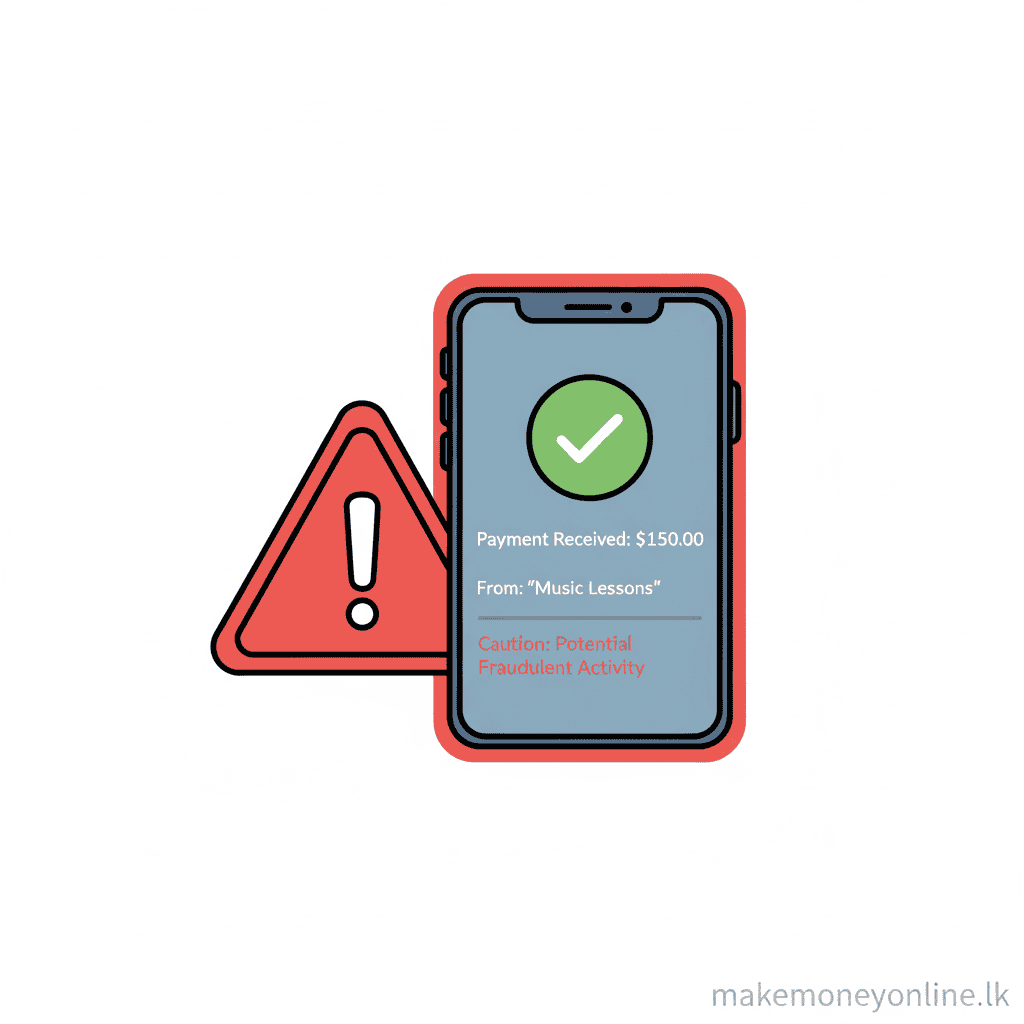
Scam Alerts: Music Teaching Red Flags
Overpayment Cheque Scams
A “student” contacts you through a platform or email expressing interest in lessons and sends payment significantly above your agreed rate, then asks you to refund the excess via bank transfer or gift cards. The original payment is a fraudulent cheque that subsequently bounces. You lose the refunded amount. Never refund overpayments via cash transfer services. Any payment significantly above your quoted rate from a new student is a scam signal.
Fake Music Teaching Agency Upfront Fees
Online “music teaching agencies” or “tutoring networks” offering to find international students for a registration fee, platform listing fee, or background check fee are almost always fraudulent or ineffective. Legitimate platforms earn commission on lessons taught, not upfront fees from teachers.
Equipment Purchase Schemes
A scam variant where a “student” or “music school” offers to hire you for remote teaching and requests that you purchase specific webcams, microphones, or equipment from their “approved supplier” before starting. They cover the cost via a check that bounces after you have already sent the equipment cost to the supplier. No legitimate employer requires equipment purchases from specific suppliers as a condition of teaching.
Fake Student Profiles on Legitimate Platforms
Scammers create student profiles on legitimate platforms like TakeLessons and attempt to move communication outside the platform immediately (requesting your personal email, WhatsApp, or direct payment link). This is done to conduct the overpayment scam outside the platform’s protection. Always keep initial communications within the platform until payment and booking systems are established.
Final Verdict: Is Teaching Music Worth It for Sri Lankans?
Music teaching is one of the most sustainable recurring income methods available to Sri Lankans with genuine musical skill. The combination of weekly recurring lessons, international rate access, and the high retention rate of committed music students creates an income that compounds and stabilizes over time.
The first three to six months require active platform building and student acquisition. Once a roster of 15 to 20 weekly students is established, the income is highly predictable and requires no ongoing marketing effort.
This method suits you well if:
- You play an instrument at an intermediate to advanced level
- You are comfortable teaching in English to international students via video call
- You are patient enough to build a student roster over 3 to 6 months
- You want predictable recurring income from a skill you already have
This method may not suit you if:
- Your playing level is not yet sufficient to teach effectively
- You dislike the teaching and communication aspects of one-on-one instruction
- You need income within 30 days and cannot invest in profile building
For related teaching income methods, see the guide on online tutoring in Sri Lanka and the overview of teaching languages in Sri Lanka for complementary teaching-based income approaches.